[00:00:00] Speaker A: Foreign.
[00:00:08] Speaker B: Welcome to the collective table where we celebrate the intersections of Jesus, justice and joy.
This podcast is brought to you by Oceanside Sanctuary Church. Each week we bring our listeners a recording of our weekly Sunday teaching at Oceanside Sanctuary, which ties scripture into the larger conversations happening in our community, congregation and even the podcast. So we're glad your here and thanks for listening.
Hi,
[00:00:45] Speaker C: I'm Janelle. I'm one of the pastors here, maybe the nicer one.
[00:00:52] Speaker D: This is true.
Hey, good morning. How are you guys?
So this is one of those dreaded dialogue Sundays. So for those of you who don't know if you are an introvert, this is where we are going to challenge you to have a conversation with each other.
And what we're going to talk about is the sermon series that we just wrapped up called After God's Own Heart, which was our teaching series that tackled this question. What does it mean for David, the figure from the Hebrew Bible, to have been a man after quote unquote, God's own heart? This is a text that we see repeated in the Hebrew Bible and also in Acts in the New Testament. And so we really started by asking that question. And we began with a bit of a dialog because we wanted to kind of like introduce you guys to why we were doing this particular series because it was about some very sensitive issues and we also wanted to similarly end with it in a kind of a similar place, like give you an opportunity to respond a bit to what you heard. For those of you who were here during the series, if you weren't here, by the way, if today's your first Sunday, congratulations. I hope you're like playing the lottery or something because you are experiencing something a little different than what we usually do.
But I think it will make some sense. So Janelle and I are going to chat a little bit first. We have some questions for each other because we thought that might be a way to kind of warm up what we're doing before we give you your question.
[00:02:32] Speaker C: Well, and I'll say, like if you weren't here over the last seven weeks, we did do a series on David and had there's a lot of stories on King David or primarily pre King David. And we didn't certainly get through all the stories, but we did get through six, seven of six of them and hit some highlights. So that's what we're going to kind of chat about today.
And again, if you weren't here, we promise we'll hopefully make it interesting enough that when we do break up in groups, you still can have something to say.
[00:03:13] Speaker D: Also, for those of you who might be watching the live stream at home, we want to try to include you as much as possible in this. So as we, for example, turn over a question to the congregation later, if you're watching by yourself at home, we'd love to get your responses in the Facebook or the YouTube feed. Or if you're watching with somebody, we'd love for you to engage in the conversation with them as well. So, having said that, I have a question for you. All right, so, Janelle, in our opening discussion about this series, where we kind of introduced what we were going to do and how we were going to teach on this topic, you expressed some real, like, moral outrage over how the story of David is handled and how that phrase, David being a man after God's own heart is misused.
And in that dialogue that we had, you kind of just left that hanging there. Right? Like, you were really angry and did not resolve that for us. And I love that, because I don't like to resolve things. I like to leave them out there.
But you did get at least one person who commented to you later, maybe you should work those things out before you get up on the stage or behind the pulpit.
And I'm wondering, I guess I have sort of two questions.
Number one, have you worked it out? Have you resolved that?
And number two, do you think it's our job to resolve these kinds of tensions for a church like this?
[00:05:03] Speaker C: Oh, a church like this?
[00:05:05] Speaker D: Well, I mean, yeah, I did. This is the job we have.
[00:05:10] Speaker C: I got a couple. I got a couple of responses that day. And one was like, maybe you need to go to yoga and meditation with me.
Another was from a visitor that was like, I don't know, maybe like, as a minister, it's really your responsibility to have some of these emotions worked out before you go up front.
And so I will answer that you asked, have I worked it out?
And so. But I also will answer, like, as ministers, I do think that we need to be careful that if there's some kind of thing that we're grappling with around disbelief that we think is going to cause somebody severe, like, harm or turmoil within themselves. Like, sometimes we keep it to ourselves.
But I will also say that I think that if I am ever up here and have said I've totally worked it all out, that that would be ridiculous.
And anybody who stands up here and behaves as if they've worked it all out is delusional.
[00:06:24] Speaker D: Okay, can I borrow a pen? I just need to cross out some of my answers for later then
[00:06:33] Speaker C: and then to have I worked out this particular story. It was really good to get into it and to read through and dig in sometimes for me, I don't know about you all, but especially around the Hebrew Bible because of violence and a whole bunch of things, like a whole bunch of ways that perhaps God is depicted in ways that I don't feel match what I, what I understood from Christ to say about God.
Like, I sometimes I like, kind of don't want to look at it at all, like, well, we'll just not deal with those books.
And I think the more that I really dug in, the more that I'm like, this is really fascinating and I can really see how a people of God were trying to reckon about who God was within a very violent world.
And so I've often said that the Adam and Eve story is not the first sin story, it's the first shame story.
And I really watched David just cover like the shame of everything going on and then the kind of COVID ups or the scheming, you know, as more kind of this is just how life is lived in sometimes in better or worse mindsets.
[00:08:10] Speaker D: So part of the way you've resolved it is to reframe it as a cautionary tale.
[00:08:15] Speaker C: Yeah, yeah.
[00:08:17] Speaker B: Okay.
[00:08:18] Speaker C: Okay. Now your question.
So this was something that had been brewing in me for about the last year and a half wanting to maybe talk here about King David. And when I originally came to you and said there should be a sermon series about this, you said, no,
[00:08:42] Speaker D: that is not the dynamic of our relationship and they all know it.
[00:08:46] Speaker C: So you said, okay, okay. You went, yeah, why?
[00:08:54] Speaker D: Yeah, that's right.
[00:08:55] Speaker C: So why kind of why or why not do you now feel it was the right or the wrong thing to do a series on?
[00:09:09] Speaker D: Yeah, I'm glad we did it.
I had, I. It was helpful to me too. So I'll just say that I don't think I've ever taught on this passage. And I've been like preaching one way or another for 20, 30 years or something like that. And I don't think I've ever taught explicitly on these passages before. So it was good for that reason for me to reckon with it myself too.
[00:09:34] Speaker C: I mean, a couple. But yeah, yeah,
[00:09:39] Speaker D: okay. The reason I was reluctant to do this when Janelle first brought it to me is because it is, it gets at the heart of something that I think is really, really important for Christians to do. Right. And you've probably all heard me say this one way or Another, and that is very simply that I think it is desperately important for Christians to learn to stop treating the Bible as though it is God's words to us individually that we cannot question it.
It's really important that we learn to allow ourselves is not even the right phrase, to take responsibility for interpreting it like interpreting it morally.
And I think that's scary for people who are raised in like, more high control expressions of religion because you were literally taught never to question the Bible.
And I think that's really important and in a million different ways. Janelle and I, whenever we're up here, try to model for you an approach to scripture that treats it as though it's sacred.
Because for our tradition it is on the one hand, but on the other hand to bring all the tools at our disposal to truly understand it and to allow it to form us.
And one way that it forms us is, is by allowing ourselves to pass judgment on the stories in it.
Like, that's how moral formation works. It's how storytelling works. Like, okay, I'm not preaching preaching today, so I could just talk and talk and talk, so don't let me do that.
[00:11:19] Speaker C: I won't.
[00:11:19] Speaker D: But it is a feature of storytelling that what makes stories powerful is that they are open ended, that we get to interpret them.
That's how stories literally work. And so when we take the Bible and we close it, we rob it of its true power.
And I think that's very, very important for us to learn how to do. Okay, so there's that.
And I think this story is especially hard for us to learn that around because its subject matter is so outrageous.
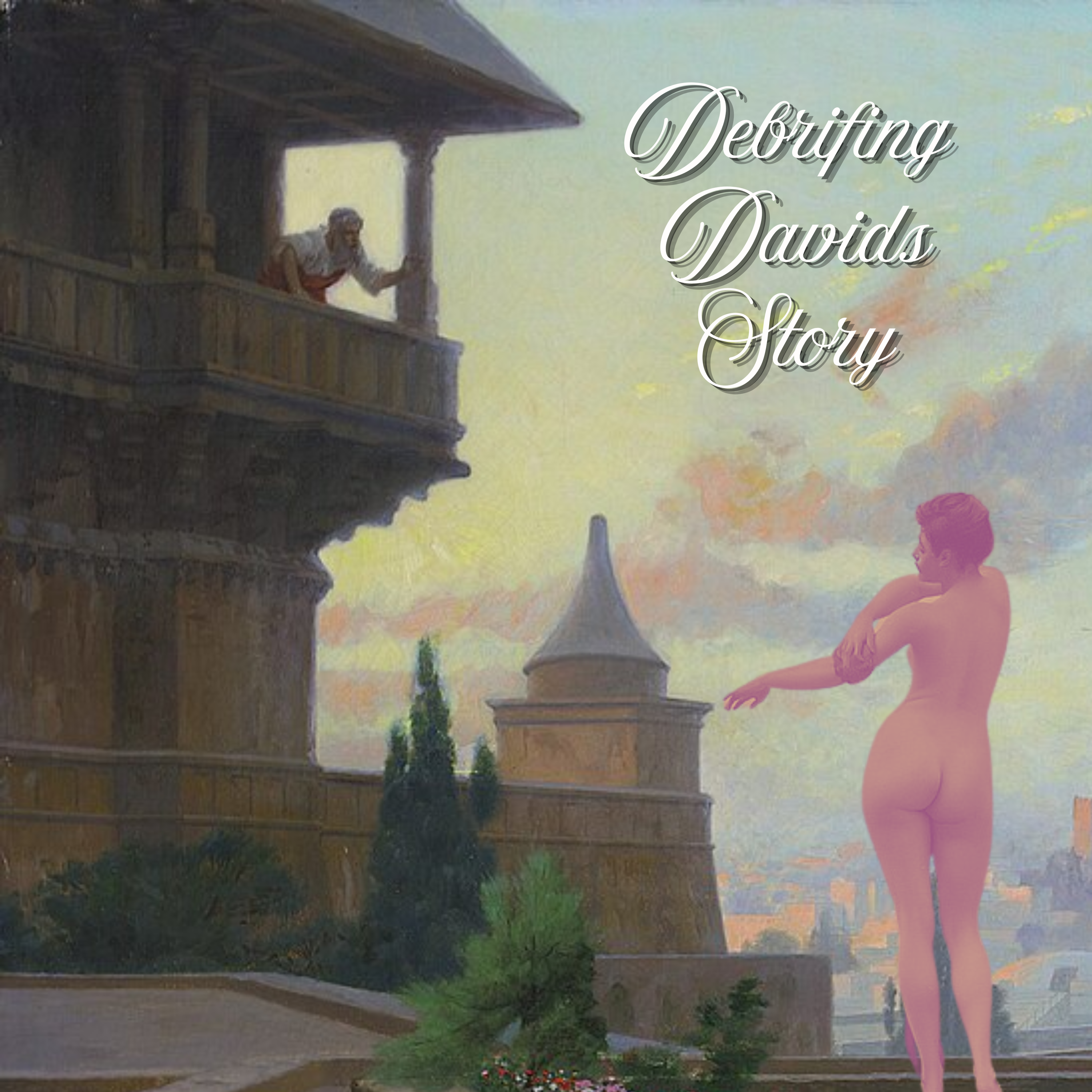
It is the story, as we mentioned a few times in this series, of David forcing himself on this woman and using his power to do that.
And I think that's such a moral outrage that we don't want the story to be open.
We want God to clearly say David was wrong and here are the severe consequences.
And I think that story is in there, but it requires some, like, nuance, some wrestling, some interpretation.
And so I was like, oh, this is going to be hard because it's a heavy lift to address topics like this in the Bible and sit with that tension of we want it to be much clearer that this was wrong, but we also don't want to like, take responsibility for learning how to do that.
And I say we and I should just say me because the truth is I'm just super lazy. So does that, is that an answer, by the way, to your question?
[00:13:11] Speaker C: Yes. You're glad that we did this?
[00:13:14] Speaker D: I mean, yes, I hope so. I mean, I don't know if it was good for anybody else, but.
But I think it's important to do that sort of thing. I just think it was a very heavy topic to do it with.
[00:13:27] Speaker C: Yeah, well. And there was a lot of topics around it.
And so one of the things that I found is because we were doing a lot of digging into 1st Samuel, 2 Samuel, 1st Kings, 2nd Kings.
There were so many things that I think we learned that we couldn't. We didn't have time to share.
[00:13:54] Speaker D: Oh, yeah.
[00:13:55] Speaker C: And so.
[00:13:58] Speaker D: Yeah. So what didn't make the cut for you?
[00:14:03] Speaker C: So many things.
I really, like, went down the road of this idea. So I spoke on the David and Goliath story, and there were two things that I found just incredibly interesting and humanizing. The first was that because of this oral tradition, I talked just a little bit about the fact that they believe that a lot of these stories would have been kind of acted out in, like, a critical theater.
And I don't know, I just. This idea of these biblical stories being told, like Shakespearean plays, like Shakespeare at the park or something, really, like, I think humanized the stories for me. And also with this dramatic effect I thought was really interesting. So that was really interesting to me. And I went down that rabbit hole.
There was a book, and I'm sorry, I can't remember the author, who kind of was like, goliath wasn't so bad. Let's take a look at Goliath. And I thought.
And so just this idea of, like, the Philistines and the war that was. That was being had was. Was interesting in. In that sermon with the David and Bathsheba story.
The fact that, like, at that time, the group of people that would have been in that town and part of David's.
I don't know what would that be? His realm would have been like 1500-2000 people.
And that kind of blew my mind.
That was like, we have bigger mega churches right here in Oceanside.
[00:15:57] Speaker D: Yeah, a lot bigger.
[00:15:59] Speaker C: Right. And so.
And so, like, again, this.
This idea that, like, as we reading these stories from kind of when I was a younger perspective and having this just giant, you know, like when you go back somewhere and you're like, they have the best hamburgers. Because when you were little they looked so good, but now they look tiny or not very. You know, I mean, like, there was just this kind of, like, I've always made it so much bigger.
[00:16:32] Speaker D: And it sort of demystified it.
[00:16:34] Speaker C: It demystified it a little bit.
And then I won't get too into this, but if anybody ever wants to talk to me about the ritual baths and the periods and how all of that came through, I've got a few. Like, I won't share all of that, but there's, like, so much in how we describe Bathsheba's bathing on a.
On a.
By the time we wrote the story down, or humanity wrote the story down, there were mikvahs, but when Bathsheba was alive, there were not mikvehs. And so the bathing was not probably.
But they've actually written it in our text as like a.
And then the fact that we talk about her period feels animalistic. There's just some things there that I find really interesting, again, in how we. We have broken down Bathsheba's story. And I really went into that. I looked into a lot of the archaeological sites and find it really, again, just so interesting how that story grew.
[00:17:53] Speaker D: She glossed. She glossed over the whole critical theater thing. But you guys should know that for, like, three solid days, she was like, we got to stop preaching. We just got to do critical theater. Like, from now on, on Sundays, we're
[00:18:05] Speaker C: going to doubt the biblical stories.
And I was like, ixnay on the. Okay, so how about you? What are. What are some things you couldn't talk about?
[00:18:16] Speaker D: Yeah, I mean, I didn't have time to actually, like, the thing that's sticking with me is actually something that you all. You shared with me, and that was like this. The story from 1st Samuel 17 has this literary motif in it, and this is, like, very much what I am about.
[00:18:35] Speaker C: Right.
[00:18:36] Speaker D: So it really appealed to me. There's this literary motif of the story of David, and it involves David's calling to be king, and then results in David's fight with Goliath.
[00:18:46] Speaker E: Right.
[00:18:47] Speaker D: So that's the story that we're talking about.
And in that story, there are three repeating instances of David leaving something behind in order to do the next thing that he's called to. In the first instance, David leaves behind his flock.
And in the second instance, David leaves behind, literally in the text, his baggage.
That's a helpful term.
And in the next instance, in order to fight Goliath, he leaves behind Saul's armor.
And I love, like, the.
Or the interpretation of that as, like, the story is trying to show us that in order for us to grow and become who we are called to be, we have to continually leave something behind.
And I just, like, when you shared that with me, I was like, yes. You know, like my. My mind exploded like ratatouille when he eats that thing in the light.
You know what I'm talking about?
[00:19:47] Speaker E: Okay.
[00:19:48] Speaker D: And I was like, I love that so much. That's so delicious. Like, the idea that at some point in our lives, we will probably have to leave behind the thing we thought we were originally called to, and then later we will have to leave behind our baggage. And then later we will have to leave behind the identities that somebody else tried to impose on us. Are you kidding me?
I love that so much. And so when you shared that with me, I was like, yes, preach on that.
And then she didn't. And then I was gonna do it, and then I. It just. It's not where the text was taking me.
[00:20:22] Speaker C: Right.
[00:20:23] Speaker D: But, like, that would be such a great sermon.
[00:20:25] Speaker C: Well, there it is. You did it right there.
So we are going to move into our next sermon series and we wanted to give a little teaser before we set you off with a.
And the last thing that I'll say that I didn't get into, because again, it wasn't part of the text necessarily, but this idea that David was at the castle when he should have been fighting with his men.
And I mean, maybe should he have been fighting? I don't know. We can get into all of that, but it was the season for fighting.
And this idea of, I think we had just gone out to dinner and we'd ordered something that should have been like, mind blowingly great.
And I was like, meh, it's okay.
And sometimes I think when we're dissatisfied with life, we have this desire to.
We're just like, we can't satiate.
And sometimes I think I said to you, I think it's about taking away.
And so that led us to kind of talk about fasting a little bit. And so we're going to be talking kind of going back to the practices.
Why do we practice the things that we practice as Christians or specifically here at Oceanside Sanctuary? And it's not that we haven't talked about those before, but kind of the thing about practice is, like, if you decide you want to, like, eat better, you usually go back to your books and you're like, okay, wait a minute, what's the newest on, like, nutrition and how I can eat? And so before we move into our holiday Advent season, we're going to go back to practice.
[00:22:32] Speaker B: Okay.
[00:22:32] Speaker D: So we're talking about some practices that we engage in here and how that can move us forward in becoming people after God's own heart.
[00:22:44] Speaker C: Right.
[00:22:45] Speaker D: Yeah. Okay. On that note, we have a question for you guys. And so what we'd like you to do is actually answer this question with each other in small groups. So this is gonna be a moment of chaos.
[00:22:58] Speaker E: Yes.
[00:22:59] Speaker C: And you don't have to. You do not have to do this. Grab out this script scribble pad and just scribble if you don't want to engage with people. We never make anybody do anything they don't want to do.
[00:23:09] Speaker D: You get to be. You get to be in charge of your own life. Yes. You get agency. Okay, so here's the question.
[00:23:15] Speaker C: I'm glad. I'm sure you're glad that we said that.
[00:23:17] Speaker E: Sorry.
[00:23:18] Speaker D: So here's the question. Where are you landing on the question? What does it mean to be, quote, a person after God's own heart? So if you've been here for the series, I'm, you know, curious. Janelle's curious, like how you're processing that sort of initial question that we attempted to explore with the series. If you weren't here for the series. That's okay. How are you answering this for yourself now?
I think that the question would work for you even if you hadn't been a part of this. So where are you landing on this question? What does it mean to be a person after God's own heart? That's the first half of the question. Second half is what practices most help you to find that heart space? And I hope it should be clear that there isn't, like, a wrong answer to that question. Just like, honestly, what things do you do regularly that bring you back to a space where you feel aligned with the heart of God? I hope that makes sense. I want to ask you guys to get into groups of about four to five.
[00:24:14] Speaker C: Don't leave anyone out.
[00:24:15] Speaker D: We're going to give you about eight minutes to talk about this so that everybody has a chance to share, and then we are going to ask you to be ready to share. So we'll have an opportunity for two or three people to stand up who are feeling willing to do that and share kind of what their group discussed. So be thinking about that. Go ahead, you're up.
[00:24:37] Speaker C: Get together.
Okay. Okay.
I know you want to keep going on your conversations.
This is part of church, so don't leave afterwards. Keep. Keep talking.
But we are going to have you go ahead and face forward again. It's so hard.
And, Jason, I think that we had a few people write some things on the Facebooks.
[00:25:10] Speaker D: Yeah, on the Facebooks, Yes.
So I love that we have People engaging with this through the live stream as well. I want to make sure that people are included. So Evelyn Thompson shared on Facebook, in terms of practices showing up at protests, school board meetings, in the aftermaths of lynchings, etcetera, this is obviously very heavy, but I actually really love that Evelyn is directly connecting her spiritual practice with a sense of, like, how to stand up in public for what is right.
And then there's somebody else.
I love that Ginny wrote on Facebook, I think it's important for me to remain true to myself, follow what I feel is best, and not be influenced by the noise coming from outside.
God is in my heart.
I think that this gets a little bit at the Saul's Armor metaphor. I know that it can sound like something that some people easily dismiss to say it's important for me to be true to myself, but I actually think. I don't know that you can overstate the importance of knowing who you are and having the courage to stand in that, which includes the courage to be wrong sometimes. That's why it's courageous.
And so I really love that Ginny shared that.
[00:26:43] Speaker C: Okay, so now it's time for maybe two of you. Owen has a microphone, and oftentimes what we'll say is, you can certainly talk from your own experience, but one of the things we like to do is invite you to maybe say something that somebody else shared that you thought was really fantastic in your group.
Please don't share any of their personal information if they shared something really personal.
But so is anyone brave enough? Okay, I've got Caesar over here.
[00:27:21] Speaker D: We are going to ask you to use the microphone, by the way, because that helps people who are on the live stream to hear you.
[00:27:27] Speaker C: Yeah, yeah. If you want to. You don't have to.
[00:27:30] Speaker E: No, no, no worries.
[00:27:33] Speaker D: Who are you, by the way?
[00:27:39] Speaker C: Put the mic. There you go.
[00:27:40] Speaker E: There you go.
So we were just talking about what it means, and I'm kind of dissecting, like, what you guys said about David and the battle and leaving things behind. And so I think being someone after God's own heart is doing things that you might think are impossible because God told you that you could do it.
So, like, David, you know, he had all these people telling him that, you know, you're a shepherd, go back to your flock. You're not a soldier. You can't do this.
But he didn't believe any of those things. He believed that God said, no, I can do it. And the Bible said that he ran towards the battle, that he didn't hesitate. He Ran towards the. The battle. And as you said, he left behind those things that he thought, well, that the army thought would protect him. The armor, the sword, the shield, and ran towards with what he knew because he believed that God did, or God called him to do that, and he won.
And so I guess that goes to what it meant for us is, you know, having faith. Like a mustard seed, you can say to this mountain, throw yourself into the ocean and it will move. And so I think that's it. Is belief and faith really good?
[00:28:58] Speaker C: Really good.
I thank you for sharing.
I think that I will also answer that I'm in agreement with you. I think when I've heard over the years that David was a man after God's heart, that that was somehow like a.
A bigger blessing from God to David.
And so then we. We couldn't look at David's failures because somehow there was this God ordained thing.
And to me, now I really look at this as a pursuit God was pursuing, or David was pursuing God's heart. He was running after it. And when he stopped pursuing.
And so I love that. Thank you.
[00:29:44] Speaker D: That's good.
[00:29:44] Speaker C: Anybody else?
Aaron, Tara or Tara?
[00:29:50] Speaker D: Aaron and Tara.
[00:29:51] Speaker C: Okay, we'll get those two, and then we'll.
[00:29:56] Speaker A: Hi, I'm Erin.
I wanted to start and just by saying that, you know, to hear a white man stand up there and say that it's not okay. What happened to Bathsheba, that was really healing for me. So I appreciated that.
Like, it wasn't okay now, and it was not okay back then. Even if times were different, it still wasn't okay. So that's one thing. But me and Alyssa talked about how being a person after God's own heart means being loving. And I added on that. I thought it meant being flexible and for this church, like, being willing to evolve. And then she shared that she wants to share that with her son. Right. And make sure that she's doing everything she can to raise him to be a loving person, maybe after God's own heart. And I for sure feel the same way about my son. So that's kind of what we shared about.
[00:30:53] Speaker D: Thank you, Erin.
[00:31:05] Speaker F: Hi, I'm Tara.
I feel like I'm at a meeting.
[00:31:09] Speaker D: Huh.
[00:31:11] Speaker F: Um, so I'll share a little bit about my view. And then obviously, some of the interesting things I heard about from the group. But when I saw these questions, just to start, I was like, wow, these are really loaded questions for me. Like, we didn't even manage to get through. We have a group of five. We didn't even Manage to get through everybody sharing. But I mean, I think first off, a person after God's own heart, that's so subjective. Like, what is God's own heart? Like, you have to assume you know God to know his heart. And so I think that's one. You have to, like, define that for yourself and for me, like, God. I look at God as like a forgiving, good God, you know, but obviously, we know people use the Bible to be like, God's a punishing, vengeful. Like, if you Old Testament, a lot of that gives a picture of a totally different God. So I think first it's defining, you know, God's own heart. Different people can take that different ways.
But as far as, like, some of the things we talked about, I mean, I'm always very critical of the Bible.
I like that you guys explain historical references, because we have to keep in mind it is things that happened in the past. The rules, the.
The exceptions, the.
Just. The general culture back then was way different. I mean, women were treated as property.
They were stoned for committing adultery, even though there's somebody else involved. But the man was not held to the same standards or punishments. So there's a lot of historical things that. I think it's always good when you put it in that historical context, because if we try to apply those standards and those cultures to today, it's just. We know it's not okay, but back then, it was a little more, unfortunately, acceptable.
I like something that Doug brought up as far as the Bible is, you know, it's a selection of readings that were from a certain time period.
But he, you know, he was saying that really, theology, the Bible is constantly evolving. It's constantly going. So it's like we're focusing on just this point in time from these stories in time. But really it should be an ongoing. Like, the Bible should be an ongoing list of stories from past to present, not just a one point in time. And then we're using that for all of time to reflect how we should be.
I agree with that. It just doesn't make sense to me to just say, oh, this was in this period of time, they knew what was up, and that's where we should follow. It's like, no, we're constantly evolving. We're constantly learning. So, yeah, but as far as, like, practices, I mean, for me, it's coming to this church. I really like that.
Even if we all have different ways of thinking, different beliefs, I feel like we're all here for an overarching vision of good. We want to help others, we want to help ourselves, you know, help ourselves understand and try to be better people. But also, I feel like all of us are here to make a positive impact.
So I really just like coming to a community where everybody's kind of here for the good of everyone who's here.
[00:34:32] Speaker A: Thank you.
[00:34:33] Speaker C: So good.
And on that.
[00:34:37] Speaker D: So for those of you who don't know, Tara just gave us a very helpful micro seminar in biblical hermeneutics. It was very, very good. And what she said is incredibly important.
So I'll just point out on that note that I find it helpful to remember that the whole notion of God is a contested category in Scripture.
And so Scripture teaches us to engage in a kind of back and forth discourse about who God is, which is just another way of saying, what is goodness?
Goodness, righteousness, and truth.
And in case you didn't know, God is also a contested category in our society today.
And if you didn't know that, you're not paying attention to Christian TikTok, which is maybe a good thing.
[00:35:30] Speaker C: Okay?
[00:35:33] Speaker D: But as crazy as it sounds, there are Christian pastors, men who look a lot like me, maybe less handsome, who are very forcefully advancing the idea that the culture of the ancient Near Eastern text does apply to us today, that women should be supervised by their husbands, disciplined by their husbands, forcibly controlled if necessary by their husbands.
And you can sit out that discourse if you want to. It's okay, you're all free to do that.
But then we're just ceding territory to people who are saying incredibly harmful things and doing incredibly harmful things in the name of Jesus. And I find that objectionable.
And it needs to be refuted. And it can only be refuted if we do what Tara is describing, which is faithfully interpret the text and apply it to our lives today.
So thank you for that.
[00:36:44] Speaker C: And now we're gonna sing our final song and go get our kids.
[00:36:48] Speaker D: Thank you very much for sharing. Janelle's like, we need to be done, so we're. We're done.
[00:36:52] Speaker F: Thank you.
[00:36:52] Speaker D: For those of you who are willing to share, let's worship as we go.
[00:36:57] Speaker B: Thank you for joining us for this Sunday teaching, no matter when or where you're tuning in, to learn more about our community or to support the work we do, Visit
[email protected] We hope to see you again soon.