[00:00:00] Speaker A: Foreign.
Welcome to the collective table where we celebrate the intersections of Jesus, justice and joy.
This podcast is brought to you by Oceanside Sanctuary Church. Each week we bring our listeners a recording of our weekly Sunday teaching at Oceanside Sanctuary, which ties scripture into the larger conversations happening in our community, congregation and even the podcast. So we're glad your here and thanks for listening.
[00:00:39] Speaker B: So I'm Janelle Coker. I am one of the co lead ministers here and we are going through a series on our core values. These are values that you all came up with during our mission commitment year long process of looking at where this church is going for the next five years.
And Jason spoke last week about integrated spirituality. Thank you. And today we're going to be talking about sacred stories.
So here is the wording that you all came up with as a value.
You said that because Christ taught us through stories and parables, we honor the sacred stories of scripture and the sacred stories of our own lives as sources of healing and transformation.
So that's your words. Good job.
I loved it.
And so when Jason was laying all of this out and we were talking about who was going to teach what, I said, oh, I'll take sacred stories mostly because as a spiritual director, I think stories are incredibly important. I think learning how to tell our own stories and hearing the stories of others is really what makes the world go round. It's what brings healing. But also because I was like, okay, this should be super easy because the Bible's full of sacred stories, so I don't have to like try to figure out which text I need. Like I can just like close my eyes and point.
However, kind of like I go to Trader Joe's more often than I go to like Costco, because too many choices, that's kind of hard too.
But what I landed on is the story of Thomas as we see it in John chapter 24. And so let's read that together.
So John 20:24 through 29.
But Thomas, who was called the twin, one of the 12, was not with them when Jesus came.
So the other disciples told him, we have seen the Lord.
But he said to them, unless I see the mark of the nails in his hands and put my fingers in the mark of the nails and my hand in his side, I will not believe.
A week later, his disciples were again in the house and Thomas was with them.
Although the doors were shut, Jesus came and stood among them and said, peace be with you.
Then he said to Thomas, put your finger here in my hands, reach out your hand and put it in My side do not doubt, but believe.
Thomas answered him, My Lord and my God.
Jesus said to him, have you believed because you have seen me?
Blessed are those who have not seen me and yet have come to believe.
So before I get into my thoughts on this, will you all pray with me and for me this morning?
God who came to Thomas, thank you for being real.
Thank you for being approachable.
Help us to see this story and see our own stories this morning.
Help us to understand the sacred.
In Jesus name, Amen.
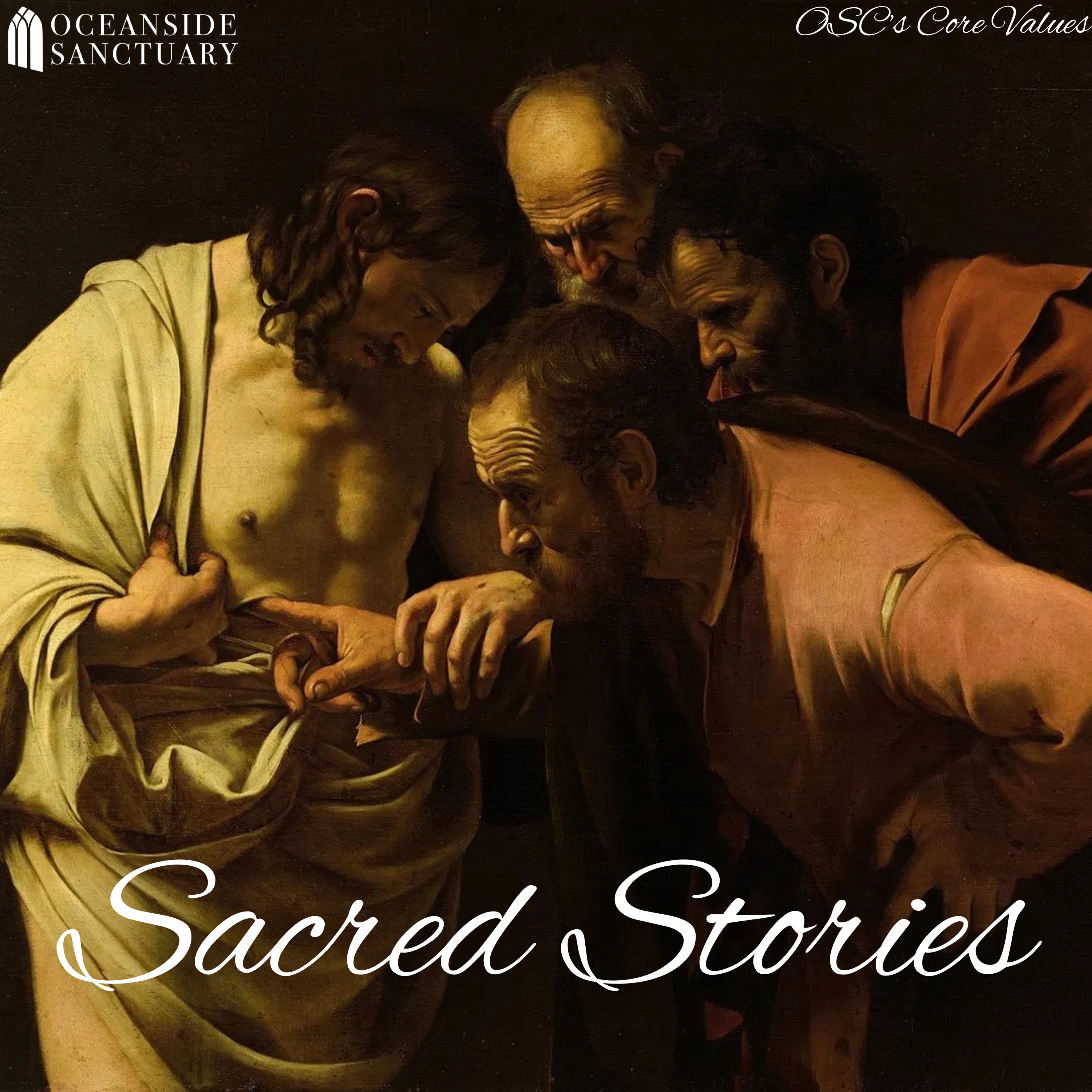
Okay, so as we begin, I would like you to see this picture and hopefully on the screen it is viewable to you all.
This is probably the most famous painting of the story of Thomas. It's called the Incredulity of St. Thomas.
It was painted around 1601, 1602.
And here is where we start to see Thomas move from being called the twin to being called doubting Thomas.
Carvaggio is the painter of this and he actually received quite a bit of crap in 1601 or 1602 for painting this. Because if you can see closely, unlike paintings of the time, there are no halos.
We see receding hairlines, wrinkles.
If you get very close to the painting, you'll see dirty fingernails, you'll see rips in the clothing.
Caravaggio took this sacred story and made a Christ approachable, made a Christ that after resurrection, grabbed the hand of Thomas and put it into his dirty finger, into his wound, a wound that is still there but is no longer bleeding.
It's an amazing portrait of the story.
So what am I seeing from this text?
I'm so thankful that Carvaggio told this story because it has transformed the way that I see it as well.
The first thing that I see is that Thomas would have never gained the imagination for believing that Christ had been resurrected. Without his friends telling them their telling him their story, he would have never been able to say out, which I'm going to say was a bit of a prayer.
I'm not going to believe it until I see it for myself.
He would have never known what he didn't know had the disciples not shared their own stories first.
I imagine that this was a bit of a moment of FOMO for Thomas.
Like, how did I miss out? Like, all my friends have come to me and said that they saw Jesus and I missed it.
And so I wonder if part of his I'm. I want to see it for myself is like, I've. I've got to grab this, I've got to investigate it. I can't Believe that I wasn't there.
And then a week later we see that Jesus hears this uttered, I'm going to call it a prayer. You know, we don't just always have to be on our knees in prayer. Sometimes it's our.
I don't know what I think about that.
Sometimes that is our utterance.
So a week later, Jesus makes his way and says, thomas, check it out.
Now, in Scripture, we don't actually know if Thomas just saw with his eyes or he did actually put his fingers into Jesus hands or side.
I like to think he did.
And then in our verse at the end of this story, I don't know about you, but I often have read it in two different ways.
Sometimes like, sometimes I don't believe and maybe I'm not good enough because I'm not one of those people that Jesus said would believe without seeing. Sometimes I want to see with my eyes. So maybe I'm a doubting Thomas and sometimes I think I'm better than doubting Thomas.
But I actually would like to see this last verse less of an admonishment from Christ and more of a prophecy.
All of the disciples now had seen Christ resurrected.
And I wonder if Christ was saying something that they couldn't understand, that he too was providing a story.
You've put your hands in my wounds, you've seen with your eyes.
But I know there's something else coming.
There's a Holy Spirit that's going to come and allow people to see with their hearts that there's going to be a difference in the way that people interact with my story.
It's going to be different from yours, that God is always moving and God is always making a way.
So I see this last verse of less of a way for us to see our failings or how good we are and more of a promise of what was to come for us now that we would learn to believe and see differently.
However, if we go and look at what Thomas did after Jesus left them, we see that Thomas got to see this for his own eyes as well.
Thomas went on and tradition tells us that he went along the coast and went to India and started what they call the seven and a half churches. I don't know what made the half.
And along his way he told his story over and over again and watched others believe because of his personal experience.
We also learned that Thomas, while he was moving along the coast and going into Asia, that he changed the way the cross was seen.
So if you look here at our cross, we have a cross of Jesus crucified on the cross.
It's a beautiful artistic depiction and one that was depicted and, and is often most depicted in the West.
But the cross of St. Thomas came through with Jesus, not on the cross, with the living cross, with a lotus that opens up and a cross that comes from it, with florets that come along the sides.
Because Thomas was so moved by his experience that he could no longer see Christ on the cross, seeing the healed wounds of Christ allowed him to see a resurrected Christ that was different than others have seen it.
What a great story, right?
What an amazing way to hear a sacred story and wonder for ourselves how not only hearing from others, but investigating for ourselves and then being changed and then having a story to tell that helps change others is what this is all about.
So we go back to our core value.
I want to light on the last part of it, because I think we get that we come here and we listen to the sacred stories of an ancient text and look at being moved by those stories.
But then you all had the gallery to say that sacred stories were also needing to be told from our own lives, that they were sources of connection and healing and transformation.
Again, this was like Ron collected all this data from you guys that participated in our mission 2030 and put it all together and came up with, with this.
And, you know, we're modern Americans, so we have so many stories that we can read that we can watch on TV that we can listen to. We can dive into history, religion, we can dive into fantasy, to all kinds of stories.
But sometimes I think we miss the balance, finding our own story.
How many of you practice telling your own story over and over again?
Two weeks ago, Mark, saying that he didn't study or practice at all, gave an amazing sermon where he dared us to ask the question that Jesus asked, who do you say I am?
And he did this saying that we needed to answer this almost unanswerable question and we needed to roll it over and over in our minds regularly because the answer might change based on where we were, but that we needed to answer it for ourselves.
And so today I want to know how well you know your own story.
How well can you share your own story? And I know if you were raised as an evangelical Christian, that then there's the, okay, so do I have to tell my story so that people accept, believe, and confess so that they don't go to hell?
So I think sometimes we're afraid of our own faith stories.
But let me tell you that if you have your own faith story and a racist Meme comes out from the highest forms of government.
You know your story, and you've practiced your story.
So when someone says something or doesn't say something that they should say, you can say, I follow a God who believes that all people were created in God's image.
So when something like this comes out, it is an abomination to the God that I serve.
That takes practice, that takes thoughtfulness, that takes interacting with the stories of others.
So this morning the church invested in you just a little bit by giving you all a notebook.
Hopefully you all got one if you didn't grab it on your way out.
I'm not a big journaler. It's not my I like to daydream, I like to doodle all kinds of things.
But when I'm forced to journal, I find that it is really, really helpful in connecting with where I am.
And so we gave you these journals because this year I'm not asking you to do it today, but this year I'm wondering if you're willing to connect with the journal to write down some of your own stories, to write down ways in which you experience God, to write down reasons why you come here for community, to consider stories that are meaningful to you.
I would love nothing more than for us someday to have a crowded church with all of us having coffee one night where people stand up and read out of their journals so that I can be impacted by your faith stories, so that I can grow an imagination for a new way that the living Christ might meet me.
I would love nothing more.
So really come and talk to me about it if you're interested in sharing your stories.
And in that vein, recently I had a prompt that I needed to write that said that asked, how do you experience God in your life, in the world? And while I will not read my entire essay, I thought I would first start and be vulnerable to my answer.
And then I'm going to invite you, if you haven't already, to start answering it for yourself today in new ways.
So here's a little bit of my prompt.
Over the years, I've discovered that I experience Christ most clearly in moments of deep embodiment, not through arguments over theology, although I'm open to those.
But in truth, my great co Creator finds me with my hands. When my hands are in clay at the pottery wheel, when I'm stirring soup for a family meal, when I'm walking my dog or holding space for someone's story, these are the places where God shows up for me in sweat, tears, laughter, stillness, the mustard seed grows slowly and is hardly noticeable from day to day.
I experience God in storytelling like the kind my husband's family does so well with embellishments and belly laughs and knowing looks.
I feel the divine in the stories of my gay siblings who, even after being rejected, are brave enough to seek community again, to cry, to learn, to heal in a place of holy kindness.
I feel Mother God in circles of women telling their birth stories, raw, sacred, full of blood and triumph.
In those stories I see Christ as midwife, as witness, as holy listener.
For me, experiencing the Holy Spirit is an act of intentional presence to this moment in time, to my own body, to the spirit of others, to the sacred ordinary.
It is remembering that God is not only in the dramatic but also in the daily humdrum.
If you have your journals today and you have a pen, I'd like to give you a couple of prompts.
Prompt 1 How do you experience God in your life and in the world?
Prompt two who has told you a sacred story that has inspired you?
Prompt 3 How are you investigating for yourself?
And then along with that, What do you want your investigation to reveal?
I pray this year you all will dig deeper into your own stories because I know you. I think you are fascinating people and I want to hear about it.
Will you guys pray with me?
God, thank you for teaching us through the story of St. Thomas.
Thank you for coming close.
Thank you for being the kind of God that allows us to investigate, to ask, to wonder, to question, to pray out. In many ways, help us to see with our hearts, help us to find you in new ways and help us to build community and healing through the telling of our own stories.
In your name we pray. Amen.
[00:25:00] Speaker A: Thank you for joining us for this Sunday teaching, no matter when or where you're tuning in.
To learn more about our community or to support the work we do, Visit
[email protected] We hope to see you again soon.