[00:00:00] Speaker A: Foreign.
Welcome to the collective table where we celebrate the intersections of Jesus, justice and joy.
This podcast is brought to you by Oceanside Sanctuary Church. Each week we bring our listeners a recording of our weekly Sunday teaching at Oceanside Sanctuary, which ties scripture into the larger conversations happening in our community, congregation, and even the podcast. So we're glad your here and thanks for listening.
[00:00:39] Speaker B: Happy Father's Day to the dads who are here and who aren't here. And also because I'm more fairly recently a grandfather, suddenly this day feels like Grandfather's Day too. Like, I'm just gonna go ahead and, like, you know, appropriate. That does that. Is that okay with you guys? Yeah. All right. I have this little pet theory that every father goes through certain predictable stages. Like, even good D go through, like, all of these stages. And these stages are sort of like, you know, the hero, you know, like, in your kid's life, you're the hero for a while, and then you're an idiot for a while. You know, like, that's just the part you have to play. Or, you know, for a time, like, in your kid's life, you're the genius. You know, everything. You know, you have answers to all the questions, and then there's a lengthy period of time where you're the idiot. You know, you just play like the idiot in their lives.
Sometimes. I like to say I have three daughters who are grown now, and they're extraordinarily competent and accomplished and, you know, brilliant and funny and kind and all the good things. And sometimes they say my parenting strategy with them was to simply create a vacuum of competence. And because they were so conscientious, they just filled that vacuum, you know, and like, a common phrase in our household was like, oh, dad, no, no.
So I played the idiot fairly well. As a dad, I've discovered a new phase. This is a relatively new experience for me. I didn't expect it. I didn't know that it was coming.
But maybe, like some of you, maybe like, stereotypically like some of the men in the room, I don't enjoy going to the doctor.
In fact, I will resist going to the doctor as much as I possibly can. A couple years ago, I had pneumonia. Didn't know I had pneumonia until our doctor, Fred, Tina, called me up and was like, you're still sick. I'm coming over. Like, that's what it takes usually to get me to go to the doctor. And one of the things that Tina discovered at that visit a couple years ago was that my blood pressure was fairly high.
Is A bit of an understatement. And so that turned into me getting medication, and now I take medication for my blood pressure. You probably didn't need to know this, but here you go.
And the day that I got my prescription, about a year and a half ago for my blood pressure, my doctor ordered some labs.
Now there's almost.
There's almost nothing I wouldn't rather do than have a needle stuck into my body and have material that belongs to me extracted from that.
It's kind of giving me the creeps right now, even talking about it.
But I went. I went and got my labs done, and then they called me a couple days later and said, hey, actually, we need you to come back and do that again because we need you to do a fasting test.
And I was like, all right.
And about a year later, when I still hadn't gone back and had those labs redone, I noticed that when I ordered a refill for my prescription of my medication, I got, like, six pills in the mail, and in all caps on the bottle, it said, do four labs.
So, like, my doctor had intentionally given me a very small prescription so that I would be forced to go back. And Janelle is like, what is going on? So I had to confess to her and come clean to her that I had been putting this off for over a year.
And she said, you have to go, Jason. This is serious. You have to go. And I was like, yeah, yeah, yeah, I'll go. I'll go.
And I didn't go, and I didn't go, and I didn't go.
And then she said to me one day. This is like a week and a half ago, she said, listen, if you don't go to the doctor and get these labs done, I'm going to tell Savannah, who is our oldest daughter.
And my heart was filled with terror.
It occurred to me in that moment, for the first time in my life, that I would almost rather suffer any kind of, like, punishment or indignity rather than have my oldest daughter give me a lecture about going to the doctor. And so I went and had my labs done the very next day.
And so I'm discovering that there's a new phase, fatherhood. And that phase is like, something like, now I'm. I don't know what I am. I'm like a child all over again being parented by my own children.
Is this a thing?
Well, it works if you want me to do anything. Apparently, all you have to do is threaten to tell my children on me, and I will immediately do it.
So happy Father's Day. To all the other like middle aged children out there who are being bossed around by their adult children.
I'm glad that you are here. Today we're going to continue our series on Acts chapter or in Acts, chapter eight. We're going to continue our series on the Spirit of Action. We've been taking a look at the Spirit of God and how the Spirit of God is depicted in the Book of Acts and what we can learn about the Holy Spirit or the Spirit of God from these passages.
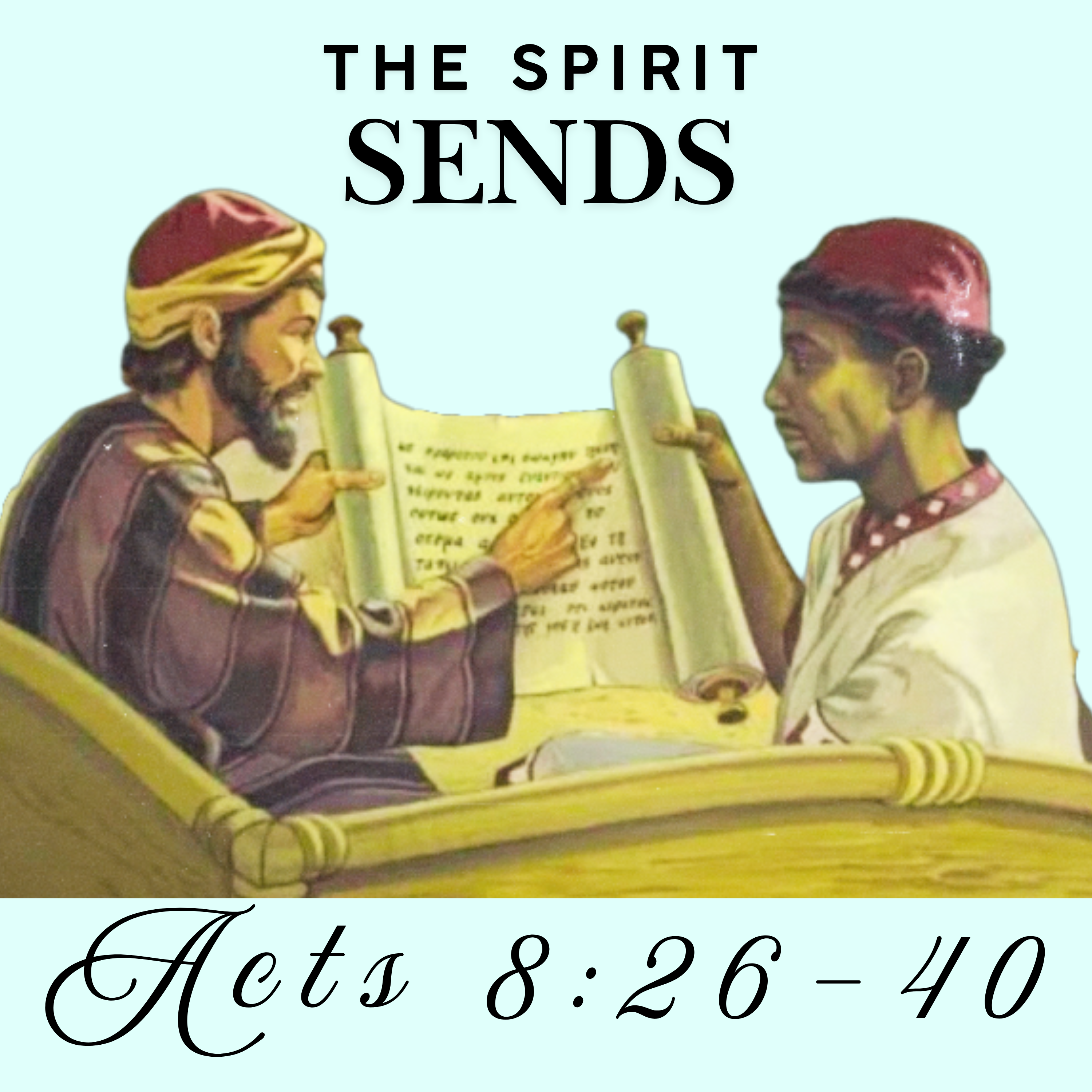
We've called this series the Spirit of Action because, spoiler alert, we think one of the things that's happening over and over and over again in the Book of Acts is that the Spirit, as we refer to it, is not a passive thing in our lives, that the Spirit is constantly leading us or compelling us to take action in some way. And in fact, the Spirit itself is often taking action in these passages. Today we want to take a look at Acts, chapter 8, verses 26 to 40. I'm going to go ahead and read it to you and then I'll share with you some of what I am noticing in this passage, starting in verse 26 says this. Then the angel of the Lord said to Philip, get up and go toward the south to the road that goes down from Jerusalem to Gaza. Now Philip is the evangelist, a fairly prominent figure in the Book of Acts, who is always going out and bringing the good news to people about Christ and about what Christ did and what Christ accomplished and what that means. And so Philip is naturally the person that we would expect to do this sort of thing. Verse 27 says, so he got up, that is Philip, and went.
And now there was an Ethiopian eunuch, a court official of the Candace. This is in a name, it's a title, the Candace, who's the queen of the Ethiopians and in charge of her entire treasury. He'd come to Jerusalem to worship and was returning home, seated in his chariot, he was reading the prophet Isaiah. And then the Spirit said to Philip, go over to this chariot and join it. So Philip ran up to it and heard him reading the prophet Isaiah. And he asked, do you understand what you're reading?
And he replied, how can I unless someone guides me?
And he invited Philip to get in and sit beside him. And now the passage of the Scripture that he was reading was this.
Like a sheep he was led to the slaughter, like a lamb silent before its shearer, so he does not open his mouth. In his humiliation, justice was denied him.
Who can describe his generation for his life is taken away from the earth. This is the passage from Isaiah 58. It's called the Suffering Servant. It is the story of what one of the Messiahs may look like.
So verse 20, or, excuse me, verse 34. Thank you. The eunuch asked Philip, about whom may I ask you? Does the prophet say this about himself or about someone else? And then Philip began to speak. And starting with this scripture, he proclaimed to him the good news about Jesus.
As they were going along the road, they came to some water. And the eunuch said, look, here's some water. What's to prevent me from being baptized? He commanded the chariot to stop. And both of them, Philip and the eunuch, went down into the water and Philip baptized him.
When they came up out of the water, the Spirit of the Lord snatched Philip away.
And the eunuch saw him no more and went on his way rejoicing.
But Philip was found himself in Azotus. And as he was passing through the region, he proclaimed the good news to all the towns until he came to Caesarea.
So we see Philip sort of moving on, continuing his activity as the evangelist. I want to share with you a few things that I'm noticing here. Maybe give a little bit of context, but would you just say a prayer with me first?
Thank you, God, for this day, for this time, for this space.
We thank you for these passages, for these very old words, these very old stories that provoke our imaginations, that challenge us and ask us to pay attention to what might be happening in the world around us.
We ask that you would use these stories to continue to stir our hearts and provoke us toward the kinds of actions that you would have us take in the world to bring your good news.
We pray all this in Jesus name. Amen.
Okay, so what in the world is going on in Acts chapter 8? I know that it may seem for some of you very straightforward or for others, a little bit confusing. Like what in the world is an Ethiopian eunuch doing worshiping in Jerusalem? In first place, what's going on here? What does it mean that Philip was snatched away? There's a lot going on here. Quick little bit of context. The first is, of course, that Christ at this point has already in the story been crucified and resurrected, ascended into heaven. And then in Acts chapter two, we saw the pouring out of the Holy Spirit on that day that we tend to describe the birth of the church.
So what's happening here in the book of Acts is a kind of documentation of how this Jesus movement, this. This growing body of people who consider themselves to be followers of this ancient Near Eastern rabbi. Like how this grew, how this expanded so quickly. Because by this time, by the time the book of Acts is being written, Christianity has kind of become a thing. It has moved on from being a. A sort of Jewish sect, a small group of followers in Jerusalem who followed this apocalyptic rabbi. And it has instead exploded all over the ancient Near East. In fact, it's exploded beyond Jerusalem, which is where it started.
And so that's a little bit unusual that this, like, esoteric little group of people suddenly would be all over the known world at that time. So part of what the book of Acts is, seeks to accomplish is to show how this happened. And the author of Acts, who is attributed to Luke, is explaining how the spirit of God has prompted this sort of incredible growth. And so this is just one of those stories.
We don't see the eunuch again.
This narrative just sort of gets dropped in. And one of the reasons for that is it's just one of many stories that shows how these followers of Jesus grew so quickly. And one of the ways is through people like the Ethiopian eunuch. So a couple of things to know about this person. The first is this word eunuch, that's translated from the Greek word from which we derive. Eunuch likely doesn't mean that he was literally castrated. It likely refers to his high position in a court in this ethnic kingdom that exists south of Egypt. In fact, in other parts of the Hebrew Bible, we see the same word being used for other high officials.
They may be eunuchs. It was not uncommon back then for high officials to be literally castrated. But the bigger point here is that this person is a person of power in a foreign government, a foreign country.
It's not likely, we think, that the eunuch was literally castrated, because in Egypt, castration was generally not practiced. It was considered taboo. And so eunuch probably just refers to this person's very high standing. In fact, the text tells us that this person is the treasurer of the queen, the Candace. Candace is a word for queen in this particular context. And so this person is a fairly high official, a person of real power and real influence, you might say an elite in the society from which he comes. And that society is very likely this ethnic kingdom that exists just south of Egypt. And one thing that we do know about that time and that place is that there were a large number of Jewish settlements along the Nile.
So even though the text says Ethiopian eunuch, and we all immediately think, well, this must be a foreigner from Africa who happens to be visiting Jerusalem. It's very possible, very plausible, that this was an ethnic Jew living south of Egypt who ascended to a high position of trust and authority and is making his way to Jerusalem to worship. We saw that in the Book of Acts, chapter two.
I told you that people would come from all over the known world who were Jewish to worship in Jerusalem for Pentecost. It's likely that that is what's going on here, that this is a Jewish person who was born and Ra, south of Egypt, who is a part of this high court in Ethiopia and comes to Jerusalem to worship. Or it's also possible that he's a convert because it was very common in the ancient world for people to be attracted, even if they weren't born as Jewish, to be attracted to the moral and ethical code of Jewish monotheism.
And so it was very common for people who were foreigners to convert to Judaism, in which case, this person may have been ethnically Ethiopian and pilgrimaging to Jerusalem in order to worship. In any case, what we have is somebody of high influence from a foreign culture who goes and worships in Jerusalem and then meets Philip and is evangelized. The good news of Jesus is brought to him. He's converted to become a follower of Jesus. He's baptized, baptized in a puddle on the side of the road. And then the story ends.
But the obvious implication here is that a follower of Jesus goes back to this ethnic kingdom south of Egypt and begins to practice his Christianity there.
And so Christianity is spread beyond Jerusalem. It's spread, in fact, into Egypt. And one of the things we know is there are very, very old Christian communities in Egypt and Kush and Ethiopia and Niger, all of these sort of North African countries. And this is probably one of the reasons why.
So an interesting thing happens in this story. Why is it that this person who represents a foreign country, a foreign culture, would become Jewish? He's obviously very serious about his faith. He travels all the way to Jerusalem to worship. On his way back from. From Jerusalem from worshiping, he's in his chariot, unrolling a scroll of Isaiah, reading from the ancient Jewish text. He's very devoted in his religion.
And along comes Stephen and shares news with him that is genuinely good. And that good news is this snippet from the Isaiah scroll, what we would call chapter 58. And that snippet says. It says this. Like a sheep, he was led to the slaughter.
And like a lamb, silent before its shearer, so he does not open his mouth. In his humiliation, justice was denied him.
Who can Describe his generation for his life is taken away from the earth. I don't know about you, but this does not sound like good news to anybody.
And so why.
Why was this little bit of scripture from the ancient Jewish scroll of Isaiah received so enthusiastically by this Jewish person from Egypt?
And the answer, I think, is exactly that. It is a reversal of what is normally expected.
This is exactly, of course, why Jesus was rejected.
We've talked about this before. Jesus enters into a context where the Jews are oppressed by the Roman Empire and they are longing to be free. They are crying out to God to be delivered from their oppression. They are dying, literally, for the opportunity to be in charge of their own fate again. And their own passages of Scripture foretell of people who will come and deliver them and liberate them. And what they expected was somebody who would come with a lot of strength and a lot of power and conquer the Roman Empire and liberate the Jews finally from their oppressors. But that is not what Jesus did.
Instead, Jesus came and he said, your power, the power of God, the power of righteousness, doesn't exist in armies or, or weapons of war or dominance. The power of God exists in kindness, in mercy, in grace, in service to those who are poor. In fact, this is his entire gospel. His whole gospel is the spirit of the Lord is on me to preach good news to the poor. Recovery of sight for the blind, release for the captives. None of this sounds like an army sweeping in to conquer a foreign nation.
In fact, it sounds a lot like weakness.
Today we hear this as the vilification of empathy.
One of the great ironies of our time is that enormous numbers of Christians have arisen up from their pulpits and on their podcasts and on their, you know, news snippets on whatever channel will allow them to come on and have said, hey, surprise, surprise. It turns out empathy is a sin. It's a bad thing. You shouldn't care for other people.
And if that sounds ridiculous to you, it should, because it is ridiculous.
But there's a reason for it. The reason for it is that a Jesus who comes and teaches us to have empathy for those who are poor, for those who are sick, for those who are oppressed, is just not strong enough, just not man enough for a muscular version of Christianity.
What we really want is to win. What we really want is to conquer our culture, to conquer our society. And gentle Jesus, nice and kind and loving and serving the needs of the poor without any desire for recognition and a willingness to completely sacrifice his life for all of those pathetic people is just not going to get that done.
And so we are actively trading in that Jesus for a Jesus who would fight in an MMA contest on the, you know, lawn of the White House.
And that is very much what happened to Jesus in the first century. He showed up and he just wasn't man enough. He just wasn't enough of a warrior. He just wasn't strong enough. He just wasn't domineering enough. And so they crucified him because he rejected all of their rules and doctrines that excluded the wrong kinds of people.
And so they crucified him.
And it turns out that that surprising reversal, that surprising embrace of a power that looks a lot like you and me, like weakness, was foretold in the book of Isaiah.
Isaiah said there would be a Messiah who would come and be rejected, who would be humiliated in public, who would be slaughtered like a sheep that was slaughtered by its owner, but that that Messiah would eventually be vindicated.
And this is one of the things that's really powerful about the Gospel of Jesus is that it turns our expectations upside down.
Have you ever experienced that when, like, you heard a bit of truth, a bit of information, a bit of news, and it completely blew your mind because it was exactly the opposite of what you expected, and all the light bulbs in your head went off and you were like, oh, my God, I've been doing it wrong.
The religious word for that is repentance.
When you've been going entirely the wrong way, you've believed entirely the wrong message, entirely the wrong truth. And when you are finally given the liberating truth, the reversal, the absolute, unexpected nature of it, the surprise of it hooks you and you go all in that moment, that moment of learning, that moment of enlightenment is, I think, exactly what happens to the Ethiopian eunuch. He is surprised and recognizes the truth of it immediately and says, this is who I want to follow. Why not baptize me right now?
This illustrates something that I think I notice in this passage about the Spirit.
This story is, of course, the story of how Christianity spreads so quickly, so fast, early on in its development. But one of the things that we notice about the Spirit in this passage is that the Spirit of God is always going out and sharing that surprising, mind blowing, enlightening good news.
In fact, I think good news wants to be shared.
Have you ever noticed that, like, if you actually had some amazing, surprising, spectacular good news, you can't keep it to yourself?
There's an old missiologist named Leslie Newbegin who liked to talk about how you know a secret is only a secret because it's something that we tell.
There's nothing more delicious, more fun than sharing a little tidbit of information that like, you know, liberated you. And so you're going to share it with somebody else. So it liberates them.
This is one of the things that's incredibly compelling about the Gospel of Jesus is that it is begging to be shared. It is begging to be told. It is begging to be revealed as the secret that blows our minds, that surprises us, that overturns our world, turns it upside down. And that kind of news, that kind of gospel is a gospel that spreads almost by itself because it's so good.
Why wouldn't you share it?
And this is where the room gets very uncomfortable because you're like, is he going to tell me? I have to evangelize my friends, Especially in a space like this, where so many of us came from high control expressions of religion, where we were told that there was some sort of score being kept somewhere, probably in the pastor's office. So, you know, for how many people you brought to church or how many people were baptized, or how many people, you know, got their embroidered name on their Bible because they took the membership class, right? Like, all of it begins to feel like a cosmic, multi level marketing scheme and oh my God, don't sign me up for that.
And I think the real kernel of truth underneath that anxiety, underneath that fear, like, is Jason telling me to evangelize. I think what really is buried down deep is that the Gospel of Jesus has in fact become bad news for a lot of people, that we are all very aware, very in touch maybe personally, with how Jesus and the name of Jesus has been used, not to bring surprising reversals of goodness into our lives, but instead to bring imperial crusades to conquer other countries in the name of Jesus so that capitalism can be spread and wealthy people can somehow get richer, so that crusades can be undertaken and people who adhere to the wrong faith or the wrong religion can be slaughtered in the name of Jesus if they refuse to convert. Or how colonialism can be brought in the name of Jesus to make sure that all of those savages leave behind their wicked ways and become Christians the way that we have defined them. Or how Jesus has been used to baptize every single war that the United States has ever undertaken, or every single person that has ever been enslaved.
Jesus has been used in service to all of this horrific, terrible news. Today, on this very day, serious arguments are being made in the United States that women should be denied their right to vote in elections. And they're being told that Jesus endorses that perspective.
We're being told that Jesus hates you if you're gay, does not condone your activity in the bedroom. We're being told that Jesus endorses the tearing apart of families by ICE and other forces who have no business ripping our communities apart. We're being told that Jesus is behind the ripping and the shredding of our social safety net, that taking snap benefits away from hungry families and hungry children somehow is an expression of the gospel.
And so when I stand up here and say that good news shares itself, you're right to be suspicious because Jesus name has been used to spread all of that hate and destruction.
So what is good news then?
How do we know if the Jesus that we're sharing is really good news?
I know that I'm a week late on this and we already celebrated this, but this story to me is really compelling.
On June 19, 1865, Major General Gordon Granger arrived in Galveston, Texas, and read general order number three out loud in front of the courthouse.
And this is what that general order number three said. The people of Texas are informed that in accordance with a proclamation from the executive of the United States, all slaves are free.
This involves an absolute equality of personal rights and rights of property between former masters and slaves. And the connection heretofore existing between them becomes that between employer and hired labor.
And when that was read out loud in front of the courthouse in Galveston, Texas, two and a half years after the Emancipation Proclamation was signed By President Lincoln, 250,000 people were freed from their slavery in Texas.
General order number three was then publicly posted in front of courthouses all over the state of Texas. But do you know how that good news was really shared?
People told each other.
Because that was good news.
And how do you keep that to yourself?
You have to share good news.
You can't not share it.
You can't not say, oh, my God, did you hear? All the slaves have been freed.
And here's what I find fascinating about that.
That was also very bad news for a lot of people.
It was really good news if you were a slave.
It was really bad news if you were a slave owner.
And here's something that I think we don't often grapple with, that we're not willing to grapple with. And that is that all good news?
Any good news is always good news for some and bad news for others.
And you better believe that every slave owner in the state of Texas also shared that news because they were compelled to.
Only the tone was a little different. It was more like, oh my God, did you hear?
All the slaves have been freed.
And that is how good news takes on a life of its own.
The people who are liberated by it share it. They can't help it. But the people who are brought low by it, they also can't help but share it.
We like to quote the Beatitudes a lot, right in Matthew, chapter five, right at the beginning of the Sermon on the Mount. Blessed are the poor, blessed are the meek, Blessed are the lowly. Blessed are those who hunger and thirst for righteousness sake. But Luke's version of the Beatitudes says the same thing. Blessed are the poor, blessed are those who hunger for righteousness. But then he adds his woes. Woe to you who are rich, woe to you who are filled.
Woe to you who laugh.
Because Luke understood that what's good news for some people is bad news for others.
And what this forces us to do, that many of us really don't like to do, is it forces us to take sides.
Whose good news do you side with?
Jesus very clearly sides with the poor, the sick, and the oppressed.
So if you want to know if the news that's being shared in the name of Jesus is actually Jesus good news, just ask yourself, who thinks this is good news and who thinks it's bad?
So, for example, when Doug Wilson, who's an obscure pastor in the state of Idaho, who, for some inexplicable reason has become the favorite pastor of Christian nationalists all over the world, when he gets on CNN or Fox News and says the gospel of Jesus demands that women no longer be able to vote, ask yourself, who is this good news for?
Is it good news for the people who have power, or is it good news for people who are denied power?
And the answer is, if it's good for the people who have all the power, then it is not Jesus good news.
It's as simple as that. It doesn't matter what name people use to spread bad news, it's always bad.
This, I think, is exactly why the Ethiopian eunuch resonated so powerfully with Philip's interpretation of Isaiah 58.
Because even though he was a person of high authority in a foreign court, he was a part of an oppressed people.
So when he read a passage about a suffering servant, somebody who expressed power in a way that stood in the face of humiliation, that made perfect sense to him.
Because people who are wounded and hurt and oppressed and poor and sick. They know exactly what it's like to stand in power in spite of suffering.
They know exactly what it's like to stand in power in spite of humiliation. They know exactly what it's like to stand their ground in spite of being denied access to goods and services and rights.
And if you don't know what it's like to do that, then that might not make any sense to you.
But for the eunuch, he understood, oh, this is what the gospel is. It's good news for the poor, for the broken, for the oppressed.
That is what we understand to be the truth of the gospel. That it is always good news for those who are hurting and bad news for those who. Who are doing the harm.
Our task, then, with the spirit of God, is to reclaim that version of the gospel.
Our task, whether you want it or not, whether you're ready for it or not, whether you totally understand it or not, is to reclaim a gospel of love and liberation instead of a gospel of hate and oppression.
That every time we proclaim Jesus, we make sure that it is attached to that good news.
And if we do, it will spread itself.
We don't have to have, like, you know, little contests to see who brings the most people to church.
We don't have to pretend that you are somehow getting in God's good graces because you have converted people. All we have to do is bring news to people that Christ is for the poor, the hurting and the oppressed, and then take action for it.
That news will spread itself.
Amen.
Would you pray with me?
God, we thank you again for today, for this opportunity for us to pray together and to sing together to lift up these words of hope together.
And for some of us, God, we know exactly what it's like to stand in power that looks like weakness.
We know exactly what it's like to stand in the face of humiliation and hurt and oppression.
And for those who understand that, it's my prayer that you would strengthen us, that we would be able to stand firm in the face of the resistance that comes from those who wield that power.
But, God, we also confess that some of us don't know what that's like.
That we have always been in places of privilege, that we have not had to understand what it's like to be publicly shamed and humiliated for our identity or our gender or our race or our religion.
And so, God, it's my prayer that for those of us who have stood in power and privilege, that you would break our hearts for the ways that power and privilege has been used to hurt others in your name and we ask that you would bring these two groups together in service to your truly good news.
We pray all this in Jesus name.
[00:39:52] Speaker A: Amen.
Thank you for joining us for this Sunday teaching, no matter when or where you're tuning in.
To learn more about our community or to support the work we do, visit
[email protected] we hope to see you again soon.