[00:00:00] Speaker A: Foreign.
[00:00:08] Speaker B: Welcome to the collective table where we celebrate the intersections of Jesus, justice and joy.
This podcast is brought to you by Oceanside Sanctuary Church. Each week we bring our listeners a recording of our weekly Sunday teaching at Oceanside Sanctuary, which ties Scripture into the larger conversations happening in our community, congregation and even the podcast. So we're glad your here and thanks for listening.
[00:00:40] Speaker A: Listen, if you don't know, my name is Jason Coker. I'm the co lead pastor here along with Janelle and we are in our Lenten period as a church and so we are teaching up to Easter. And so during this Lent period we have landed on a teaching series that we're going to call Spotlights of Jesus or excuse me, I'm getting it wrong already, Snapshots of Jesus. So we're going to be dipping into Jesus's story over the next five weeks in the lead up to Easter and pay special attention to some of the practices Jesus engaged in in his life as he was leading up to Easter, partly as a way for us to ask ourselves, how are we engaging in those same practices? Do they make sense for us?
What's the point of them? How do we sort of interpret those practices for our lives today? And so today I want to chat with you about Matthew, chapter three, verses 13 through 17. I'm going to read this to you and then we're going to talk about this practice. This will be the first practice we visit for this series. Matthew chapter 3, verse 13 says this. Then Jesus came from Galilee to John and at the Jordan to be baptized by him.
John would have prevented him, saying, I need to be baptized by you and do you come to me?
But Jesus answers him, let it be so now, for it's proper for us in this way to fulfill all righteousness.
And then he consented. And when Jesus had been baptized, just as he came up from the water, suddenly the heavens were opened to him and he saw the Spirit of God descending like a dove and alighting on him. And a voice from heaven said, this is my son, the Beloved, with whom I am well pleased.
Would you guys say a prayer with me?
God, we thank you again for this opportunity for us to gather in community.
We are grateful for the community that you have formed here, for the people who come here from different walks of lives and different religious backgrounds, different shades of belief, and yet all seem to be interested in organizing our lives around Jesus, this person who lived and taught in such a compelling way that 2000 years later we still find our imaginations and hearts captured by him.
So we pray today, God, that you would stretch our hearts and imaginations by Jesus's words and actions here in a fresh way, in a new way. We pray that in Jesus name, amen.
My baptism could have been, like, filmed for one of those cheesy Christian movies that you see now increasingly on, like, you know, Amazon prime, right? You ever, like, watch, you know, previews for movies on Amazon prime, and you're like, I feel like this is a Christian movie.
I don't know what it is, right? But I.
For some reason, I feel like this is a Christian movie. And then turns out that it is. It's like a covert Christian movie. My baptism could have been in a movie like that. I was 15 years old. I participated in a youth trip at the mega church that I was a part of. I was. I grew up in one of, like, the original mega churches here in Southern California.
If I told you what church it was, you'd probably recognize it, because they recently hosted Erica Kirk for a special event.
So that tells you a little something about my upbringing.
And we had a big church and a big youth group, and the youth, at one point decided to go on a trip to Catalina. And so we went to Catalina island, and the whole trip was like a spiritual retreat. And we literally hiked from one end of Catalina to the other, and we camped along the way. And then at the end of that, like, destination, we ended up in a bay on the. On the west side of Catalina Island. And as the sun was setting over the ocean and seals and otters were playing in the water, the youth pastor gave an inspiring speech about baptism and said, you know, anybody who wants to be baptized, I'll go ahead and baptize you in the ocean. And me and, like, 16 other teenagers, like, ran into the water to be baptized. And that was, like, my baptism. It was amazing. Like, it was a really meaningful and effective event for me in my life, partly because I'd been resisting baptism for a long time up to that point. I know I was 15, like, how long could it have been?
But I, like, you know, accepted Jesus into my heart when I was, like, 8 years old in Sunday school. Like, you know, I sort of made the classic Pascal's wager. Like, they kept, like, inviting kids outside into the hallway to accept Jesus in their heart. And I figured, I mean, what's the worst that could happen? Like, I say yes, and if it's true, then I go to heaven. If I say no and it's true, that's bad, right?
And so I was like, this seems Like a. A good bet to make, right? Not much cost. So that was like, when I got saved, right?
But then as I became a teenager, and like a lot of you, I began to question a lot of the things that I was hearing in church. And I was, like, I said, a part of this big church, and I had questions about Christianity and about the history of Christianity and about the beliefs that I was being taught. And, like, I was probably that annoying kid, right? Like, I'm. Now I'm that annoying adult. Like, Tina and I are definitely those annoying adults. Sometimes we have lunch and we are annoying with each other, right? And so I never liked the answers that I was getting from my youth pastors and from the pulpit. And that was frustrating to me. And I didn't like the idea that I might be, you know, like, just obeying. Because every time they talked about baptism, they said, well, Jesus was baptized, and so you have to be baptized as a matter of obedience.
And listen, if you don't want me to do something, tell me it's a matter of obedience, right? Because I was just like, well, I'm not doing that. And then also, it just seems like sort of a big machine that's sort of all about money. And I wasn't into that at all, anyway.
Yeah, I know. Yeah. So, but here's the thing, right?
I got dropped on Catalina island with a, like, 50 pound backpack with like, you know, 20 other teenagers, and we hiked across the island, and it was, like, kind of hard. You know, it was a little bit strenuous. And, you know, like, we actually broke a sweat. Then, you know, like, we helped each other along the way and had this whole wilderness experience together. You know, it was, like, built some camaraderie amongst us, and then we ended up at the ocean. And it just made sense to me all of a sudden. Instead of, like, obedience to an institution that was kind of problematic, baptism suddenly for me was this experience in the wilderness that bonded me to a group of people that I had just been, like, struggling with and suffering with and enjoying, like, the outdoors with. And it seemed to represent new possibilities. Like, as the sun was setting over an endless horizon and wildlife were playing in the bay. I was like, this is a new start.
It's just that. Just that difference in framing made all the difference for me. And I was in, like, I. I jumped in the water and I got baptized.
I tell this story because I think that especially if you are the kind of Christian who has spent any time interrogating your upbringing, questioning beliefs that you were Told you had to obey, wondering whether or not the institution you belong to was genuinely good, and trying to figure out whether or not you still believed in Christianity or Jesus or faith or God at all.
First of all, you're in good company if you went through that.
But one of the issues is, on the other side of that, we wonder about these kinds of rituals, these kinds of practices. What does baptism mean anymore? Is it a good thing? Am I just obeying an institution that is problematic?
And so I want to tell you a little bit about baptism and suggest that it might mean something that we aren't aware of when we're just told to do it because Jesus did it.
The first is, it's important, I think, to understand that what John was doing was drawing upon a long Jewish tradition of mikvah, right? So in the ancient near east, mikvah was the practice that comes out of Leviticus, especially chapters like 11 through 15, and then also like numbers 19 in the Hebrew law, there is accommodation made for people who become ritually unclean.
And ritual uncleanliness is something that barred you from entering into the temple grounds and participating in, you know, the most important part of your identity as a Jewish person, right? Like the acts of worship that you do. And those. Those things that might make you unclean were things like, for example, coming into contact with a dead body. If you came into contact with a dead body, then you were considered to be ritually unclean and you couldn't participate in worship. We hinted at this when I taught a few weeks ago on the parable of the Good Samaritan, when I suggested to you that the priest and the Levite weren't necessarily like, you know, being bad people when they crossed to the other side of the road and they ignored. Ignored the man on the side of the road, they were just obeying the strictures of holiness.
And so coming to contact with the dead body can make you ritually unclean. There are other things, too, like certain diseases that if you came into contact with somebody who had a disease like leprosy, you were considered ritually unclean. Also just sort of normal bodily functions like childbirth. If as a woman you gave birth, then after that you were considered ritually unclean. By the way, a lot of this ritual uncleanliness has to do with bodily fluids. So as a woman, once you begin to menstruate, you were considered every month to be ritually unclean during that time because of the blood that was coming out of your body or likewise. I know we don't use this Word very often from the pulpit in Christian churches. But if, as a man, you had an issuance of seminal fluids, say, in the middle of the night, especially if you're like, you know, 14, that suddenly makes you ritually unclean. I expected a bigger laugh from that moment.
I'm a Christian pastor talking about wet dreams from the pulpit, and you all are not giving me my fair due.
Thank you.
This is being recorded and livestreamed, you guys.
Thank you, Andy. So the point here, of course, is that none of these are sins.
It's not a sin to have your period. Ladies, good news.
Perhaps more controversially, it's not a sin to have a wet dream.
It's not a sin to give birth.
It's not even a sin to come into contact with a dead body. Like, if you live in the ancient near east, where people will die and then, you know they're in your house, right? They're in the community. There's not like the sort of apparatus of sanitation that comes along and takes care of dead bodies that, like, we have in place today, you're probably going to come into contact with a few dead bodies in the course of your lifetime as a matter of just living life. These aren't sins.
To say that you're ritually unclean does not mean that you should feel guilty that you've done something wrong.
But you still need to be cleansed in order to enter back into society, in order to enter back into the most important things that you do that include you in the community.
And so mikvah, then this practice of ritual cleansing that ancient Near Eastern Jews would practice is it becomes a way to re. Enter the community after they've been separated from, becomes a way for them to be reunited, to be restored, to be renewed to that place of connection.
That, by the way, is not what John the Baptist is doing, strictly speaking. What he's doing is he is appropriating this practice of mikvah, and he's using it to make a fairly strong statement about Israel and its place in the world and its relationship with God. Because what John does is he takes this idea of. Of mikvah, of cleansing people of their uncleanness, and he does some interesting things with it. The first, going back to chapter three, I'm going to read more Bible verses. Is that okay? Okay. Matthew, chapter three, verse one, going back a little earlier, says this. In those days, John the Baptist appeared in the wilderness of Judea, proclaiming, repent, for the kingdom of heaven has come near.
This is the one of whom the Prophet Isaiah spoke when he said the voice of one crying out in the wilderness, prepare the way of the Lord. Make straight his paths. And now John wore clothing of camel's hair with a leather belt around his waist. And his food was locusts. His food was locusts.
It's. You know, he's sort of a wild person, right?
And then the people of Jerusalem and all Judea were going out to him and all the region along the Jordan, and they were baptized and. And they were baptized by him in the River Jordan, confessing their sins.
What John does here is he takes the practice of mikvah, which is normally in the center of the city around the temple. Archaeologists have found Mikvot, which are these little pools designed specifically for these ritual cleansings. They're all clustered around the temple. That makes sense, because you got to cleanse yourself before you participate in worship. John takes the mikveh and he moves it out of the city, outside the gates, in the wilderness, out at the River Jordan. By the way, that's what that is.
That's a mural painted in 1827 when this church was built. It's based on a picture of the River Jordan. That's what that is.
It's a little sentimental for my tastes, but, like, you know, every time I propose painting over it.
See?
See?
I mean, wouldn't just, like, a neon sign of our logo look good back there?
I love you guys so much. Okay, so the point is, he takes what normally is in the center of society, the center of civilization, very close to worship, and he moves it out into the wilderness. He's a wild man in the wilderness who eats locusts and honey and wears, you know, camel skin clothing. And he's out in the wilderness where people on the margins of society exist, and he calls them to a different kind of mikvah.
And that kind of mikvah is one that is challenging the very idea of identity for people in Israel. Because in verse seven, the very next passage, it says this. But when he saw many Pharisees and Sadducees coming for baptism, he being John the Baptist, said to them, you brood of vipers, who warned you to flee from the coming wrath, bear fruit worthy of repentance. Do not. This is a key part. Do not presume to say to yourselves, we have Abraham as our ancestor. For I tell you, God is able to raise these stones up as children of Abraham. And even now, the ax is lying at the root of the tree. And every tree, therefore, that does not bear good fruit is cut down and thrown into the fire. What John the Baptist is doing is as the holiest people in society, the religious leaders, the religious elite come to him. He's saying, don't assume that you're okay.
Don't assume that you are safe with God because you have failed to do what is more important.
You can't lean on your inherited identity.
John is calling into question everything about ancient Jewish identity.
And what's important to know about this is the people that John is saying this to are the good guys.
Like, I know we tend to vilify Pharisees, but Pharisees were a renewal movement in Israel. The Pharisees were the people who, because they live in Rome occupied Palestine, because they are a conquered people, because they are suffering under the abusive power of Rome. They have asked themselves, what can we do to get God to actually move on on our behalf the way God used to move on our behalf? What can we do to provoke God to vindicate us, to vindicate his people, to vindicate himself?
And so the Pharisees were a tradition that said, well, maybe if we follow the law especially carefully, that we will fulfill righteousness and God will rescue us.
And so what they did was exactly that. It was a renewal movement where they went around and said, we have to follow the law so carefully so as not to break it, that it becomes an incredibly strict approach to being Jewish. We've talked about this a few times before. There are different schools of thought in ancient Judaism about how to fulfill the law. There are more strict schools, right, like the school of Rabbi Shammai, or more liberal schools like the school of Rabbi Hillel. This is an ongoing debate in Jesus's day. And Jesus and John are arguing with those who would say, no, we must follow the law strictly.
Jesus elsewhere says, what you've done is you've tied up like boulders around the necks of people. They can't possibly obey this interpretation of the law. And that's exactly the problem with this renewal movement is they've made the law so impossible to obey, so hard to follow, that it's created an entire class of outcasts, an entire group of people who suddenly have become marginalized, pushed to the edges of society, who are now, for all intents and purposes, irredeemably, ritually unclean, completely separated from their life giving identity as people who belong to God.
It's to these people that John the Baptist comes and offers them their own mikvah.
Not in the center of the city, not close to the temple, not in a place where they're being asked to Uphold standards that they can't possibly fulfill, but instead, out on the edges of society, he offers them their own mikveh. He offers them a way to re enter their community.
And in doing it, he's critiquing an interpretation of the law that is so strict that it creates outcasts and marginalized and poor people.
This is the problem that John is trying to solve.
This is the problem that John is speaking to. When he says to those who have established themselves as the righteous religious elite, he says to them, don't think you're safe. God can cut you off and raise up all new people.
What John's doing is nothing less than creating a movement of outcasts and marginalized sinners who have free access to the goodness of God. And this whole thing he characterizes as repentance.
But it's not just a repentance for their personal sins. John is calling like the Pharisees, but just in a different way.
He's calling the nation of Israel to repent.
He's calling them to return to the practice of righteousness.
Jesus shows up and enters into that baptism.
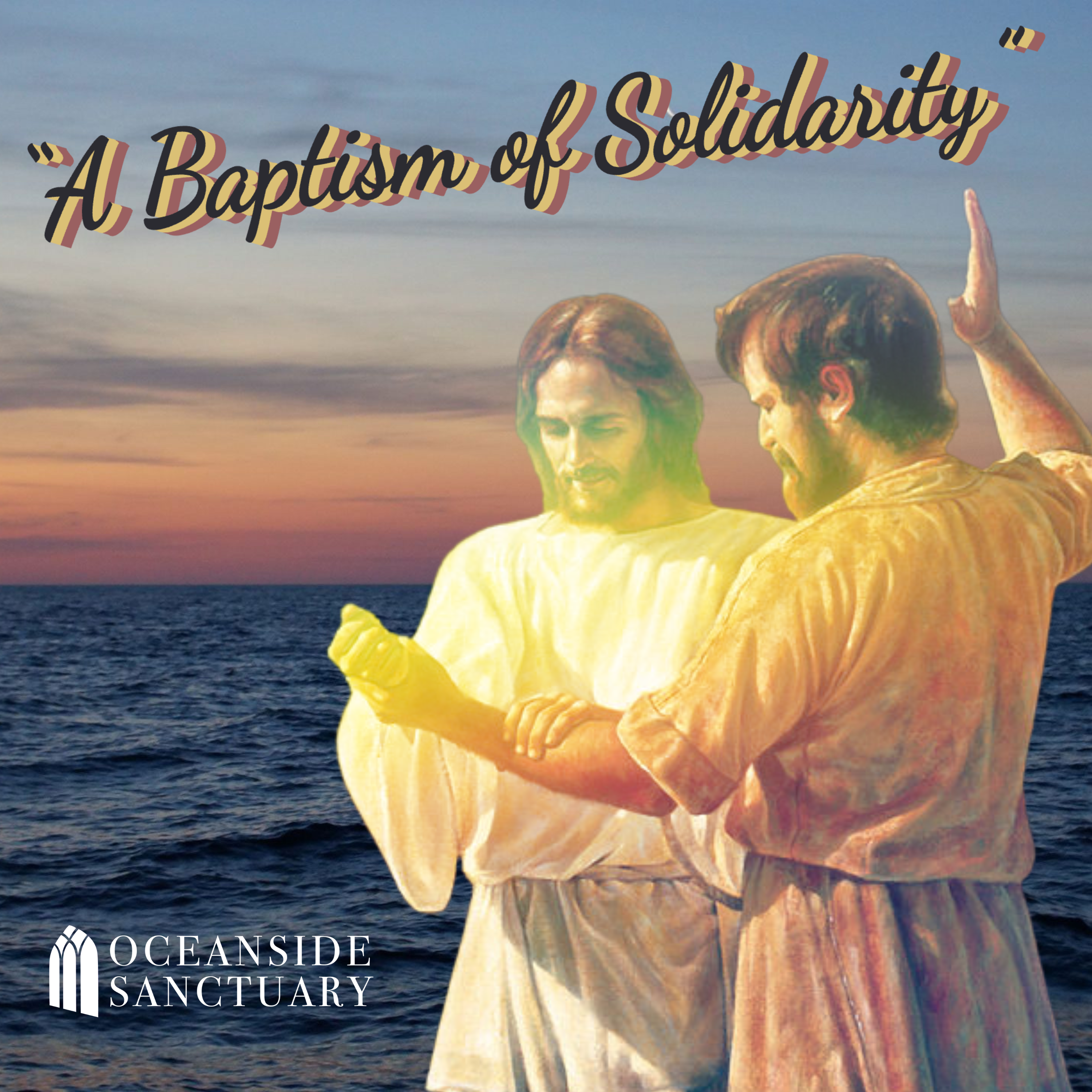
Jesus, who is not marginalized, is not outcast, is not hopelessly poor, is not pushed to the edges of society. Jesus, who is at the beginning of a sort of rabbinical career where he will create his own movement that draws upon John's political critique of the religious elites of his day. Jesus, who is by all counts righteous, already steps into the water of the River Jordan. And he is immersed into a baptism not of obedience, but a baptism of solidarity.
He joins himself with those who are in the wilderness, on the edges of society, rebuked and rejected, and says, I'm with you.
This is who he identifies with.
That's Jesus baptism.
My suggestion to you is that it's ours too.
That if Jesus baptism was him being immersed into a community of people who had been pushed out and marginalized and excluded, that when you were baptized or when you are baptized, that is what you are being immersed into, a community of solidarity with the poor, the naked, the hungry, the outcast, the oppressed.
You know, This is an important topic, I think, because I don't know if you've noticed, but Christianity is a bit problematic these days.
And there's a movement, a pretty powerful movement of people who are running for the exits.
Some of you are those folks.
Some of you ran for the exits of Christianity because it seemed like an institution that was committed more to its own survival, to its own wealth, to its own supremacy, to its own power, than it was to restoring people who had been outcast and excluded.
And now the people who have left that kind of Christianity.
That is as large a group of people in the United States as the two biggest versions of Christianity, which are, by the way, evangelicalism. About 60 million people in the United States consider themselves to be evangelical. It would be a really fun conversation to talk about whether or not that's a religious identity or a political one. It's a fascinating conversation.
But the point is about 60 million people in the United States consider themselves to be evangelicals. About 60 million people in the United States also consider themselves to be Catholic. Those are the two biggest versions of Christianity in the United States. Those who consider themselves to be unaffiliated with any expression of religion are now about 60 million people, too.
That is an enormous increase from when we started counting it in about 1972 in the general Social Survey.
I could talk endlessly about this, but it's 1058. So here's the thing.
The church would like you to think that those 60 million people ran for the exits because they just like to sin.
It is fun, Honestly. Tina and I could just have a conversation while you all watch, like, and it would be a fun conversation. She's not wrong.
The church would have us believe that people are leaving Christianity because they just can't give up their sin.
But when you ask those people why they disaffiliated from Christianity, what they say is that the church is doing too much harm for them to in good conscience be aligned with it anymore.
And most of those folks, 2/3 of them, still say they believe in God.
They still greatly admire Jesus. They think Jesus teachings are spectacular.
It's just the institution that's a problem.
And so what's happened in the United States over the past about 50 years, but really it's increased dramatically since the mid-1990s. Right.
What's happened, I think is a kind of protest movement against institutional Christianity. It's not just Christianity, by the way. This is a problem for other religions too. But Christianity is the dominant religion in the United States, and because of that, oftentimes the most problematic one.
My point is this.
These are the people in the wilderness.
And I don't mean that they're lost, like wandering.
I just mean that we have pushed them to the edges of society.
What if our baptism into the teachings of Jesus, the life of Jesus, wasn't our obedience to an institution that has a long history of causing harm? What if our baptism was our immersion into Jesus? Solidarity with people who can't in Good conscience align themselves with harmful institutions, but say to themselves, I still like Jesus.
That's sort of my story, right? Janelle's story, too. Like, our stories are different, right? But they converge around this one inescapable, frustratingly annoying conclusion. And that is, I just really am compelled by Jesus.
Things that he has to say, like, they inspire me, they.
They confuse me, they frustrate me, but they draw me into something that I can't deny is a better version of life than the one where we just constantly, like, compete with each other for the most stuff until we die.
What if that's what our baptism was about, was about being immersed in the solidarity of Jesus with those who have been harmed so that we can together make something better.
Janelle and I would like to invite you, by the way, into that kind of baptism.
On Easter Sunday. We traditionally do baptisms here at the River Jordan.
And if you have not been baptized, if the idea of reclaiming baptism and Christianity as an expression of solidarity with those who are in need is appealing to you, if you are compelled by the teachings of Jesus and you would like to identify with that tradition, not the harmful institution, not even the Oceanside sanctuary, but if you want to identify yourself with the life and teachings of Jesus, then we want to offer you the opportunity to engage in that symbolic ritual.
And so we're inviting you, if you are interested in being baptized, to sign up to be baptized on Easter Sunday.
It's super fun and also a little weird, not gonna lie.
But mostly it's super fun because you get to say, this is who Jesus is. This is what I believe about Jesus, and I'm with him.
If you'd like to do that, scan the QR code, sign up, we'll meet with you, we'll explain to you what all is involved. There's a little bit of a class so that we can, like, you know, talk about what all of this means. And then we're going to like, dunk you underwater. And if, like, you're an extra sinful person, we'll hold you under a little bit longer.
I'm kidding.
I'm kidding about that part.
If you have been baptized, you don't have to do this.
One of the things that John the Baptist did is sort of declared that this mitzvah was a kind of one time thing. And traditionally in Christianity, we say if you've been baptized, you don't have to do it again. But I have baptized people who had been baptized before and for whatever reason just didn't really feel like it. Stuck.
And usually, usually that's because, you know, maybe they were very, very young. And I always tell people, like, if you were raised in a tradition, like your Lutheran church or Catholicism or Anglicanism, any of these traditions that practice infant baptism, if that's you, like I want to say, there's no reason why that isn't completely legitimate. There's no reason you have to be baptized again if you were baptized as an infant. But if you were baptized as an infant and you're like, ah, doesn't mean anything to me, it's okay to do it again and we'll accept you. So just so you know.
All right. Does that make sense?
All right. Can we pray together?
God, we thank you for today. Again, we thank you for how these words and stories in this ancient book still have the power to challenge us and stretch us and inspire us. It's my prayer today that you would ignite our imaginations so that we might be able to see new possibilities, not just for baptism, but also new possibilities for what we have been baptized into. New possibilities for a faith that doesn't just have to be about building institutions of power, but a faith that is about meeting people in solidarity who have been harmed or pushed aside or oppressed so that we can make a better world.
We pray that you would help us to find our place in that mission. We pray this in Jesus name. Amen.
[00:34:28] Speaker B: Thank you for joining us for this Sunday teaching, no matter when or where you're tuning in.
To learn more about our community or to support the work we do, Visit
[email protected] We hope to see you again soon.