[00:00:00] Speaker A: Foreign.
Welcome to the collective table where we celebrate the intersections of Jesus, justice and joy.
This podcast is brought to you by Oceanside Sanctuary Church. Each week we bring our listeners a recording of our weekly Sunday teaching at Oceanside Sanctuary, which ties scripture into the larger conversations happening in our community, congregation, and even the podcast. So we're glad your here and thanks for listening.
[00:00:38] Speaker B: Thank you so much, Pastor Jason. Thank you, Pastor Janelle. Thank you, church. What a beautiful, beautiful sanctuary you have here. I was telling Janelle that you have a doppelganger of a church in Burbank.
We have a baptistery. Not as pretty as this, but it's like right there, it doesn't work. And so we use one of our members swimming pools when we do baptism. And when we.
And after that we have celebration. And it's fun. It's fun.
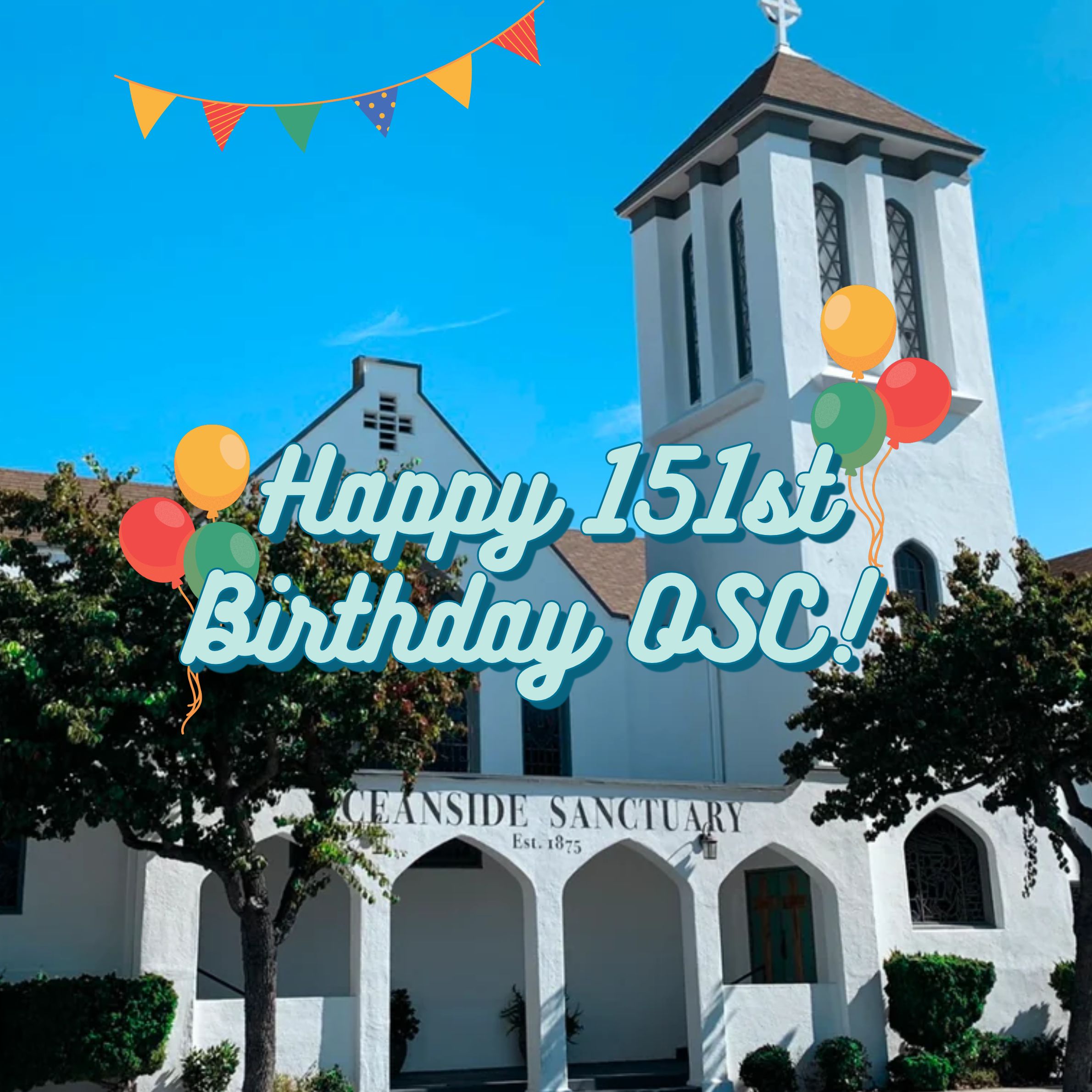
Happy 151st anniversary.
That is amazing. That is amazing.
It's like one of the oldest disciples churches in this county. And when I see this space and I read about in one of the earlier history books of Southern California, y' all started in a like 18 by 24 foot space with a kerosene lamp and, you know, a tin roof. And now look at you.
Amazing. It's beautiful.
And I thank God for your faithfulness, for the beauty of this congregation, which I already feel and I'm already feeling at home.
And I know that you celebrated Pastor Jason's 11th year as your pastor last week, but I need to tell you, you should know that Reverend Jason Coker is celebrating today his 12th ordination anniversary as a Disciples minister. And so thank you, Reverend Jason, for accepting the call to be led by God and to lead God's people in all of God's creation. Thank you.
So as being the anniversary of osc, I've been asked to talk to you all about celebration.
Celebration as a practice of belonging. Celebration. What does it mean and what does it mean to belong to God, to each other, and to this church?
So will you pray with me?
Holy God of love, we give thanks for this beautiful church for Oceanside Sanctuary Church, where they celebrate 151 years, over a century and a half of faithful believers. We celebrate Pastor Jason's ordination and his call to ministry.
Be with us now as we talk about celebration, as we talk about belonging to and what that means to you for us and what that means to us for you.
In Jesus name we pray. Amen.
So our scripture reading today comes from Luke 22:7 through 8 and 14 through 19, and it's from the NRSVUE and it's the last supper.
So then came the day of unleavened bread, on which the Passover lamb had to be sacrificed.
So Jesus sent Peter and John saying, go and prepare the Passover meal for us that we may eat it.
And when the hour came, he took his place at the table and the apostles with him.
He said to them, I have eagerly desired to eat this Passover with you before I suffer.
For I tell you, I will not eat it until it is fulfilled in the kingdom of God.
Then he took a cup, and after giving thanks, he said, take this and divide it amongst yourselves, for I tell you that from now on I will not drink of the fruit of the vine until the kingdom of God comes.
Then he took a loaf of bread, and when he gave, and when he had given thanks, he broke it and gave it to them, saying, this is my body which is given for you.
Do this in remembrance of me.
The word of God before us. The word of God amongst us. The word of God in us. Thanks be to God.
Really, Sisa, you're going to choose this verse to talk about celebrating as a practice of belonging, celebration as a habit or custom, a way of behaving that connects to belonging?
Yeah, let's break it down.
Let's talk about the word belonging.
So to translate the classic Hebrew expression of multi of mutual possession and devotion, there are several ways that the word belonging is used in the Hebrew Bible.
It's a preposition or it sounds like the word lameh.
It means to. It means to connect.
So the most common way Hebrews indicate that something or someone belongs to another is to add the prefix la.
So when you hear la adonai, it translates as to the Lord. It belongs to two of the lords. Or when you say la adonai, la arez, it means the earth is the Lord's, which is in Psalms 24. Another word that's used to say belong is segula. Segula, it means treasured possession.
So the valued. It's a valued treasure. It's a special property or a prized possession. And the biblical Context, in Exodus 19, verse 15, God tells Israel that they will be God's segula out of all the people of the earth, the chosen people.
Belonging is not merely a social inclusion. It is a covenantal claim, being chosen, being protected and prized by God as God's own.
It's the word in Hebrew, ahuza, Ahuza meaning holdings or ancestral property.
When speaking of physical land, homes or tribal inheritance, we use the word ah ahuza meaning to Grasp, to hold, to possess.
And I look at these words of belonging, it's like, I'm not sure that's the one that they want here on this Sunday. It's not about owning, it's not about possessing, but maybe it's this other one and it's about relational or communal belonging.
So rather than an abstract emotion or sentiment, belonging in the Tanakh, the first five books of the Hebrew Bible, is tied, tied to identity, it's tied to lineage, it's the covenantal faithfulness.
So belonging to a people, belonging to a house, belonging to a family means sharing collective destiny. It means historic memory, it means ritual life. So the things that you do together in a family is belonging. You belonged because you were bound by covenantal Hebrew word beref to God. You belong to God through the community, through shared obligations, through shared worship, through obedience to the Torah.
Now, in the New Testament, the word belonging is not about an exclusive club or a test of rigid ideological conformity, but instead it centers on radical inclusion, mutual interdependence, and the dismantling of social and cultural boundaries.
The New Testament looks at the body of Christ as an example of belonging and radical equality.
In Paul's metaphor of the body of Christ as found in First Corinthians 12, where he looks at the gifts of the Spirit. Many members, one body.
We read this not as a top down hierarchy, but as an ecosystem where every member, especially the marginalized, the overlooked, the downtrodden, are honored as essential and equal.
It rejects ancient imperial, exclusive models that demand people stay in assigned social stratus. That's not what it is.
Belonging in the New Testament is a dismantling of boundaries as found in Galatians 3, 28. And it's that famous declaration of there is no longer Greek or Jew, there is no longer slave or free, there is no longer male or female. For you all are one in Christ Jesus.
This is viewed as the blueprint for belonging.
For progressive Christians, this means that the divisions of race, gender, sexuality, class and nationality are transcended in Christ.
The community is defined by radical hospitality rather than gatekeeping.
The New Testament of belonging is seeing open tables and fellowship Jesus ministries, seen in open communion practices where Jesus ate with saints and sinners alike.
Belonging starts with an expansive table prior to any demand of conformity or assimilation.
The New Testament looks as looks at belonging as belonging to this world and creation. So rather than viewing faith, faith purely as a ticket to otherworldly escape, progressive interpretation emphasizes incarnational belonging, caring for the human community, caring for the vulnerable, the Physical earth as part of God's household.
In South Africa, there is the word Ubuntu. You might have heard of it before. It says, it is I am, because we are. It is an interconnectedness. We do not live alone. What happens to one person affects the whole group.
It's shared humanity. You become a true human being through your kindness, through your respect, through. Through your care of others.
It's about working together. It promotes sharing, empathy, lifting each other up rather than competing for just yourself. Does that sound like something that you all do here?
I think so. I think so.
In the Philippines, in one of the Philippine languages, we use the word kapwa K a P W a kapwa. And that means never mind, let's go. That means love your neighbor as yourself, because your neighbor is yourself, because your neighbor is yourself.
Belonging is tied to how one lives out love and mercy and justice, echoing in John 13:35, where it says, by this everyone will know that you are my disciples.
If you love one another, that's the belonging to each other.
In belonging to each other, you belong to Christ.
And it's this rather than an airtight checklist of exclusionary doctrines.
That's not what Jesus is about.
Disciples of Christ came about because of resistance against exclusionary doctrines. We find our roots in the Presbyterian Church. And there was this church where you, before you could have communion, you had to meet with an elder of the church or a minister of the church, and they had to say, you deserved communion. Here's a little token. You bring that up with you when you take communion. And so Alexander Campbell and Barton Stone said, no, we're not doing this. They took their token and they laid it on the communion table and they walked out because this is not what Jesus is asking us to do.
So it became the communion where everyone is welcome at the table.
There's a Cuban American theologian, Kat Armas. She's a writer as a speaker, and in her book sacred belonging, a 40 day devotional on the liberating heart of scripture, Scripture, she talks about when we belong. It's not about I choose you to belong to me, but rather I choose to belong to you.
I choose this group, I choose this family, I choose this church.
And that makes it relational.
It's relational belonging where you choose, where it's not chosen for you, but you choose to love.
Dr. Rev. Dr. Christopher Carter of Westwood United Methodist Church says, when we choose to belong on purpose, we practice how to love, which is the greatest gift the Beloved has given to us.
I am a child of Immigrants from the Philippines. My father came in 1930 and my mom came in 1950.
And talk about trying to find belonging in that time as a brown person in the midst of the Depression, doors were closed to my dad says, we don't employ Filipino bookkeepers here.
And my mom was asked, how much do you charge for gardening? When she was gardening her own garden.
But they found belonging in church.
So my mom was Catholic, my dad was Methodist and when they were courting they were pen pals. My mom asked, my dad says, you're Methodist and I'm Catholic. How could we possibly think of belonging together? My dad wrote my mom back, this is before email, before phones.
My dad wrote my mom back. He says, in the housing where I live in there are a cat and a dog and they are the best of friends. They eat together, they play together, they sleep together. If mere animals can do this, how much more for us?
Mom didn't have an answer. My dad came to the Philippines, back to the Philippines in May they got married and I was born the next year when my mom and dad came back to the United States.
So they found belonging in church.
Every morning we went to three churches. We went to the Catholic Church at 8:30 in the morning.
And then when my parents drove, they were able to drive. They drove downtown to the United Methodist Church, to the service at 10 o' clock and then they drove back to the neighborhood where there was the Filipino Christian in church, Disciples of Christ. And we always made it just in time for the sermon.
Why did we do that? Because that's where we belonged. Because that's where they had chicken adobo and rice after church.
We knew that that's where home was. We knew that that's where we could talk about our problems and the things, the challenges that we have come up with through the week. And we can hear other people's stories and maybe find solutions and maybe find playmates and may and just fellowship.
That's belonging. That's where they finally found belonging.
Let's look at the word celebration.
So in the Hebrew Bible, celebration is not merely a light hearted party, it's an embodied communal act of liberation, of rest, of justice.
So the English translation of celebrate is used in different ways. Again, to celebrate in Hebrew means to hagah, to dance, to move, to dance in circles, to do a pilgrimage festival together. You've probably seen Jewish dance, fiddle around the roof or other places, but it's such a joyous movement of celebration.
It's the word Shabbat, which means to cease, to rest.
To observe in a progressive Christian reading, stopping work is an act of resistance against empire and systems of endless productivity, declaring that the human worth is not tied to labor.
Yes, halal.
The word halal means to shine, to boast, to praise. It's the root of hallelujah.
It carries a sense of making a loud, radiant noise, of shining brightly. It frames celebration as uninhibited, joyful expression. So I expect at the end of service, y' all should be dancing in the aisles because you have hala as you celebrate this anniversary.
It means simha, which is gladness, joy, festivity.
Frequently paired with feasting, simha represents shared delight in the goodness of creation, goodness of harvest, the goodness of relationships.
And with the progressive lens, we see celebration as political liberation.
The foundational festivals of the Hebrew Bible, most notably Passover, commemorates the liberation of enslaved people from the oppressed empire.
We see celebration as a radical inclusion at the table.
In books like Deuteronomy 16:11, the instructions for festival celebrations explicitly mandates who must be included. And it's not just the nuclear family.
It's the enslaved people, it's the helpers, it's the Levites, it's the immigrants, it's the strangers, it's the orphans, it's the widows, all y' all come to the party.
You are all invited.
A biblical celebration is considered incomplete if the marginalized are left out of the feast.
The ultimate cycle of celebration in the Hebrew Bible is tied to economic justice. And this is especially expressed and seen in the year of jubilee in Leviticus 25, where celebration is inseparable from debt cancellation, land distribution and free captives. I wish we had that today.
Prophets like Amos and Isaiah fiercely critiqued religious festivals and music when they detached from justice for the poor.
Celebration is embodied in earth centered joy. Many festivals like Sukkot or Shavot, which is festival of weeks and festival of Tabernacles, are rooted in agricultural cycles celebrating rain and first fruits and harvests.
Rather than viewing the physical world as something to escape to, Hebrew celebration affirms food and affirms drink and affirms music and affirms dancing and the rhythms of the earth as inherently sacred.
Celebration is sacred.
Celebration is communal belonging. It's the word koinonia in Greek.
Early church practices in passages like Acts 2, 46, 47 says, breaking bread from house to house with gladness and sincerity of heart are viewed as blueprints once again for mutual interdependence, for belonging.
Celebration is the glue that builds safe, equitable and resilient communities across ethnic socioeconomic and gender lines.
So when we look at the Last Supper through these words and through this understanding, we see the celebration as a practice of belonging.
The Last Supper is viewed not necessarily as a solemn exclusive rite of atonement, but more as a culmination of Jesus radical boundary breaking. Table fellowship A defiant celebration of unconditional belonging.
The day of Jesus last meal with his gathered friends and family was actually a feast day. It was the day where the Hebrew people remembered their ancestors escaped Egypt in such a hurry that their bread was not able to fully leaven. So it's the feast of the unleavened bread. And it was a feast day of remembrance, A day to commemorate their resilience and the ability to survive and thrive. Thrive.
And it's beautifully connected to Jesus's Last Supper if you can imagine that the Last Supper embodies an unconditional open table.
In the Gospel accounts, Jesus shares this final Passover meal with deeply flawed fractured community including Peter, who would deny him and Judas, who would betray him.
Jesus does not gatekeep the table based on doctrinal purity, moral perfection or future loyalty.
But everyone is served an open table where no one is turned away again, all y' all come.
The Last Supper subverts empire and hierarchy. Gathering an occupied city on the eve of a state execution, Jesus turns a traditional meal into an act of non violent resistance.
In John's Gospel, Jesus pairs the meal with washing of the disciples feet, deliberately dismantling social rank and redefining leadership as mutual service rather than domination.
The Last Supper embodies solidarity.
One bread, one body.
Breaking a single loaf and sharing a common cup emphasizes human interdependence.
The physical act of eating together, eating cake together affirms that we belong to one another and we bear each other's responsibility for each other's material survival.
The Last Supper is defiant joy in the face of crisis.
Celebrating a feast on the night before his arrest frames joy and communion and communal connection as acts of resilience.
By telling his followers to continue gathering and remembering him whenever they eat and drink, Jesus transforms ordinary daily meals into an ongoing space of safety, grace and restoration.
The Last Supper is about radical excess.
Accessibility. Radical accessibility.
There are no prerequisites welcoming people across all backgrounds, ages, sexual orientation, gender identities, even states of doubt. The table is a place of nourishment rather than a reward for righteousness.
The table is a place of deep longed for intimacy.
Only in Luke does Jesus begin the meal by expressing a heartfelt desire. He says, I have eagerly desired to eat this pentecost with you before I suffer.
Rather than a somber funeral dinner, it is framed as a gathering of companions, those who eat bread together. The word companion comes from that, and it's preparing to carry a movement of mutual aid forward.
Holocaust survival and political activist Elie Wiesel famously wrote, if life is not a celebration, why remember it?
If life mine or that of my fellow human is not an offering to the other, what are we doing this for?
He also said, there is more in any human being to celebrate than to denigrate.
And so here we are, Oceanside Sanctuary church, celebrating our 150th church anniversary as a practice of belonging, celebrating our past. It's one of your oldest churches in this county and living out our faith in action as you have on your website. In 1932, Grace MacDonald became the first woman pastor. Thank God for grace, otherwise I would not be up here.
Yes, and to all women pastors as well in the Disciples denomination, she had a weekly soup kitchen to feed the hungry during the Great Depression. That's bold.
That's a baddie.
In the 1960s, Pastor Charles Elswick preach anti war sermons and march with activist Angela Davis. Oh, where are my pearls and 5,000 other ocean throughout Oceanside.
And they protested about the Vietnam War. And you've helped children with computer skills. You've provided weekly dinners and personally supplies and personal supplies for the unhoused.
In 2016, you opened the church's food pantry and you successfully advocated for an enforceable de escalation policy at the Oceanside Police Department.
Now you all are baddies.
In 1923, your church rallied with other local organizations and city staff to provide shelter and aid to 100 plus asylum seekers.
I pray for those people as we go through what we're going through now at the borders.
We celebrate your past, we celebrate you now.
All the practices of belonging in this church is a celebration.
A celebration of belonging from your various meetup groups to your worship team through Queer Calm, through anti Racism Team through Justice Works and even your lending library is a celebration. And voter guide. Voter guide, voter guide.
How many churches do that? Where you sit down and you talk about the policies and you talk about the people that are running and you make an informed decision.
Wow, that's awesome. And your food pantry. And by the way, you can volunteer in all of these expressions of celebration as a practice of belonging.
Bishop Yvette Flunder, pastor of the City of Refuge United Church of Christ, said in a sermon, and I paraphrase it here, our job is not to decide who can come to the Lord's sake table.
Our job is to make sure that there are enough chairs for all who wish to come.
So here we are.
Here we are.
Where do we go from here?
Forward, forward. Not one step back.
May you continue to celebrate Christ.
May you continue to follow Jesus and belong to God. Belong to each other. Belong to this church. Belong to this community.
Belong to the world.
Amen and amen.
[00:32:04] Speaker A: Thank you for joining us for this Sunday teaching, no matter when or where you're tuning in.
To learn more about our community or to support the work we do, Visit
[email protected] We hope to see you again soon.