[00:00:00] Speaker A: Foreign.
Welcome to the collective table where we celebrate the intersections of Jesus, justice and joy.
This podcast is brought to you by Oceanside Sanctuary Church. Each week we bring our listeners a recording of our weekly Sunday teaching at Oceanside Sanctuary, which ties scripture into the larger conversations happening in our community, congregation and even the podcast. So we're glad your here and thanks for listening.
[00:00:41] Speaker B: Hello everyone, my name is Janelle and I am the other co lead minister and it is great to have you all here. This morning we are continuing our series on practices in our Christian faith and specifically practices that we here at the Oceanside Sanctuary are are involved in, oftentimes corporately, although not always, but kind of what we spend our time practicing like communion. So last week Jason spoke about communion and the joy of bread and today we are going to be talking about fasting for justice.
So now that we got this fancy new table, y', all, I'm going to get to use my computer notes which are great.
We are going to start off with our Bible verse first and then we will pray and get into it.
We are reading Daniel starting in chapter one and just a couple of verses today, starting in or I'm sorry, starting in chapter 10, reading verse 1.
In the third year of King Cyrus of Persia, a word was revealed to Daniel, who was named Belshazzar.
The word was true and it concerned a great conflict.
He understood the word having received understanding in the vision at the time. Now it goes to the first person here. At the time, I, Daniel, had been mourning for three weeks.
I had eaten no rich foods, no meat or wine had entered my mouth and I had not anointed myself at all for the full three weeks.
What are we going to do with that? Maybe we should pray.
God, we have an interesting task before us to take this literature, this ancient world that looks nothing like ours and try to understand how these folks were understanding God.
And how does that even apply to us today?
The world seems so far apart and yet we dig in.
We believe that there's truth and we believe in a vision of a better world.
Be with us today.
In your name we pray.
Amen.
A little story before we get right into what this might mean.
As many of you know, Jason and I raised three daughters. And they're grown ups now. But when they were little, we had a bit of a reputation for being the animal family.
We had your typical dogs and cats.
We also had bunny rabbits and fish and lizards and snakes and for a while we had birds.
And our youngest girls had two little budgies, you know, little parakeets One was blue, one was yellow. They loved them. They sat on their shoulder, they bit them sometimes, you know.
And as a family, we always felt a little guilty because they were in a cage inside, and they didn't have the opportunity to see the sunshine and experience kind of at least a taste of the world that they would be living in, were they not caged.
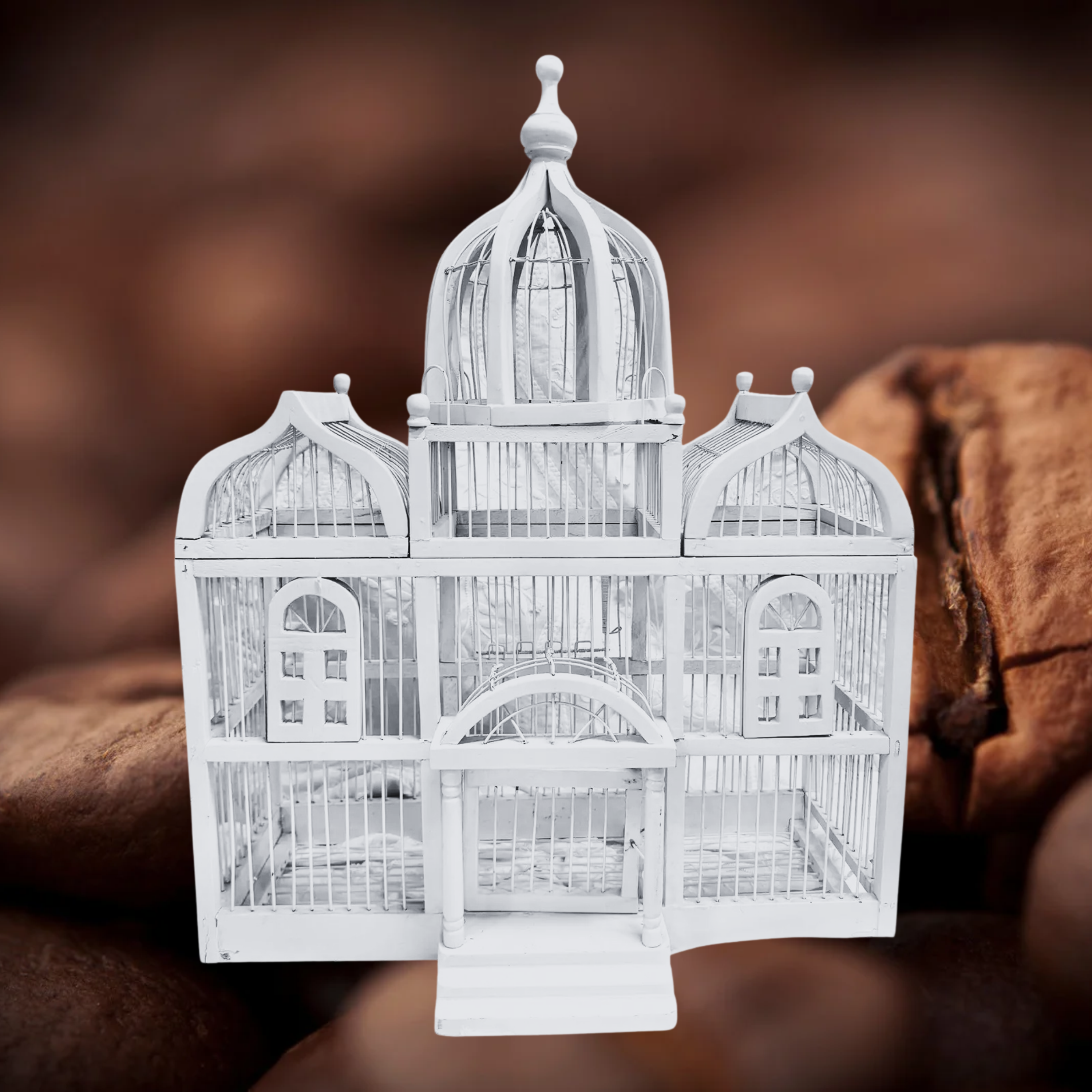
So one day we were at a garage sale and we found an incredible Victorian birdcage. And I actually have a picture that I wanted to share with you all.
That's exactly what it looked like. And on first dibs, I guess it's worth money. Back then, I think we spent like $10.
And so ours was maybe a little ricketier, but that was it. And we thought, how perfect. We'll put that outside, underneath the apricot trees, we had a stump. We'll stick it on the stump and secure it. And then when the days are nice, which were often, we will go ahead and put the birds in the cage.
So we did, and they would sing. And we just thought we were a phenomenal bird people, parents.
And I was doing the dishes, looking out at the kitchen window, and I actually noticed right on the top of our bird cage, right at that little coral or whatever that is, that little button on the top was a giant hawk looking down.
So I went running out of the kitchen door into our side yard, and the hawk spread its giant wings and flew away.
But inside the cage was quite a bit of devastation.
While the birds could not. Our little birds could not get out. The hawk's claws definitely could get in.
And one had already died. I won't get into exactly how she passed, but the other was gravely injured. And for a couple of hours, my daughter Judah held little Sunny, the yellow bird, in her arms, and cried.
And, you know, I grew up on a small farm. It wasn't a huge farm, but it was a small farm. And I was pretty used to the circle of life.
You know, I had seen animals die. I participated in animals dying for our own food or because the rooster would, you know, try to go for my face.
Like, I was pretty tough.
But for whatever reason, maybe it was because my kids were struggling with this so much. I was devastated.
And I went to bed that night and I couldn't sleep. And all I could think about was this system that I created for these two little parakeets that left them defenseless from the hawk.
And I started.
Because I've shared this with you before, and if you work with me, like, Joey can definitely attest to this I have a flair for the dramatic.
I thought, oh my gosh, I'm the hawk.
I'm this bloodthirsty thing that uses the natural world for my own benefit.
And so for six weeks, my family had to deal with the fact that even though we all loved hamburgers, I could not look at meat.
I could not cook it. I could not see the blood of really sent me into this really interesting space.
And over that six weeks, it became less about the birds or the poor hawk. The hawk was just doing what hawks do.
And it took me into this place of really taking a look at what things cage people and what things allow people to be free and where I had been participating in things that may have caged someone else or where I myself was caged.
And what was interesting about this whole time was that this was when I was really dismantling my own faith. I was really looking at did my Baptist faith that said, because I was a specific sex, that in this body I was not allowed to do certain things that I really felt called to do.
And so I was in this, you know, really interesting place. And yet for that six weeks, I really identified with being the hawk, the one that watched from above.
And so I'd like to share that.
And now I'd like to get into our passage a little bit.
So we started here in the book of Daniel with verse 10.
And before we can really talk about verse 10, I want to share a little bit about verses one through nine. I promise I'll be quick, but a little bit about who Daniel was.
So when we meet Daniel in chapter one, he is a teenager, and the king Nebuchadnezzar has taken over his land, the land of Judah.
They've occupied it. And they're at this moment in history, are allowing the land of Judah to kind of still be exist without being decimated at this point.
But they are occupying it. They're going to charge a great deal of taxes. They're going to take the government.
And one of the things that was very popular then, and actually I think it's still popular now, we could call it assimilation or colonization.
What they would do when one group would take over another is they would take the young people, the teens of that society, and they would bring them back to their town of origin, and they would assimilate them. They would give them different names, they would dress them in different clothing. They would teach them in the ways of their own society. So Daniel was taught in Babylonian culture, education.
He wore Babylonian clothes. He was given a Babylonian name.
And he, along with several of his friends, were taught for three to four years to be in service to King Nebuchadnezzar.
It was another way of going to battle.
And it says that he was overseen by the chief eunuch.
And that is important because while our text does not say this, there is a. A very, very good chance, which would have been common at that time, that Daniel and his friends were castrated.
This was a way, again, of making sure that these young boys, whose families had some power, could not have children of their own that might rise up against the king.
It was a way of changing a person's body.
Right. We're doing. They're doing everything they can to bring Daniel and his young friends into subservience to the new ruling kingdom.
And Daniel does something really interesting in that first chapter. He asks his captors who are taking good care of them. They're getting. I mean, taking good care of them. They're doing terrible things to them, but they're feeding them. They're trying to raise them up to be good Babylonians.
And he says, I'll only eat vegetables and drink water.
And his caregivers say, if you start to diminish in strength, I will have to force you to eat the king's food. But he doesn't. And for a period of time, we don't know how long. It doesn't state how long Daniel eats vegetables and water. And it says that he remains strong and he goes through his training to become a good servant in the king's palace for about three to four years.
And the Book of Daniel is really interesting because it's considered an apocalyptic book. And so it's a little like a modern novel or film where we change the timing all around. You know, you're reading chapter one, and it looks like it was happening in the past. And then you're. You're reading chapter four, and is it like, is that happening now or is that the future?
Daniel is similar throughout this book.
The timeline is really fluid.
And so we're not sure if Daniel has the ability to interpret dreams while he's in this training or if it's sometime after.
But at some point, King Nebuchadnezzar has a dream and he can't totally remember it. And so he's trying to get all of his soothsayers to tell him what he dreamt and what it meant, and they couldn't.
And Daniel, after praying, has the ability to do so.
And so now we see Daniel, who's been kept as a captive in service of the king, whose body may have very much been mutilated, who has a different name, who's wearing different clothing, who's being conformed to his captors, to the enemies of his people.
Because of his interpretation of this dream, he is given the ability to rule over Babylonian government.
He's been put in a high place.
And his ability to be put in this high place, he brings his friends with him.
So we have Daniel in this place that he is quite powerful within a government that he didn't choose.
And by the time we get to chapter 10, he is probably our best guess, around 86 years old.
And there's been many changes he's experienced. A Babylonian rule has been taken over by Persian rule. So now there's a different king.
But he has remained in some bed of power.
And his people have been given the opportunity to return from many nations back to the land of Judah. But for whatever reason, Daniel does not choose to go. Maybe it's because he's 86, maybe he doesn't want to go. But also, the land over all of these years, from the time he's a teen to now, the time he's in his mid-80s, has greatly been dismantled.
It is in ruins. The people that remain there were the poorest of the poor that were left.
They had very little resources as the diaspora began to move back to their homeland.
And that is not where Daniel lived.
Because we see in chapter 10, verse 1, that Daniel decides to abstain because he's mourning from what?
Rich foods, from meat, from wine.
And then he doesn't anoint himself. And in some texts it says anoint himself with lotions or oils that are perfumed.
So I want you for a minute to sit here with Daniel's beginnings that we see Daniel, how he has taken and where he's come.
He refrains from the riches of that time.
And so he says he does that for three weeks.
And from there he has. We're not sure if he has the vision after the three weeks, or he has the vision first and that the three weeks come again a little like this.
But it says he's in mourning.
He has a vision, a revelation of a great war.
And really chapters 10, 11 and 12 are all kind of one big body of his vision and his fast and what comes after.
And he's. He's grieved.
And here's what I want to say. What does that have to do with us 2500 years later?
I actually don't think we have much of a difference. Maybe we're not receiving revelations and visions in our minds, but we carry around a little box.
We have multiple boxes in our homes that provide us information that we see to be true of a world that feels decimated.
We see immigrants being terrorized.
We see climate change taking away homes for polar bears.
We watch as food insecurity rises, as school shootings feel like just another blip in our box.
We see these things to be true.
Just as Daniel had a vision of what's to come, and then I would imagine that as you watch on your phone or your TV what's happening, or you hear from somebody who experienced something firsthand, you also have a vision of what the future holds if we continue to go down this road.
So a minute ago, I think you might have thought, daniel's not me.
But I'd like you to see that you, too, are similar to Daniel as you watch what you find to be true and you imagine what may happen if we continue down the road that we're going down.
And all of you at the same time are also like Daniel in that.
I would imagine that many of you go to work every day. You get up and go to work, and some of your wages pay taxes, and those taxes go to things like roads so you can get to work and clean water.
And in a lot of ways, it enables you to have a home and rich foods.
But in other ways, you also know that when you take your kids to school with a hope that they are going to have an amazing future because that's what school brings, that there's also a fear.
A fear. Are they safe in this moment?
Some of you come during the week and talk to Jason and I, and you talk about wringing your hands because of these visions that you see that you know to be true and you don't know what to do.
You know that you are contributing, that you're living in a world that doesn't feel quite right, a world that you, in fact, did not choose, and yet you are benefiting in some way. We all are.
When we're in that place, I think sometimes we think we'll just pile on more.
Jason talked last week about joyful bread, and he talked about croissants specifically, and how croissants were there not because we needed them to survive, but because they were joyful bread.
It's the richest bread.
But sometimes we can stuff ourselves with joyful bread over and over and over again, and it does not satisfy because our bodies need to mourn.
We need to give space to our bodies to mourn.
Christian fasting is really interesting because some Christians will say, well, Daniel didn't fast.
That's not a fast. A fast is no food, right? No food.
And here Daniel is fasting with just the kind of the richest things.
So then there's the other side that will write books about how the Daniel fast is really good because it can give you a trimmer waistline and get you right with God.
I think Daniel was fasting for justice for his people.
He understood his fast was not going to make his people not go back to a place that was decimated by war.
It was not going to change every circumstance, but it was a way to give his body resonance with his people.
And I also love what Daniel did because, you know, I don't know, there may be a few of you here who've done that 40 day, no food fast, but that doesn't seem all that prudent.
I can. I'm not saying it couldn't be life changing, but Daniel, like us, is in this place between.
He's in a land that took him away, that colonized him, that gave him a different name, perhaps change his body.
He is a caged bird.
But he also made his way up the ranks and participated in a government that also caged his people.
He didn't fast completely, but he allowed his body to not take the energy to digest rich foods while he used energy to understand his vision and get a new vision of God.
And I think that this is what we can do as a group when it comes to fasting.
It's not about getting a tremor waistline or showing God how strong you are, or complaining to your friends that you're not eating chocolate and how hard it is.
It's when the more does not satisfy the lament.
And you set it aside for a time.
I'm not going to tell you how to fast or exactly when to fast, but I will say this. We do, as a church, offer fasting opportunities. We do talk about Lent and we invite you during Lent to do this.
And then last year we invited you, as a church to walk in Jane's shoes.
And I don't know how many of you did it, but what it was was I took Jane, one of our pantry guests, and I did the math with her and we used what she had in SNAP benefits and what she brought to her grocery budget. And we invited you one day a week for all of Advent to try to eat on Jane and her son's budget.
It was a fast for justice. It was a fast for understanding. It was a Fast for solidarity.
And Chuck, one of our. I was hoping he could be here, but for a little interview, but he's traveling. But he.
He actually didn't even every day do exactly that. But being a money guy, an accountant and a big money guy, he's on our finance team. He did all the math in his head.
So with my $8 a day, could I afford cream in my coffee?
I definitely couldn't go out to lunch with my friends at work.
Could I afford, bread's kind of expensive.
Could I buy flour to bake bread? Maybe that would be cheaper. But then he allowed himself to go down further past Jane and say, well, but what if I lived in my car?
I couldn't actually bake the bread.
And then he said, you know, it's expensive to be poor.
And by the Christmas party that we both attended, he was changed.
He was in this place where he came with great emotion to tell me what this did for him.
And, you know, here's the thing.
Chuck's fast needed to be for only a period of time. Otherwise, it's not a fast, but it was a perspective change. It brought him closer to people that he may have. I'm not saying he ever judged them, but it brought him closer to those that were struggling, that were in systems that kept them from flying, that kept their wings clipped.
And this is what I think fasting or fasting together can do. Can you imagine if every professing Christian in the United States took Jane's challenge?
How might they vote differently?
How might they see when a billion dollars is being taken from the free school lunch program?
How might they change their perspective if they were? No. And I'm not saying every Christian is from this height, but if they were from the height of the hawk versus the place of the parakeet versus.
So corporate fasting or fasting for justice can bring us new perspective.
And if we go back to our dear Daniel after his fast, assuming he went back to eating rich foods and anointing himself with perfumed oil, he saw an image of the divine.
And while his people were still going to go down a very hard road, he also found hope.
He also found that there could be a new way.
And without that new way, we cannot fight for justice.
So I'd like to end today with we are highlighting a book throughout this series called this Here Flesh by Cole Arthur Riley.
And she says this.
You cannot tell the story of injustice without telling the story of power.
It requires integrity to become honest about how our power systems and our positions in the world affect our capacity to do justice.
So if you are justice minded, I invite you at some point to be in prayer and maybe skip a meal or eat cereal instead of steak or to go three weeks and eat more simply and take your time to look at the power dynamics.
Where are you looking at a place of height and where are you also caged in a system and how can you stand in a balance that allows you to live in a world that is a struggle each and every day?
I think there is where God can be with us as a people to come together and believe that there can be something better.
Amen.
All right, let's pray.
God of Daniel, God of justice, help us to always align ourselves with the least of these.
Help us to see where we have put ourselves too high and help us to see where we are low.
Draw near to us, bring us hope and allow us to have revelation from you that will create hope and truth and light for all people in Christ's name.
[00:33:02] Speaker A: Amen.
Thank you for joining us for this Sunday teaching, no matter when or where you're tuning in.
To learn more about our community or to support the work we do, Visit
[email protected] We hope to see you again soon.