Episode Transcript
[00:00:00] Foreign.
[00:00:08] Welcome to the collective table where we celebrate the intersections of Jesus, justice and joy.
[00:00:15] This podcast is brought to you by Oceanside Sanctuary Church. Each week we bring our listeners a recording of our weekly Sunday teaching at Oceanside Sanctuary, which ties scripture into the larger conversations happening in our community, congregation, and even the podcast. So we're glad your here and thanks for listening.
[00:00:39] For those of you who don't know, my name is Jason Coker. I'm one of the co lead ministers here. And this is when we do our, you know, kind of teaching time. So the kids go out to their classes and then you are all trapped in here with me for, you know, 40 or 50 minutes.
[00:00:55] It's a joke.
[00:00:57] That's a joke. If you're new, I was hoping to scare you a little bit.
[00:01:01] It's not that bad, I promise.
[00:01:03] Anyway, we are in the midst of a teaching series called Practices of Belonging. We've been talking about how, as a church, there are certain kinds of spiritual practices that we tend to engage in here at the Oceanside Sanctuary that aren't just individual practices. They are group spiritual practices. They essentially mark ways in which we know that we belong to a community and what that community is and what our community is all about. And I'm excited today to talk to you about baptism as a community practice. And the reason I'm kind of excited about that is because we tend to think of baptism as an individual thing, that we make a choice to be baptized and then that, you know, does something in us or to us, maybe in God's eyes or the eyes of the other people around you.
[00:01:58] And certainly to some extent that is true. But I want to talk to you today about the idea that baptism also is a kind of community practice that we all engage in together. And it's a practice that we're going to be engaging in in just a couple of weeks, twice a year, we officially baptize people here at osc. That doesn't mean that we're not open to baptizing people in, you know, the other seasons, but we sort of regularly baptize people in the spring and the fall, so at Easter and then in the fall, which is just coming up in two weeks. So in two weeks, we're going to fill this baptismal back here behind me with a bunch of water and we're going to dunk some people under the water. You know, some of them are going to hold underwater a little longer, you know, depending on, you know, whatever.
[00:02:43] And I want us to be sort of prepared for as a church what that means for us to be a part of this. And we talked about baptism last spring when we did it recently. And I want to pick up sort of where that sermon left off, if that makes sense. But first, I want to read to you our passage for this today. It's Matthew, chapter 28, verses 18 through 20.
[00:03:11] It's a very familiar passage. And usually when we read this passage in church, we're not talking about what baptism means. So that's what I want to use as our springboard for today. Matthew 28:18 says this. Then Jesus came to them, excuse me, and said, all authority in heaven and earth has been given to me. Therefore go and make disciples of all nations, baptizing them in the name of the Father and the Son and of the Holy Spirit and teaching them to obey everything I've commanded you. And surely I'm with you always to the very end of the age.
[00:03:50] You might have noticed that my translation that I read from was maybe a little different than what you saw on the screen. The reason for that is usually when we preach here, we use a translation called the nrsv, New Revised Standard Version. It's generally considered the best scholarly interpretation. That's also very readable.
[00:04:11] But I read to you from this Bible, which is a New International version. Niv.
[00:04:16] This is a Bible that was given to me by a mentor of mine in my early 20s. He made the COVID And if you look in my Bible In Matthew 28, verses 18 through 20, you'll notice, like, a bracket and some circles on the text, like I'm a. Like I can't read a book without writing on it or in it. That's just how I am. And I bracketed this passage because it would be hard to overstate how important this passage that we sometimes call the Great Commission was in the early part of my Christianity, where, like, Christianity meant doing this as much as possible as vigorously as possible, essentially bringing the good news of God to other people. And so I read from this because, for me, it's a bit of a reminder of how I used to read this passage.
[00:05:10] And I don't really read it that way anymore. And that does have some relevance for how we're going to talk about it today.
[00:05:17] So would you pray with me before we jump in?
[00:05:21] God, we thank you for today, for this opportunity for us to visit these words, these ancient texts, to be stretched by them, to be challenged by them, and to learn, perhaps, what it means to follow after you, to be people who are formed and shaped by your baptism.
[00:05:46] We pray that in some way, this would bring us a sense of hope and also a sense of purpose.
[00:05:57] We pray all this in Jesus name. Amen.
[00:06:01] Many of you know because I talk about it all the time. Some of you do. Not that. I have two grandkids. One of them is Otis. He's four years old, just turned four yesterday. And for Otis's fourth birthday, I took him to be baptized, so to speak, into coffee shop culture.
[00:06:24] I did this because when I was Otis's age, my grandfather used to take me to the coffee shop all the time. It was Jay's Coffee Shop in downtown San Bernardino, was somewhat noteworthy for its architectural features. And then they bulldozed it a few years ago. But this was one of my favorite memories, going to the coffee shop with my grandfather. And he'd get a cup of coffee and he'd read the newspaper, and I would sit next to him and I would get a cup of hot chocolate, you know, and I would, you know, scribble on the, you know, coloring book or whatever. I just loved this ritual with him. And so for his fourth birthday, I took Otis to the Start Fresh Cafe down here on Coast Highway. And we went in and we sat at the counter, right? Cause that's what my grandfather and I used to do. Sat at the counter and we sat there and I ordered a cup of coffee and I said, would you like a hot chocolate?
[00:07:15] And he said, what's that?
[00:07:19] And I was like, dude, you're gonna find out.
[00:07:23] So I ordered him a hot chocolate, and the waitress brought him this giant mug full of hot chocolate and, like a crown of whipped cream with chocolate sprink sprinkles on the top. And he was, for the first time in his life, speechless.
[00:07:38] And he ate that hot chocolate with a spoon because it was, you know, hot, too hot for him to drink from. So he ate it with the spoon, you know, for like the first 15 minutes. And then he grabbed that mug after it was cool enough to drink, and he sucked down that mug of hot chocolate like it was a religious experience.
[00:08:00] And I say that he was sort of baptized because when he got to the end of the hot chocolate, you know, he had to tip that cup all the way up.
[00:08:08] And by the time that cup had been drained, he was covered in hot chocolate. He had hot chocolate on his shirt. He had hot chocolate all around his mouth. He had hot chocolate on his forehead where the mug made contact with his forehead.
[00:08:26] Wasn't just the hot chocolate he was baptized in. He was also baptized in the whole experience of sitting at the counter At a coffee shop where, you know, waitresses were fawning all over him.
[00:08:37] 20 year old waitresses, 40 year old waitresses, 80 year old waitresses, they like couldn't get enough of Otis. They would come and they would talk to him and tell him how cute he was and he would beam.
[00:08:49] Then he got to see, like the workings of the kitchen from there, right? He got to see that there were cooks behind the little pass through and they were busy, you know, making stuff and throwing, slinging plates up on the top and people come and get them. And he asked me like, what are they doing and what is that back there? And we talked about what the kitchen was and we talked about all the machinery right in front of us, right? One of them made hot chocolate and it said, hot, delicious, creamy. And I was like, that is where the nectar of life comes from. And he was like, yes. And then right next to that was the coffee pots. And I said, that's how the coffee is made. And he got to see all the commotion, all the action of that. And then above that was a big flat screen tv, of course, and the Cal game was on. And he was like, who's your favorite team? And I was like, well, in this game it's definitely the Golden Bears. And he was like, who's that? Because his favorite team is the Broncos. Don't judge him.
[00:09:38] He doesn't know the difference between pro and college yet.
[00:09:43] But he was kind of immersed in the whole experience.
[00:09:47] And I kind of love that for him, it wasn't just that he got to drink a hot chocolate, it's that he discovered something new about the world.
[00:09:56] And maybe I did too, right? Like through his eyes a little bit.
[00:10:01] And I think that we underestimate the extent to which we are baptized into cultures like that.
[00:10:16] We underestimate the extent to which the experiences that we have every day over and over again that we take for granted the ideas and the input and the beliefs and the people and the manners and the customs and all the little ways that we interact.
[00:10:33] We forget how truly formative and remarkable those things are until we experience it for the first time, maybe through the eyes of a four year old.
[00:10:44] And I think that we have done that with our faith too.
[00:10:49] I think that we have taken baptism and we have made it into a kind of individual ritual that we think is going to do something to us magically or we really hope that it's going to do something to us magically. And we have forgotten to see that baptism is immersion into more than just your ability to be cleansed of your individual sins, that. That there is a whole culture into which we have been immersed.
[00:11:18] And I do think that is what Jesus is talking about in Matthew 28, verses 18 through 20. I don't think that when Jesus says, therefore go into all the nations, because all authority on heaven and earth has been given to me. Go into all the nations and baptize them in the name of the Father and Son and the Holy Spirit. I don't think he's saying, what you should do is align yourselves with power and go and conquer other cultures and turn them into little versions of the modern west and convert them into Christianity. I don't think that's what he's saying.
[00:11:50] Call me crazy.
[00:11:53] I think instead Jesus is saying to his followers, to his students, the people who spent three and a half years learning from him how to be in the world. I think what he's saying to them, to his followers, to his students, to now his friends, is go into all the world and immerse them into the same reality that I have immersed you into.
[00:12:20] And this is, I think, what the passage means.
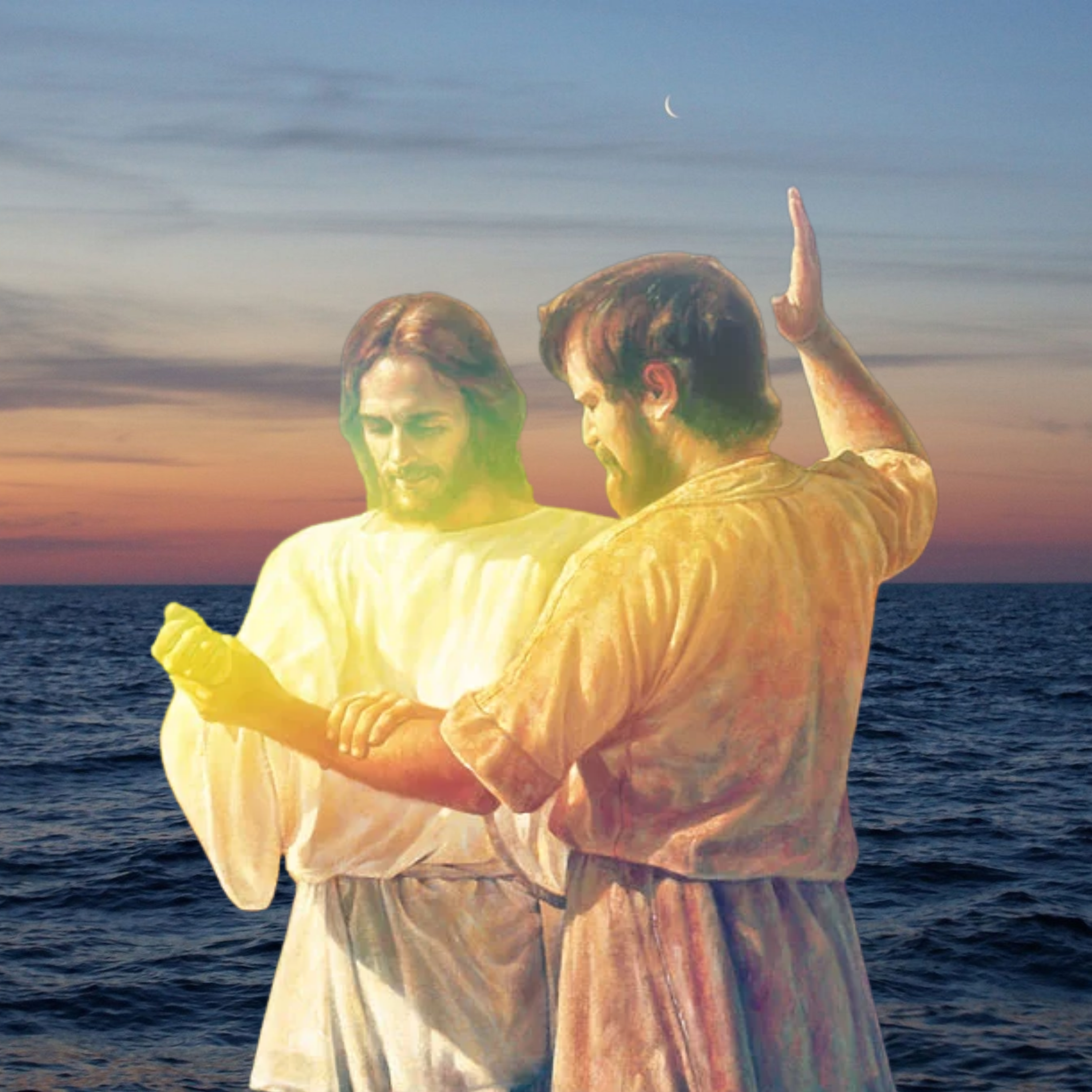
[00:12:24] But before we jump into that, just a reminder that the last time I spoke on baptism, because maybe you were here, we talked about Jesus own baptism. Jesus being baptized by John the Baptist in the River Jordan. By the way, that's the River Jordan painted on the wall right behind you in 1928. The people who built this building were like, wouldn't it be cool if we had a River Jordan in the baptismal? So that's what's going on there. Just in case you didn't know, I keep threatening to paint over it. And Janelle's like, absolutely not.
[00:12:57] But now you know a little bit about our relations.
[00:13:04] We talked a little bit about Jesus's own baptism.
[00:13:08] And one of the things that I said was that Jesus was participating in a kind of ritual that had developed in what we sometimes call, like Second Temple Judaism, which is, you know, first century ancient near east, when Jewish culture had sort of developed to this point where there was this second version of the temple, and there's a whole kind of distinctive culture around that time. And one of the things that develops from the teachings in Leviticus, chapter 11 and 12 and 13 and 14 and 15, where there are instructions for ritual cleansing. What develops from those Leviticus passages is a tradition referred to often as the mikvah. Mikvah is a Hebrew word which just means where the waters are gathered.
[00:13:54] And so imagine like a naturally occurring pool in the wilderness or a pond or a Lake or a river. Any of these would technically in Hebrew be a mikv mikvah. But mikvah came to be understood by Jesus's day as a kind of pool where you would ritually cleanse yourself in order to be compliant with the law in Leviticus 11 and 12, especially now, here's what you need to know about that. Because when we think about cleansing, we think about, like, being dirty, right?
[00:14:27] And when we think about being dirty in a religious context, we think about sinning. We think about all the things that we have done wrong and how we have to be cleansed from those sins because we are dirty, rotten, filthy people who need to be fixed. But that is actually not what's going on in mikvah cleansing.
[00:14:49] In those passages in Leviticus, all the things that people are being cleansed of, the things that have quote, unquote, made them unclean, are things that they didn't do. They're things that happen to them.
[00:15:05] So you became unclean. For example, if you happen to be near somebody who had a disease, it's not your fault that somebody is sick.
[00:15:13] But if you're close to somebody who's sick, you might get what?
[00:15:17] Sick.
[00:15:19] And so there is this sense that develops in ancient Hebrew culture leading up to Jesus's day that you may not have committed a moral offense, but you have been exposed to a moral hazard.
[00:15:34] So if you know somebody's sick or they appear to be sick and you are around them, obviously ancient people understood that that sickness tended to transmit to you. And not only would that make you sick, but then if you went to the community, you could make them sick as well.
[00:15:51] And so it just makes sense for you to be separated until you're no longer sick. And then there was a ritual for marking the transition from the separation to the reintegration.
[00:16:07] And that ritual cleansing was a symbolic way of saying you're now clean not from the dirty, terrible thing you did, but from the harmful thing you were exposed to.
[00:16:20] This is the difference between a moral failing and a moral hazard.
[00:16:26] And all of those reasons for ritual cleansing in Leviticus chapters 11 through 15 have to do with moral hazards. Coming into close contact with a dead body would make you ritually unclean. Menstruating, if you are a woman, would make you ritually unclean. That is not your fault.
[00:16:49] It's something that happened to you. And out of an abundance of caution and a misunderstanding about what menstruation involves, they want to make sure that nobody is harmed.
[00:17:02] Childbirth, other things that seem to, like, be problematic. Bodily Functions would, out of an abundance of caution, lead to the practice of Mikvah ritual cleansing.
[00:17:17] By the time Jesus comes along, this symbol takes on incredibly powerful resonance and becomes a way to symbolize how people are reintegrated into the community after they have been separated from it. And to summarize, my sermon from last spring, on Easter, I said that when Jesus partakes in this Mikvah tradition, this ritual cleansing, he is essentially expressing solidarity with all who have been separated from the community. And even though he has not morally failed or been exposed to a moral hazard, he is joining with those who have been excluded and bringing them all back into relationship with the people of God. And I said baptism was an act of solidarity, that it's a way of demonstrating justice for those who have been excluded.
[00:18:09] All right, that's last spring. That's what I said about baptism back then.
[00:18:15] And I still think that's true. By the way, baptism is, and this is, I think, the most helpful way to think about it. It marks a re entry or an entry into a community of some kind, a way of belonging.
[00:18:31] But what kind of community are you entering?
[00:18:37] And this is where, like, Christianity has just become extraordinarily complicated and problematic because baptism is entry into Christianity as a community. But which Christianity?
[00:18:57] Like, I've said this before, right? But like my favorite religious statistic is that in the entire world, to the best of our knowledge, there are 10,000 different forms of religion on the planet, of which Christianity is just one.
[00:19:12] But there are 40,000 versions of Christianity alone.
[00:19:17] There are four times as many versions of our faith tradition as there are any other kind of religious system in the world. So which of those do you belong to?
[00:19:30] And if you ask growing minority of people in the United States today if they belong to any of those Christian traditions, their answer on an official census is, hell, no.
[00:19:46] And the main reason is who would want to be affiliated or associated or identified with expressions of religion that appeared to be doing so much harm in our world today.
[00:20:00] So if you ask those same people, like, which of these versions of Christianity do you belong to? And they answer like, none of them, thank you very much.
[00:20:08] And then you go on to ask them what they believe. Many of them, about 2/3 of them believe all kinds of things that are very compatible with Christianity. They're not atheists, they're not agnostics. About one third of them are. But 2/3 of them are like, oh, yeah, I think Jesus is great, but his people, not so much.
[00:20:30] And so the question, I think remains, if baptism is our entry into Christianity. My question is, which one have you been baptized into? The Christianity of empire, the one that is primarily concerned with power and conquering and control of all the levers of political and civic power in the world? Or have you been baptized into a Christianity of supremacy, that believes that Christianity should be at the height, the top, the ruling position of all hierarchies, hierarchies of race and gender and sexuality and class, is that the Christianity into which you have been immersed is the Christianity of prosperity, the one that says to be a Christian is to be super rich and wealthy and successful no matter what. That. That is what Jesus came for, to ensure that you and I had the opportunity to have all of the abundance that was due to us as children of the king?
[00:21:42] Or was it a Christianity of nationalism, a Christianity that is obsessed with maintaining the purity of our ethnic or national identities, that wants to ensure that there are borders that cannot be violated and that we're willing to use violence to enforce those borders?
[00:21:59] All of these are just a few versions of the Christianity that we are given and presented with all the time.
[00:22:14] I'd like to think that I have chosen to be baptized into a Christianity that follows the teachings of Christ.
[00:22:24] I don't see any of that in Jesus teachings.
[00:22:31] This passage, I think, is helpful to us in understanding what all this means because he says something here in Matthew 28, 18:20 that's a little bit confusing, but helpful if we unpack it a little bit. He says, therefore, go and make disciples of all the nations, that is, students of the people that you encounter across boundaries of difference, and baptize them in the name of the Father and the Son and the Holy Spirit. What in the world does that mean?
[00:22:56] What is it about this Mikvah tradition, this immersion in water that re enters you, reintroduces you into the community?
[00:23:05] And how is it that that has anything to do with somebody like me dunking you underwater and holding you for a little while and making sure that I say, in the name of the Father and the Son and the Holy Spirit? Are those, like, magic words?
[00:23:19] Like, if I forgot to say one of those, would it not count? If I, like, was like, I baptize you in the name of the Father and the Spirit and forgot the Son? Would it, like, be null and void? Would God be in heaven being like, oh, too bad for Bruce, Lake of Fire for you because Pastor Jason forgot to say the Son?
[00:23:44] I don't think that's it.
[00:23:47] The Hebrew tradition, there is this amazing tradition of giving God all kinds of colorful names and the reason for this is that nobody was allowed to utter God's actual name. In the Hebrew tradition, most of us know this to some extent. Like, there's the Tetragrammaton, which is Yahweh, you know, Y, H, W, H, which is meant to be a kind of acronym for God's name. But in. In the Hebrew tradition, God's name was a kind of guarded, protected mystery. Nobody could utter God's name.
[00:24:19] And the reason for that is that in that culture, not unlike our own, if you know somebody's name and you can use it, it gives you authority over them.
[00:24:29] This is why every time my wife and I get into an argument, I say, janelle.
[00:24:36] I don't think so. Janelle.
[00:24:41] You ever do that?
[00:24:43] You ever wonder why you do that?
[00:24:45] It's not like, you know, she doesn't know that I know her name.
[00:24:49] Something like amazing happens when you're making your point and you use somebody's name.
[00:24:56] You may see a video with Abdul said in that town hall where the guy stands up and challenges him. And Abdul said, the first thing he says is, what's your name?
[00:25:07] It's not because he really wanted to know his name, although it is humanizing in a sense. It's a rhetorical strategy.
[00:25:18] Well, in the ancient Hebrew religion, there was also a kind of rhetorical strategy. If you knew the name of God, you could have power over them.
[00:25:27] Ancient Judaism believed that we could never have power over God, that God was not God unless God was God.
[00:25:39] And so it was forbidden to know God's name. And so for this reason, the ancient Jews came up with all kinds of really colorful ways of referring to God without actually using God's name. They would, for example, call God In Genesis 22:14, Jehovah Jireh, which means the Lord will provide. And this is a great example of how they used to do that. They would use a verb to describe God's actions in the world. And by describing God's actions in the world, they would essentially be declaring who God actually is.
[00:26:17] Jason in Greek means healer.
[00:26:22] That doesn't necessarily mean anything because in our culture, we don't attach names to meaning. But it's a holdover from the ancient world where a name actually said something about who you are and what you do. Coker is a reference to a crooked river in England.
[00:26:39] I know on brand. But our names are supposed to say something about who we are, right?
[00:26:49] Well, in the ancient Hebrew tradition, God was called Jehovah Jireh, the Lord will provide. In Genesis 22:14, in Exodus 15:26, it's Jehovah Rofeka, which means the Lord who heals.
[00:27:03] In Exodus 17:15, it's Jehovah Nisi the Lord is my banner, right? The declaration of who is my authority. In Judges 6:24 Jehovah Shalom. You all know that word. It means the Lord is my peace.
[00:27:21] Psalm 23:1 Jehovah Roi the Lord is my shepherd. What is a shepherd? A guide and a Protector. In Jeremiah 23:6 Jehovah Sidkenu the Lord is my righteousness. Ezekiel 48:35 Jehovah Shammah. The Lord is present. The Lord is here.
[00:27:42] Exodus 31:13 Jehovah Makadashim. I know, that's a hard one. The Lord who sanctifies the Lord who makes good.
[00:27:56] All of these are descriptions of God. All of these are also the names of God.
[00:28:02] And by naming God in this way, the ancient Jews are telling us who God is. They're telling us what the reality is to which we refer when we use the word God.
[00:28:18] To what are you referring when you use the word God, what comes to your minds?
[00:28:23] Is it still an old white guy with a beard in the sky who is really pissed at you for no reason than because you dare to exist?
[00:28:35] Please shed your latent Calvinism?
[00:28:42] Or when you imagine God, when you use the word God, are you imagining, like, a kind of vast universe that can't be, like, held or located or quite described, and certainly not controlled, whose mystery somehow delivered you to be in this place at this time, listening to this white guy talk endlessly like he knows what he's saying? Like, is that what you think of when you think of the word God, this sort of mystery?
[00:29:17] Or is it something else you think of, like, you know, the caricature that the Texas Republican Party have invoked when they make fun of James Talarico because he dared to say that God wasn't a man or a woman, which should just be the most obvious thing in the world.
[00:29:41] Like, I can't imagine why it's controversial to say that God doesn't have a penis.
[00:29:50] This isn't the first time I've used that word in a sermon. It won't be the last.
[00:29:58] What do you imagine when you hear the word God?
[00:30:01] Do you imagine that God is peace? Do you imagine that God is righteousness? Do you imagine that God is your banner of protection? Do you imagine that God, however mysterious, is present here with you, with me, with all of us?
[00:30:18] Because the Jews. I think the ancient Jews were onto something here.
[00:30:24] Their approach to naming God was to name all of the positive attributes to which God belonged and to whom belonged to God.
[00:30:37] And in that way, what they're doing is describing a reality that far too few of us experience on a regular basis. Moreover, I want to suggest to you that the motif of baptism in scripture, throughout Scripture, from the beginning to the end, every time you see somebody being immersed in or passing through water, that that motif tells us the story of this very reality that I am trying to describe.
[00:31:06] So, for example, when the slaves who escaped from Egypt passed through the Red Sea, they have been baptized.
[00:31:16] And that baptism is an entry into a new reality. They have left a reality of slavery and oppression, and they are entering a reality of liberation. It's a new day, a new world, a new way of being for them. When those same Israelites, after wandering for 40 years in the desert, lost, not knowing where they were going or what they were doing, finally enter into the land that was promised to them, what do they do? They cross the River Jordan.
[00:31:53] They pass through water and are baptized again.
[00:31:58] As they leave their old reality of being lost in the desert. And they enter into a new reality of a better hope, a better future that was promised to them. That is a corporate baptism.
[00:32:13] Both of these are a kind of mikvah for the Israeli people, a kind of cleansing, a way for them to move from exclusion to inclusion, a way for them to move from curse into blessing, a way for them to move from having no identity to belonging to a better reality.
[00:32:42] And this, I want to suggest to you, is our baptism.
[00:32:49] That when we invite you to be baptized here, if that's not something that you have ever done, what we are inviting you into is not just an opportunity for you as an individual to, like, participate in a magical ritual where, like, hopefully, hopefully, those terrible things you did are forgotten by God. Because that ritual somehow, like, you know, is an injection that causes amnesia, but rather that we are seeking to be immersed into the name of God.
[00:33:21] And that name, that reality of God, means a new future where there is provision for the hungry and the hurting, where there is healing for those who are sick and dying, where there is protection for the weak, where there is peace for the victims of war and trauma, where there is guidance for those who wander, where there is goodness for those, as Jesus said, who hunger and thirst for righteousness, where there is presence for the lonely, where there is belovedness.
[00:34:01] But those who have been in isolation and disconnection, that is the reality into which I think, we are meant to be baptized.
[00:34:14] And that is, I think, exactly what Jesus taught, I think that's our promised land.
[00:34:25] And when any one person is baptized, whether it's like, you know, here in this little 100-year-old leaky baptismal that we have, or maybe at the beach or whatever it might be, every time you are baptized as an individual and the rest of us are there, we are all crossing that river together.
[00:34:48] Because if you've been baptized, it's a remembrance that we are all being immersed in a different reality.
[00:35:00] And if you haven't been baptized, it's an invitation.
[00:35:05] It's an invitation to leave the desert behind and to pass through the waters into something better, something good.
[00:35:14] Amen.
[00:35:16] Would you pray with me?
[00:35:17] God, we thank you again for today, for an opportunity for us to be stretched and challenged by these old words, these old stories.
[00:35:33] We pray that you would make this a community, however small a place where your presence is known.
[00:35:47] By your presence we do mean righteousness and peace and provision and healing and protection, all those things to which the ancient Jews referred when they uttered your name.
[00:36:08] It's our prayer today, God, that each time we practice baptism, each time we witness it, and for all the times in between that we would be immersed in your name.
[00:36:19] We pray this in Jesus name. Amen.
[00:36:27] Thank you for joining us for this Sunday teaching, no matter when or where you're tuning in.
[00:36:33] To learn more about our community or to support the work we do, visit us@oceanside sanctuary.org we hope to see you again soon.