[00:00:00] Foreign.
[00:00:08] Welcome to the collective table where we celebrate the intersections of Jesus, justice and joy.
[00:00:15] This podcast is brought to you by Oceanside Sanctuary Church. Each week we bring our listeners a recording of our weekly Sunday teaching at Oceanside Sanctuary, which ties scripture into the larger conversations happening in our community, congregation and even the podcast. So we're glad your here and thanks for listening.
[00:00:40] We've been visiting the post resurrection appearances of Jesus and asking ourselves what it is that we can learn from these narratives and stories today. It's a very familiar narrative that has played an oversized role in my Christianity. And maybe that's true for you too, or maybe it's not. Maybe the things that I'll share today are utterly foreign to you. And if that's the case, God bless you.
[00:01:07] But I do have some things to say before I say what I need to say about the thing that I'm going to say at the end. Right. So we have some work to do.
[00:01:17] But I wanted to preface it by saying that as we read this passage, if you come from a particularly like, controlling expression of Christianity, you, you might hear these words and feel a bit of like, resistance rising up in you. That's okay.
[00:01:34] We're going to talk a little bit about what you might be experiencing today, and some of that will be what I experience when I hear this passage too.
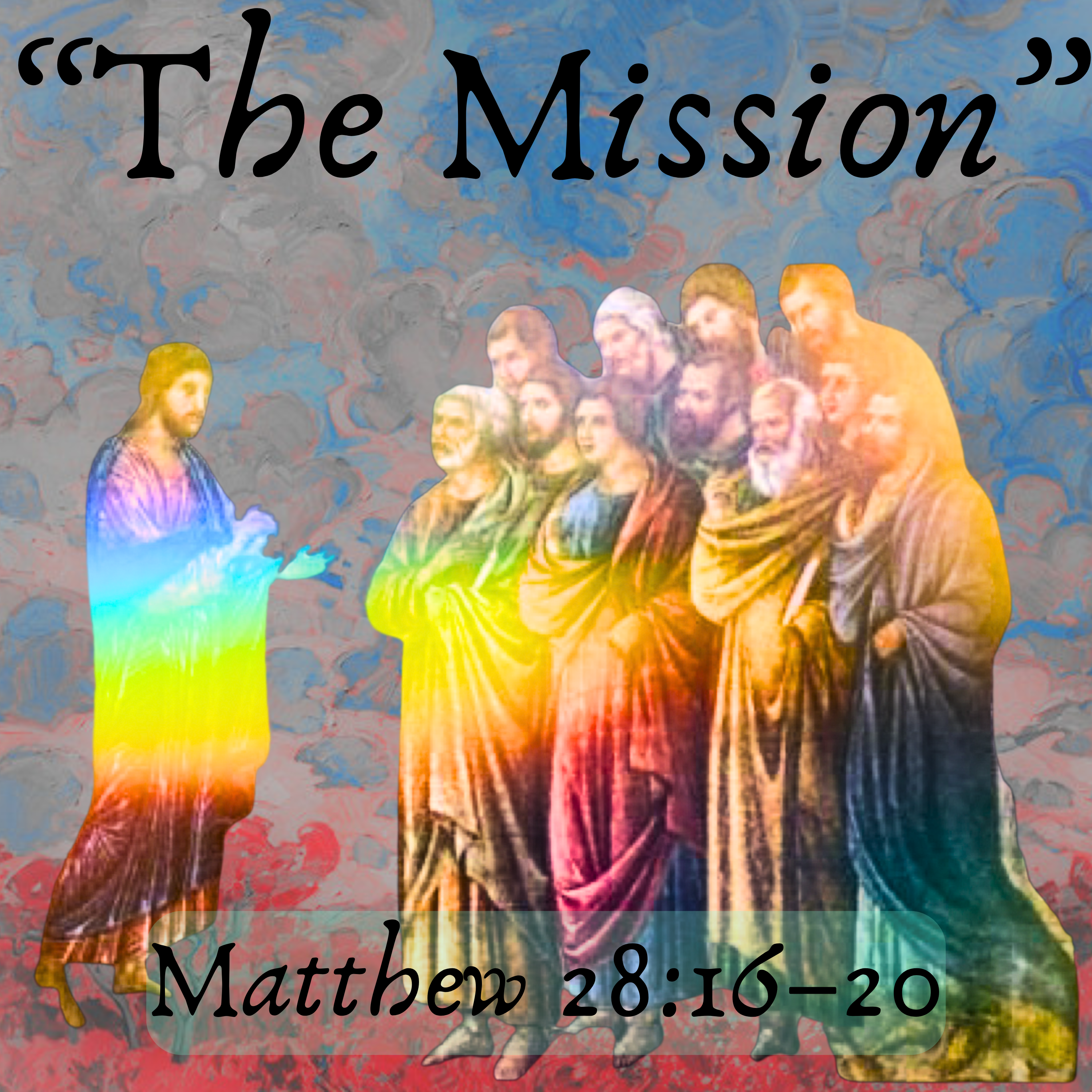
[00:01:42] So let's start by reading it. Matthew 28:16 20. And I want to share with you what I'm taking away from this passage, especially in light of what we have been learning over the past several weeks. So Matthew chapter 28, verses 16 through 20, known as the Great Commission. You might see it in your Bible subtitled as the commissioning of the disciples says this. Now, the 11 disciples went to Galilee, to the mountain to which Jesus had directed them, and when they saw him, they worshiped him.
[00:02:14] But some doubted and Jesus came and said to them, all authority in heaven and on earth has been given to me.
[00:02:23] Go therefore and make disciples of all nations, baptizing them in the name of the Father and the Son and the Holy Spirit, and teaching them to obey everything that I have commanded you. And remember, I am with you always to the very end of the age.
[00:02:42] Would you pray with me?
[00:02:44] God, we thank you again for today and for this opportunity for us to gather as a community, to encourage each other, to meet each other, to get to know one another, to lift our prayers, to sing with our hearts, longings and desires, and to hear words that challenge us and stretch and grow us.
[00:03:14] It's my prayer that your grace would be really present today in a way that we are aware of, that we would have the sense of being immersed in your love and your grace.
[00:03:29] We pray all this in Jesus name.
[00:03:32] Amen.
[00:03:34] Janelle and I have been married for a very long time, but I wanted to show you a picture of our 10th anniversary.
[00:03:39] This is a picture of Janelle and I on our 10th.
[00:03:42] Yes, that's me.
[00:03:45] I know. I know you're thinking, janelle doesn't change.
[00:03:51] We've been married for 34 years. Yeah. So this was.
[00:03:57] Thanks.
[00:03:59] But this was our 10th wedding anniversary. And we are sitting in a great little restaurant just south of Rosarito Beach, California. Because we were, of course, on a mission trip.
[00:04:13] A mission trip with a bunch of teenagers that we had wrangled as, like, youth and children's ministers at our little, like, hyper Pentecostal church high in the mountains of Park City, Utah. We enlisted a gaggle of teenagers to come with us to Mexico to bring the good news of Jesus to the poor, like, impoverished, like, hurting people of Mexico who desperately needed more than anything for white people to come and to share with them the good news and to get their hair braided on the beach and to buy necklaces from the people who walk up and down the beach. We did this over and over and over again. I can't even begin to tell you how incredibly important foreign missions was to the Christianity that Janelle and I were really immersed in in our young adult years where we were children's leaders and youth leaders, like missions was it. To be a missionary was the pinnacle of existence for a true Christian. If you weren't a missionary, serving in a foreign context might not be a Christian. It was suspect whether or not you were truly a Christian. Like, at least if you didn't want to, like, go overseas, maybe you were cursed and you were stuck in the United States with all the other white people who had Jesus. But at least you wanted to go overseas and bring Jesus to all of the non white people of the world.
[00:05:46] We were real Christians, of course. So not only did we go to Mexico to bring Jesus to the brown people in Mexico, but we also, you know, brought a bunch of teenagers with us. And these were such fun trips, like, incredibly formative and important trips.
[00:06:02] And we really were exposed to differences, like cultural differences, language differences, religious differences.
[00:06:13] For example, it turns out that a lot of people in Mexico are Christians already.
[00:06:24] Like, you know, and by Christian, I don't mean Catholic, because, you know, they're not Christians. You know, of course, that was sarcasm. In case you're new in case you're new pastor Jason likes sarcasm, right? But you know, even though like Methodists and the Presbyterians were suspect, you may not know this because, you know, you might not be as immersed in like the theology of missions as I am. Like, I have spent way too many years in graduate school studying mission theology. It's essentially my thing, right. I don't talk about a lot here because missions is problematic, but essentially Mexico was the purview of the Methodist Church and the Presbyterian Church way back in the day, early part of 20th century. All the mainline Christian denominations, the big institutional denominations got together and they carved up the globe and they assigned different parts of the globe to different churches. And Mexico was the responsibility of the Methodist and the Presbyterian Church. So when you go to Mexico, there's lots of, lots of people whose history is Methodist.
[00:07:30] Now if you're a Pentecostal, they're not Christians. And then there are lots of people who are Presbyterian. And if you're Pentecostal, they're not, they're not Christians either.
[00:07:40] And then of course, you know, there, there are Catholics, which definitely not Christians, you know, because like in the history of Christianity, they're really far from Protestantism.
[00:07:50] And then what's really annoying is they're charismatic Catholics.
[00:07:55] That's confusing because they look a lot like Pentecostals. If you're a Pentecostal, they act a lot like Pentecostals. They wave their arms, you know, and they like pray in tongues and stuff like that.
[00:08:05] All the weird stuff. If you do the weird stuff, you're in, right?
[00:08:11] But then what's really confusing too is that there are a lot of Pentecostals just not your kind of Pentecostal.
[00:08:19] And so that's where you're like, yeah, but are they really Christians? Are they like oneness Pentecostals or do they believe in the Trinity?
[00:08:27] Right? So suddenly like, you know, your well intentioned mission trip to like help people learn to find Jesus becomes a lot like, you know, the World Series of Christianity, right? It's like the tigers versus the, you know, Indians, right? Before they were the guardians, right?
[00:08:46] You guys didn't get that joke? Okay, fine. Fine, fine, fine.
[00:08:52] Yeah, yeah, yeah.
[00:08:55] One of my favorite sort of memories of these trips is we would sit on the beach at the end of the day because doing mission trips in Rosarito is awesome because you work during the day and then you go to the beach in the afternoon.
[00:09:06] You sit on the beach and you guys, I'm sure, experienced this. You go to Mexico, you're sitting on the beach, and there's like, you know, somebody who comes walking up and they've got, like, a little suitcase, and they open it up and they're like, the coolest, like, rings and toe rings and necklaces and, you know, stuff. And you look at it and they're like, you know, trying to sell it to you. And then, you know, you haggle with them a little bit, and then, you know, you buy a ring maybe, right? You put it on your finger, your toe or whatever necklace, you put it around your neck, and off they go. And like 15 minutes later, another guy comes along.
[00:09:35] He has a very similar suitcase, right? And you're like, oh, he's got some jewelry, too. Can I see what you got? And he opens it up, and it's the same. Jewelry prices might be a little bit different.
[00:09:49] Some of the styles and stones might be a little bit different, but they look suspiciously the same.
[00:09:55] And so you're like, well, how come there's nothing new here?
[00:09:59] And then they, you know, go on. And 15 minutes later, another guy comes by, he opens up his suitcase. It's all the same stuff.
[00:10:08] It took me a while before I realized after spending a few years taking kids to Mexico that Christianity felt a lot like that.
[00:10:18] But there seemed to be a lot of variety.
[00:10:24] But there also was a lot of similarity. It all seemed to be sort of the same stuff.
[00:10:31] So it's important that we understand before we dig into what I think Jesus is trying to say with the Great Commission, that we acknowledge that missions has been a bit problematic in the history of Christianity, that this one passage where Jesus says, all authority in heaven and earth has been given to me, therefore go into all the nations and make disciples, that this passage has been used to justify a lot of work in the world that is problematic.
[00:11:04] And, you know, we don't have time for a whole lesson on the history of missions. I know more about missions than anybody should ever know, because that's like, you know, what I go to school to learn about, and you don't want to know it.
[00:11:17] But here's what's helpful to know. It's helpful to know that the little band of followers that Jesus gathered and began to sort of teach and empower and to push out into the community in Jerusalem and Judea and that whole area that we know today of as Palestine experienced a pretty radical change after Jesus's death and resurrection. And that radical change broke them beyond the boundaries of Judaism. And they began to spread out into the world and began to gain a lot of traction because they did A lot of things in the world that other people didn't do, like treat their enemies with respect and bury dead people who didn't belong to their family if they didn't have somebody to bury them or feed people who were hungry, even if they didn't belong to their same community.
[00:12:12] And so Christianity sort of took root and spread and eventually became a problem.
[00:12:16] But around the third century, something really amazing happened, and that was the emperor, at that time of the Roman Empire, Constantine became a Christian. He had a kind of deathbed confession. And I'm way oversimplifying, complicated story. But the gist of it is this. Constantine decided that Christianity would become the official religion of the empire.
[00:12:36] And when that happened, Christianity exploded across the globe because it was accompanied by armies with swords.
[00:12:47] It became the official religion of whoever was politically in power at that time.
[00:12:55] And then a funny thing happened, because it exploded all over the world. Something that was already true about Christianity all the way back in the first century became even more true. And that more true thing was that it became more and more diverse.
[00:13:12] People had different ideas about God and different ideas about Jesus. And some people thought that, you know, Jesus only appeared to have resurrected, and some people thought he actually resurrected. And some people thought that Jesus was literally of the same substance as God, wherever God exists. And other people thought, no, no, that doesn't make any sense at all. And so as Christianity infiltrated lots of different cultures and lots of different ways of being in the world, it took on lots of different forms. And that started to cause a lot of conflic competition. And so began a series of what are now known as the Ecumenical Councils, which is where Christians from all over the world came together and they decided what was right to believe and what was wrong to believe.
[00:13:59] Today we call this being orthodox or being a heretic.
[00:14:04] If what you say you believe about God and about Jesus lines up with what six ecumenical councils decided over 1500 years ago, then you are either okay or you are definitely not okay.
[00:14:19] You are either an orthodox believer with a small O, right, or you are a heretic. And if you're a heretic, you know, there are all kinds of terrible things we can do to you to get you to not be a heretic.
[00:14:35] And so this begins a long, sordid history of Christianity essentially trying to conquer the globe for Jesus.
[00:14:46] And that is exactly how we tend to view this passage.
[00:14:51] That Jesus In Matthew, chapter 28, verses 16 through 20, gathers up his disciples and he says, listen, I died and now I'm resurrected. And for that reason, I have all the power.
[00:15:06] Because I have all the power. I want to give all that power to you and I want you to go out and conquer the world for me and in my name.
[00:15:17] And that is exactly what Christianity has done.
[00:15:21] It has gone out and tried to conquer the world for Jesus.
[00:15:26] After the fracturing of the church and the church finding different expressions of itself in every single culture on the planet, it began to turn that competition for conquering the world for Jesus against itself.
[00:15:42] So then it wasn't enough for Christians to try to conquer the world in competition with Muslims or in competition with Jews or in competition with Buddhists, because, you know, Islam and Christianity and Buddhism are like the three missionary religions. They're the only religions on the planet, those three that have a mandate to go out and grow.
[00:16:03] Everybody else is like, yeah, we're good.
[00:16:09] And so this global competition began to sort of proliferate and Christianity began competing with itself, began to do a lot of violence, not just to non Christians, but to others who were the wrong kind of Christians.
[00:16:27] So Christianity became, by the 20th century, when we really started to take mission seriously, there was a global conference in the early part of the 20th century in what is now the UK, where all of the faiths, all the Christian versions of, you know, Christianity, all of the varieties of Christianity got together and decided that it was time, that the 20th century was the century when everybody was going to become a Christian in the world.
[00:16:58] And so it was sort of like another global push.
[00:17:01] And so they divided the world up, like I said earlier, and they decided this is the century that we all become Christian.
[00:17:10] And when they did that, they sort of unleashed what became the spread of Western capitalism.
[00:17:20] Because just like Constantine, making Christianity the religion of the empire, guaranteed that Christianity would take the Roman Empire wherever it went. And in the 20th century, aligning Christianity with Western civilization meant that we could bring capitalism to everywhere in the world.
[00:17:43] And so Christian missions, the effort to bring Jesus and the good news of Jesus to every corner of the globe really turned into a really powerful and effective way to bring McDonald's to every corner of the globe.
[00:18:00] There's really no, this is not controversial, by the way.
[00:18:06] Like, I go to a relatively conservative seminary.
[00:18:11] They're not my biggest fan, but I pay my tuition.
[00:18:17] This is not controversial.
[00:18:20] Even the most conservative theologians would agree that Christianity throughout the 20th century essentially became a conduit for Western capitalism. Now, some people think that's a good thing, other people think it's a bad thing, but that is what missions became.
[00:18:38] It is sort of a competition for bringing Jesus everywhere.
[00:18:43] And it was a competition for bringing a particular kind of Jesus everywhere.
[00:18:50] Okay, so I want to pause there.
[00:18:53] I want to invite you to consider the possibility that Matthew 28, verses 16 through 20 is not Jesus charging his followers to bring McDonald's to every corner of the globe.
[00:19:09] It's not Jesus charging his disciples to go and bring a particular esoteric 20th century version of Christianity to tribal people living in sub Saharan Africa, that it might be something else, that there might be something else going on in this passage.
[00:19:31] And to do that, I want to remind you of one other thing, and that is what we have been discussing up to this point.
[00:19:40] We've been talking about the post resurrection appearances of Jesus. And there are some things about these appearances of Jesus that I find absolutely fascinating.
[00:19:50] The first you might remember from the stories that Janelle and I have shared so far is that Jesus, when he appears after his resurrection, is really elusive.
[00:20:01] Like he's kind of mysterious, right? Like he appears out of nowhere and then disappears into nothing.
[00:20:10] When he appears to Mary Magdalene in the cemetery, she thinks that he's the gardener, right? And he says, don't touch me because I haven't ascended to my father yet and you can't hold on to me, right? So not only does she not see him, she doesn't recognize him at first, but she can't touch him and she can't hold on to him. Jesus in all of these stories is sort of elusive.
[00:20:33] When he appears to the disciples on the road to Emmaus, like Janelle taught last week, they don't recognize him at all.
[00:20:40] They have a conversation with him for half the day as they walk to Emmaus from Jerusalem. And then at the end of it, they only recognize him when they break bread with him and they have lunch with him. And then as soon as they recognize him, poof, he's gone.
[00:20:55] The story that I shared the week before that is, you know, the disciples despondent and distraught because Jesus has been crucified. And so Peter says, hey, I'm going fishing. They go fishing, right? They don't catch anything. And then a mysterious figure appears on the beach. They don't know who it is. They don't recognize him until they have this miraculous catch of fish. And then John, the disciple whom Jesus loved, right, the humble disciple, he says, it's the Lord, it's Jesus.
[00:21:27] And then they recognize him. And then they come on shore and he cooks them breakfast. And the text literally says they're afraid to ask him if he's Jesus. They're pretty sure, it's him, but they're afraid to ask, you know, because what it doesn't say is because they're freaked out, right?
[00:21:45] And so Jesus in his post resurrection appearances is this elusive figure. He appears out of nowhere, the only person who touches him.
[00:21:57] And we didn't even visit this story. The only person who touches him is Thomas, who's like, no, no, I gotta stick my fingers in your holes before I know that it's you, right?
[00:22:07] But even then he's elusive. He appears out of nowhere and then disappears again.
[00:22:15] Not only is Jesus elusive, but the other pattern that we see in these stories is that Jesus appears as different kinds of people.
[00:22:24] This is part of like the story of them not recognizing him.
[00:22:28] Along come the disciples in any of these stories and they encounter somebody. They encounter a gardener. They encounter a fisherman on the shore who cooks them breakfast. They encounter a fellow traveler on the road. They talk to him the entire time.
[00:22:45] Jesus appears to them as different kinds of people.
[00:22:50] A gardener, a cook, a fellow traveler on the road.
[00:22:59] Much like they can't see him or really touch him or hold on to him, they also can't quite grasp who he is, what his identity might be.
[00:23:09] And then the third thing that I notice is that in those stories they encounter Jesus when they finally do recognize who he is, when they have a genuine experience, when they connect with Jesus. This also comes in diverse ways, in different kinds of encounters. In the story of Mary, when she encounters Jesus, she encounters him when he finally says her name.
[00:23:33] He says Mary.
[00:23:35] And she's shaken and recognizes who he is because she hears her name called. But that is not always what happens.
[00:23:44] Peter and John, after a long night of frustration and failure trying to catch fish, only recognize Jesus when they have this massive catch of fish. And it reminds them of their first calling. Because that's the same thing that happened when Jesus first called them to ministry.
[00:24:03] And suddenly their eyes are opened, they see who it is.
[00:24:08] The disciples who are on the road, they encounter Jesus after Jesus tells them the story of their own rabbi, their own experiences in a fresh way, they hear their own story from a different perspective.
[00:24:29] They connect with the Gospel in a way they hadn't understood before and still don't recognize him until he breaks bread with them. They have the experience of communion.
[00:24:44] Listen, here's what I love and hate about these stories. At the same time, they don't answer any questions.
[00:24:57] The fundamental question here is, is Jesus alive or is he dead?
[00:25:02] We all saw him nailed to a cross. We all saw him and his side pierced.
[00:25:09] We all saw the crown of thorns. We saw him take him down from the cross and bury him. And now people claim to have seen him. So is he alive or is he dead?
[00:25:19] The answer these stories give is, yes, People have encountered him.
[00:25:29] He's alive, but they can't touch him. They often don't recognize him, and they definitely don't get to keep him.
[00:25:38] So in a very real sense, he's also dead.
[00:25:42] Listen, I like flowery, imaginative language just as much as the next person. I often will say that I have a relationship with Jesus, that Jesus is important to me, that I love Christ. But I have never seen Jesus the way that I see my wife or my children.
[00:26:01] I've never touched Jesus the way that I touch my friends and embrace them after having not seen them for a long time.
[00:26:10] I've never shared a meal with Jesus in the way that I have shared a meal with some of you.
[00:26:18] I think we do a real disservice to the existence of Jesus when we pretend like he is just walking around like one of us.
[00:26:24] He's not.
[00:26:27] The way that these stories answer the question, is Jesus alive or dead? Is. These stories explode the concept of alive and dead.
[00:26:38] They obliterate our categories, our way of understanding the world. And the answer to the question is yes, Jesus is alive and dead.
[00:26:48] There is no longer any meaningful distinction between the two. Not for him, not for me.
[00:26:57] And if you put your faith in Christ, not for you, that binary doesn't make sense anymore.
[00:27:10] These stories explode other categories too, I think.
[00:27:17] Not just the category of alive and dead, but also the category of sacred and profane.
[00:27:24] What is sacred? Was it okay for me to eat? What is it okay for me to touch? What kind of celebrations is it okay for me to participate in?
[00:27:34] Are we Jews or something else?
[00:27:40] All of these categories no longer exist according to these stories.
[00:27:47] There is no longer any Jew or Greek, slave or free, male or female. I feel like I've heard this somewhere before.
[00:28:00] Jesus doesn't just destroy categories of life and death, sacred and profane, but also categories of belonging and exclusion, identities of ethnicity and tribalism and family.
[00:28:21] All of these categories have been exploded because of these stories.
[00:28:28] Something new is happening.
[00:28:32] Something new has happened.
[00:28:35] And this, I think, is the lens that we ought to bring to Matthew 28.
[00:28:41] Not, am I playing for the Methodists or the Presbyterians, or am I like, playing for the Catholics or, you know, the pagans, the Hindus, the exvangelicals, the LGBTQ friendly Christians, the.
[00:28:57] You name it. We have a category for everything that ensures that we feel like we belong, like we're safe, like we're okay.
[00:29:07] This is just the perpetuation of a competition.
[00:29:13] We all want to be a part of the winning team.
[00:29:18] But what these stories tell me is Jesus does not care about those teams, but he does care about something.
[00:29:28] He cares, according to Matthew 28:19, about making disciples.
[00:29:36] And so if Jesus is not inviting us into a global competition where our team wins the race for the best religion or the best version of Christianity, I think that Jesus is inviting his followers into something else.
[00:29:51] And what he says is this.
[00:29:54] All authority has been given to me. Therefore go into all of the nations and make disciples.
[00:30:00] A disciple is not a convert. A disciple is just a learner, a student, a follower of a rabbi, somebody who has something to teach you about how to live and be in the world. Jesus says, go into all the nations and do that. And that is radically different because in saying to go out into all the nations, he's saying that there is no longer any with Paul, Jew or Greek, slave or free, male or female, for all are one in Christ Jesus. There are no longer any distinctions because of our tribes, because of our ethnicities, because of our families, because of our nations.
[00:30:46] We no longer belong because of those identities.
[00:30:50] Instead, we now belong to one source of goodness and grace.
[00:30:57] Jesus says this rather provocatively in Matthew, chapter 10, verse 34, when he says something that I don't quote a lot in this church because it's a bit troubling. He says, do not think that I've come to bring peace. I have not come to bring peace. I have come to bring a sword.
[00:31:13] What in the world is he talking about there? Well, then he goes on to quote Micah chapter seven, verse six, which says, I have not come to bring peace, but to set a man against his father, a daughter against her mother.
[00:31:28] Jesus is saying that his teaching explodes all of our categories of belonging.
[00:31:39] The goodness of God is no longer about being a Jew or being a non Jew. It's no longer about being a Christian or a non Christian. It's no longer about being white or black or brown. It's no longer about being straight or gay. It's no longer about being male or female. These categories don't matter, not to Jesus.
[00:32:04] When he tells his followers to go to all the nations, all the ethnos, he's saying, those old divisions, the way that we used to organize the world, they don't matter anymore.
[00:32:17] He's not saying, go convert all the heathens to a brand new religion that's got a great Logo and a standing army.
[00:32:29] And then when you get there, baptize them in the name of the Father and the Son and the Holy Spirit. Listen, we just had baptisms on Easter. We baptized six people. Baptisms are so fun and powerful and meaningful because they symbolize something bigger that's happening. But Jesus is not saying here that they should all go into all the nations and get people and dunk them underwater and hold them a little extra long if they're really sinful. Right.
[00:32:53] And do all that in the name of the Father and the Son and the Holy Spirit. He's speaking of a whole different kind of reality here. To back baptized literally just means to immerse or put into. When we put people into the water, we're baptizing them, Jesus is saying, baptize them in the name of the Father and the Son and the Holy Spirit. In the Jewish tradition, the name is the tradition of Shem. It means a reference to one's essence or reality or character.
[00:33:21] God's name always refers to God's character.
[00:33:28] God is the God who heals. God is the God who nurtures. God is the God who suckles. God is the many breasted one, the one who cares deeply for God's children. All of these are God's names. So when Jesus is saying, baptize people in the name of the Father and the Son and the Holy Spirit, he isn't saying, hold them under water while you say those words. He's saying, immerse these learners, these new disciples, into the reality of the goodness of God, because that's who God is.
[00:34:07] God is about goodness and righteousness and peace. Immerse them in that.
[00:34:13] And lastly he says, teach them to obey everything I've commanded. And this is, I think, where we fall woefully short.
[00:34:20] We are happy to baptize people and get them to agree to a list of beliefs and then give them the T shirt or the coffee mug. We have T shirts and coffee mugs. I'm not against T shirts and coffee mugs, but a T shirt and a coffee mug and the right translation of the Bible doesn't make you a follower of Jesus.
[00:34:40] When he said, teach them to obey everything I commanded, what did Jesus command? He commanded us to uplift the lowly.
[00:34:50] He commanded us to resist corrupt forms of power.
[00:34:56] He commanded us, most annoyingly, to love our enemies.
[00:35:04] This is what he commanded us to do.
[00:35:08] If we aren't teaching people how to love their enemies, to bless those who curse them, to resist oppressive forms of power, then we are not following Jesus, it doesn't matter how often you're reading your Bible or how often you pray or what T shirt you're wearing or what translation of the Bible you read. If you are not trying to learn how to do the things that Jesus taught, you're not a Christian. That's okay. Don't be a Christian.
[00:35:46] If that's not your bag, that's fine.
[00:35:50] But to be a Christian means to obey what he taught because we believe that what he taught is good.
[00:36:00] Matthew, chapter 11, verse 30. Jesus says, Come to me, all you who are weary and heavy laden, and I will give you rest.
[00:36:14] My yoke is easy and my burden is light.
[00:36:19] We sang that song today.
[00:36:22] I've heard it said the gospel is rest.
[00:36:26] Oh, how I need it.
[00:36:31] This is what it means to be commissioned by Christ.
[00:36:38] It means to go to people and to share the goodness that you have, whatever goodness you have. It doesn't mean to convert them.
[00:36:51] It doesn't mean to sell them your version of the religious trinkets that all come from the same place anyway.
[00:37:00] It just means to share whatever goodness and peace God has given you by God's grace, to teach what you can teach and to learn what you need to learn.
[00:37:15] And to do that because true authority rests with the One who said, all authority has been given to me.
[00:37:27] So go make learners, make students of goodness and peace.
[00:37:35] Amen.
[00:37:37] Would you pray with me?
[00:37:39] God, we thank you again for today, for this opportunity for us to be stretched by your words.
[00:37:54] We confess, God, that it is easy, sometimes preferable for us to engage in a kind of competition to find our identity as Christians, as followers of you in whether or not our team is winning, whether or not we seem to be the head in the global competition for religious or political dominance.
[00:38:29] But God, that is a heavy burden.
[00:38:34] It grinds us down and it puts us in service to somebody other than you.
[00:38:44] And so my prayer today is that we would let go of that burden and that we would take up your yoke instead.
[00:38:52] That we would learn to follow in your goodness and your righteousness and your peace.
[00:38:58] Amen.
[00:39:03] Thank you for joining us for this Sunday teaching, no matter when or where you're tuning in, to learn more about our community or to support the work we do, Visit
[email protected] We hope to see you again soon.