[00:00:00] Speaker A: Foreign.
[00:00:08] Speaker B: Welcome to the collective table where we celebrate the intersections of Jesus, justice and joy.
This podcast is brought to you by Oceanside Sanctuary Church. Each week we bring our listeners a recording of our weekly Sunday teaching at Oceanside Sanctuary, which ties scripture into the larger conversations happening in our community, congregation and even the podcast. So we're glad your here and thanks for listening.
[00:00:39] Speaker A: For those of you don't know, my name is Jason Cooker. I'm one of the co lead ministers here as well and this is our teaching time. But before I have to just confess to you that so I'm a Gen Xer so like I have a weird relationship to music and all week long I've had this song stuck in my head from the latest U2 EP that they dropped called Easter Lily. If you're not into it, if that's not your thing, that's totally okay. But there's one song on there that I just like cannot get out of my head. So my solution this week was I just binged listened to Led Zeppelin all week and actually that was bad move. So now I can't get Led Zeppelin out of my head.
And that little ditty that Brett was playing during communion, I swear is going to California like that. So that's where my head is at right now as I get up here to like preach the word. So anyway, whatever that means.
So we have been doing a series on the post resurrection appearances of Jesus and so we're going to go ahead and pick it up again and continue today with a passage from John chapter 21. But first I wanted to just commend this book to you. Janelle already made this announcement, but I'm really appreciating this book, Holy hurt by Hilary McBride. It's our book club selection for this month and as Janelle said, it's available on the recommended reading shelf out here. There are 10 copies including this one. So if you'd like a copy, feel free just to grab it and then you can just make a donation. The price on the back says 22.99, but we're like a pay what you can kind of a church. So if $2.99 is what you can afford, that's fine. If you can afford $22.99, that's great. Just pull up the QR code and just make a donation in whatever amount you can afford. And if that's, you know, $2,299, that's that's okay too. I believe in taxing the rich. So you know, that's Totally fine.
But I do recommend it. We're going to have a great conversation, I think, with Dr. McBride about that. And I wanted to share this quote from the book with you because I think it goes along with hopefully what I'll be sharing today.
In chapter eight of this text, she's talking about this dynamic where, by the way, the book Holy Hurt is about religious trauma.
Spoiler, right? So she's talking about how deeply hurtful a kind of colonizing or imperialistic expression of religion can be to people.
And in the context of that, she's talking about how one of the most harmful doctrines or teachings in especially Christian communities is this idea that you are fundamentally broken, that you. That you are wrong, that there is something deeply wrong with you, and that that's something that we have a hard time shaking. So this is the context for the quote. And then she says that sometimes we tend to sort of like, begin to break out of that, outgrow that sense of, wait a minute. Sure, I make mistakes, sure I have challenges and issues, but I'm also deeply good.
Created as good, you might say. And in the context of, like, growing out of that, she said, she writes, there's this nudging process of spiritual exploration where they. That is, people who are waking up to this realization where they eventually realize, that was silly, I'm not spiritually evil.
My intuitions are flourishing for good.
And then they come to this new level of satisfaction. But a lot of times, their spiritual and religious communities and can't hold that kind of growth that is a disorientation of its own.
They end up becoming spiritually exiled.
They have to find new communities.
And I want to share a little bit today about that experience of growth, as it sometimes happens.
But first, I want to ask that you would pray with me if you would.
God, we thank you again for today, for this opportunity for us to gather in this place to pray and to sing, to read, to think and to consider and to reflect on ancient words that are inspiring and challenging, and also to connect with each other. We are grateful for this opportunity to connect with a community that is devoted to a spirituality of growth and goodness, of challenge and of flourishing.
We pray that you would make those little resurrections real to us every day.
Amen.
I shared that quote because I also wanted to share with you a little story about Janelle and I.
Many of you know this, but Janelle and I were raised in a very high control expression of Christianity. Separate churches, separate traditions.
I was raised Calvary Chapel, if that means anything to you. Janelle was raised Southern Baptist, and we both ended up in our early 20s. After we married at the ripe old age of 20 and 21, we both ended up in a Pentecostal church in the mountains of Utah. Spent many years there, called to ministry in that space, was in that context for about 14 years, and then ended up coming to California to.
Not because of the Led Zeppelin song, but coming to California to plant a church for our denomination at the time, which was a kind of charismatic evangelical denomination.
And that didn't go well. It coincided with the Great Recession, and so we found ourselves broke and bankrupt and struggling to make ends meet in the high cost of living community of Oceanside, California, like, 2008 to 2010. And also at the same time, we're processing changes in our theology around, like, the liberation of LGBTQ people and women for leadership, and that set us at odds with our denomination. All that resulted in the fall of 2010, with us shutting down our, like, charismatic evangelical house church here in Oceanside, and walking away not only from ministry, but also walking away from church. We didn't attend church for about five years, and, boy, was that a nice time.
I highly recommend it.
Like, we discovered that, like, if you don't work for a church, and bear in mind that we worked for a church from the time we were about 22 until 2010, when we were. Oh, my gosh, somebody do the math, right? It was, like, 40 years old.
So we had worked our entire adult lives in some capacity for church, which meant every Sunday we were coming to church and responsible for doing all the things and also disentangling ourselves from spiritual community that said that we were rotten to the core and also that we had to obey no matter what, and, you know, a whole host of other things that were hurtful and harmful to us in different ways.
And so when we stopped going to church, we were like, we could do anything on a Sunday.
Like, anything.
And so because we had relocated from Ohio to California, we went to the beach.
We went to the beach, like, every Sunday morning. Like, every Sunday, we packed up the kids and a lunch and sometimes a hibachi and some coals. And, like, we went to the beach and just sat there Sunday after Sunday, staring into the waves.
And what I found is that there was something about the ocean, something about sitting on the shore staring out into the, like, eternal abyss of the ocean that was deeply therapeutic.
It was deeply divine.
I wouldn't have been comfortable with that terminology for the first few years, but there was something about just sitting on the beach and Staring at the water.
Something about the beauty of the ocean, something about its incredible like vastness that made me feel small in the very best way.
Like this has always been here and always will be, and whatever turmoil is in my life, this thing endures.
And yet at the same time, while there's this infinite vastness before you, when you sit on the ocean, there is also this rhythm. Every wave rolls in and every wave is somehow new.
Every wave is different. Every wave has its own shape and size and character. And sometimes they're small, and sometimes they're big, and sometimes they're violent and sometimes they're gentle. And there is this like infinite surprise alongside this like infinite sameness.
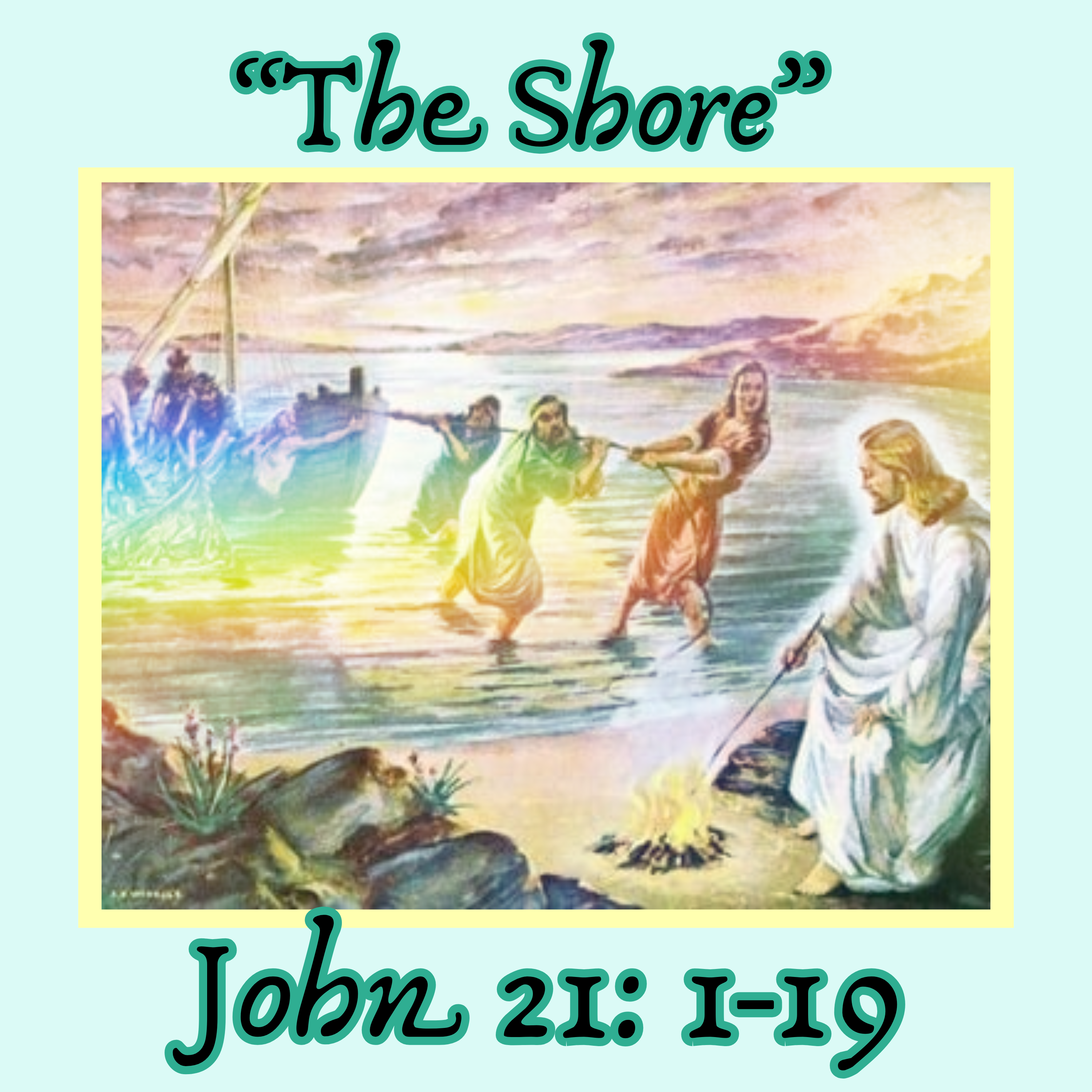
And that's really lovely for me and maybe that's not the case for you, but I want to set that picture before you as we read this passage of another one of these post resurrection sightings of Jesus. And I sort of think about this story as a story in three acts. So the first act is this. John, chapter 21, verses 1 through 3 says this. After these things, Jesus showed himself again to the disciples by the Sea of Tiberias.
And he showed himself in this way. Gathered there together were Simon Peter, Thomas called the twin Nathaniel of Cana in Galilee, the sons of Zebedee, and two others of his disciples.
Simon Peter said to them, I'm going fishing.
And they said to him, we'll go with you.
And they went out and they got into the boat. But that night they caught nothing. Now I want to like just remind you of what's going on here. These are men who, along with Mary Magdalene and other women, had been following Jesus as disciples for three and a half years. They were called by Christ into what they thought was a revolutionary movement that was going to overthrow the rule of the Roman Empire. And they spent three and a half years giving their hopes and their dreams and their blood and their sweat and their tears every single day to that cause. And then Jesus was arrested, convicted and crucified in front of them. All of their dreams, their hopes were completely shattered.
And in the wake of this, they do what they know how to do. The only thing they know how to do. They go back to fishing.
Because that's what they did before.
It's the only life they understood.
And so here you have Peter and the disciples sitting around on the shore of the Sea of Tiberias after losing literally everything, utterly failing at what they had hoped to do.
And Peter says, you know what, I'm going fishing.
And they're like, yeah, okay, I guess we should too.
But they even fail at that.
The thing that they did for a living, the thing that they were trained to do, raised to do, the thing that of all the things, the thing they felt competent to do, they went out, they pushed off the shore, they spent all night and didn't catch anything.
This is like adding insult to injury.
They've reached the complete and total peak of their frustration.
Signed up to be revolutionaries in a movement to overthrow their oppressors that utterly crashes and burns. And now they can't even catch fish.
But verse four, just after daybreak, Jesus stood on the beach.
But the disciples did not know that it was Jesus. And Jesus said to them, children, you have no fish, have you?
And they answered him, no. And he said to them, cast the net to the right side of the boat and you'll find some.
So they cast it. And now they were able to haul or not able to haul it in because there were so many fish.
And that disciple whom Jesus loved said to Peter, it is the Lord. Now maybe you know this just a little aside.
In the Gospel of John, anytime it says that disciple whom Jesus loved, John's talking about himself.
I mean, if you wrote the book, you could refer to yourself any way you wanted to.
But John, who the Gospels do depict as having an especially close relationship to Jesus, seems to be the first to recognize that it's Jesus. And this is where one of the things I love about these stories is. There is this recurring theme of the post resurrection Jesus appearing to people that he spent every single day with for years. And they do not recognize him.
They don't understand that it's Him. We talked about this last week in the story of Mary Magdalene, but I just want you to notice the same thing is happening again. They don't recognize Jesus until there is this moment of revelation, this moment of understanding. And in this case, it dawns upon John, who says it is the Lord.
And when Simon Peter heard that it was the Lord, he put on some clothes for he was naked. Don't get hung up on that. I don't know why he was naked.
Some of your translations say he was just wearing his, like, you know, underwear.
Whatever the case, Peter was a bit weird. But he's also weird because, like, he puts clothes on to jump into the water.
I'm sure there's some cultural like, context that would help us understand this, but I don't think it's material to the story.
When Simon Peter heard that it was the Lord, he put on some clothes, for he was naked. And he jumped into the sea.
But the other disciples came in the boat dragging the net full of fish, for they were not far from the land, only about 100 years off.
The moment of revelation that we talked about last week happens, I think, in this passage when it occurs probably to John first.
There's something very familiar about this story.
Here we are at the end of Jesus's ministry, after he has been crucified, after he's been resurrected, after he spent three and a half years with these disciples, and they go out into a boat. They spend all night fishing. They catch nothing. They're completely frustrated. And Jesus shows up and suddenly says, hey, cast your net on the right side of the boat. And there is this massive hall of fish.
This is exactly what happened in Luke chapter five, when the disciples were first called to follow Jesus in Luke chapter five. Just to remind you, the disciples are minding their own business.
They're fishing, right? They're struggling to catch anything. They don't catch anything all night long. They come into the shore to be done for the night. And here's this wandering Jewish rabbi who has a crowd of people following him, and he says, hey, the crowd's too big. Can I get into your boat and push off the shore? So he has, like, a place from which to address the crowd. And they're like, yeah, sure, whatever. He gives his speech, the crowd disperses, and Jesus turns to them and says, hey, let's go fishing.
And they're like, dude, we've been fishing all night. There's no fish to catch. He's like, meh, trust me.
They go out, he says, cast your net on this side of the boat. They do. They pull in an enormous catch of fish.
And this is when he says to them, hey, follow me, and I will make you fishers of people.
This is the beginning of the ministry here. At the end of the ministry, the same thing happens. And John is like, wait a minute.
That's Jesus.
All of this has happened before.
This, I think, is supremely important for understanding this story.
Ecclesiastes, chapter 1, verse 9. Everybody loves this passage. You've probably quoted it before.
What has been will be again.
What has been done will be done.
There is nothing new under the sun.
The preacher of Ecclesiastes, Qohelet, is trying to tap into this idea that whatever it is that you experience, the ups, the downs, the highs, the lows, the successes, the failures, all of this is history repeating itself like a big cycle over and over again. For the preacher of Ecclesiastes, like the vastness of the ocean that goes on forever. This makes him feel small in the best possible way.
It comforts him to know that the injustices and failures of life are just a part of the cycle that we are a part of as humans.
Or if you're a Battlestar Galactica fan, the reboot from 2004 to 2009. The entire show was premised on this. When they quote, all of this has happened before, and all of this will happen again. Do you like how I tied that in? Did you watch Battlestar Galactica?
I do. Yeah, I knew you did, but I gotta look for Molly.
All of this has happened before, and all of this will happen again.
The cycle of injustice, the cycle of suffering and failure, the cycles of pain that then are followed surprisingly, amazingly, unpredictably by waves of grace that seem brand new.
No matter how many times waves of grace roll up onto our shore, we're surprised every time.
And that tension between the waves of grace and the cycles of failure and frustration together, if we can see it, if we can recognize it, become healing to us.
I love how this story continues because I think it illustrates what that healing looks like in really tangible ways. Verse 9 says this. When they had gone ashore, they saw a charcoal fire there with fish on it and bread.
And Jesus said to them, bring some of the fish that you've caught.
So Simon Peter went aboard and hauled the net ashore full of large fish, 153 of them.
And though there were so many, the net was torn.
And Jesus said to them, come and have breakfast. This, by the way, is my love language.
Come and have breakfast.
Come and eat with us.
Come and enjoy the, not just the nourishment, but the goodness of the world that we live in. Let's enjoy it together.
Now. None of the disciples dared ask him, who are you?
Because they knew it was the Lord Jesus came and took the bread and gave it to them and did the same thing with the fish.
This was now the third time that Jesus appeared to the disciples after he was raised from them.
There is an entire sermon in this little like one off bit of the story where Jesus serves them a meal from the fish that they themselves caught.
I don't have time to pull on that thread this morning, but it's kind of an amazing little aside to the story that the way they experience the resurrection of Christ is that he cooks the fish that they bought.
But altogether, I think this story is one of the best depictions of resurrection we have in scripture.
Because first there is this amazing element of surprise when they Realize that this stranger on the shore is Jesus. And I think that is exactly what we talk about when we talk about God. I know that in religious settings like this, or we generally try to name God or brand God in some way that makes him a part of our exclusive tribe or tradition or denomination. But I think that when you and I talk about God, when we speak to each other about the miracles that have happened in our lives, the waves of grace that have surprised us, when we have been in a season of failure or frustration or pain or suffering, I think the thing that we talk about when we talk about God is the surprise grace.
And I think that surprise of grace, those waves that roll up on our shore that seem new to us every single time, no matter how many times it's happened. I think that comes in every conceivable way.
It comes to us when people, in an unexpected way, show us a kindness exactly when we need comes to us, when we are surprised to discover that there is a community of people who will love us and accept us in spite of our identity. It comes to us when we discover that our children are the very best reflection of us and also the worst.
There it is.
And somehow that's good.
I also love this story because alongside the surprise, there's the recognition that that's what it is like. John, we learn to recognize our encounters with the resurrected Christ in our day by learning to recognize the patterns of grace that wash up on our shores over and over again. And that is how we learn to live in a place of resurrection, to appropriate this idea that no matter how big, no matter how vast, no matter how endless or eternal God is, that there is grace and sustenance every day that surprises us. And when we learn to recognize it, when we learn to look and say, there it is, it's the Lord, then we enter into a place of abundance. And I'm not going to get weird. I'm not going to tell you that if you recognize this, that checks are going to start showing up in your mailbox. We're not that kind of church.
But there is an abundance of grace that we access when we learn that we already have everything we ever needed because God created us along with everything else.
And that, I think, is the story of how Christ makes breakfast with the fish that the disciples themselves caught.
I think you know this story.
I think you've lived this story of surprise and recognition and abundance. Because everybody, I think, has lived this story over and over and over again. It's both the oldest story in human history and yet at the same time, new every time we experience it.
And that, I think, is what we're learning how to do when we are following in the tradition of Jesus. We're learning to recognize that that story is happening all the time, all around us, in every relationship. If, like John, we just have eyes to see it.
I love the way that the Argentinian poet Jorge Luis Borges took that Ecclesiastes passage and he flips it upside down. Here's what he says.
There's nothing old under the sun.
Everything happens for the first time, but in an eternal fashion.
May you and I experience the resurrection every day for the first time by the grace of God.
Amen.
Would you pray with me?
God, we thank you again for today and for this opportunity we have to experience your grace in new and good and surprising ways. It's our prayer today that you would teach us how to have eyes like John, to recognize how your resurrection is at work in our lives, in our relationships, in our workplaces, in our businesses, at our schools, in our churches.
We ask God that you would help us to see how these waves of grace, how this old story of resurrection is at work not just for us personally, but also for our whole communities.
Also for our politics, also for history and even for the cosmos, for the universe. How you are always at all times making all things new.
We pray that you would help us to have eyes to see that in Jesus name.
Amen.
[00:28:07] Speaker B: Thank you for joining us for this Sunday teaching, no matter when or where you're tuning in.
To learn more about our community or to support the work we do, Visit
[email protected] We hope to see you again soon.