[00:00:00] Speaker A: Foreign.
[00:00:08] Speaker B: Welcome to the collective table where we celebrate the intersections of Jesus, justice and joy.
This podcast is brought to you by Oceanside Sanctuary Church. Each week we bring our listeners a recording of our weekly Sunday teaching at Oceanside Sanctuary, which ties scripture into the larger conversations happening in our community, congregation, and even the podcast. So we're glad your here and thanks for listening.
[00:00:40] Speaker A: Happy Palm Sunday.
I. I cut these this morning, so they're nice and fresh right up from the parking lot. They were hanging over Brett's car. I thought, perfect.
Those are the ones to cut to prune.
So of course we are going to be talking about the triumphal entry do every year for Palm Sunday. But before we do that, I have a little exercise I want us to try. So I have a graphic.
All right, so by a raise of hands, this is called the coffer illusion. Can you tell me if you see rectangles? Raise your hand if you see rectangles.
Okay.
Raise your hand if you see circles.
Okay.
Two people. Raise your hands if you can see three people, both rectangles and circles. Raise your hand if you can't see circles at all.
Uh huh. For those that are listening to this as a podcast, really, hardly anybody can see the circles. Okay, so are you ready?
Let's look at another graphic here.
So if I circle those and you kind of look in between.
Okay. Oh, okay.
Now raise your hand and tell me if you can see the circles.
Okay.
So this illusion has been around, I think, since the 1960s.
But recently some researchers from the London School School of Economics used this illusion in a new way.
And the way in which they use it was they asked people from the UK and US what they saw first.
And you all did exactly what the experiment said, because I would assume that most of you are from the US Is that they saw rectangles. And some of you are still going, I'm not seeing the circles.
And the reason that they believe this is because they also showed this picture to Namibians.
And guess what they saw circles. They couldn't see rectangles. They were doing what some of you are doing now. Where are the rectangles? All I see is circles.
It took me like 10 minutes.
About 20% of population on either side could never see the other shape, even when it was pointed out. 20% of the population could only see circles or only see rectangles.
What they are hypothesizing is that if you live in a place that has a lot of buildings, a lot of straight lines, that you have been trained, your brain has been trained to Recognize right angles, rectangles.
If you live in a place that doesn't have a lot of straight lines and edges, more natural landscape. And that's mainly what you see.
Your mind has been trained to see circles, therefore it is hard to see the rectangles.
Fascinating, right?
Okay. So, like, what does this have to do with the story? Well, we'll see if I can pull it all together here.
So maybe we should pray on that.
Lord God, Hosanna. Hosanna in the highest.
We call out to you for so many things.
Help us this morning to take the story that so many of us have heard over and over again and let it rest in our hearts.
In Jesus name.
Amen.
Okay, so the story is in a couple of books, but we are going to be in Matthew 21, verses 1 through 11. If you have your Bibles, you can follow along or even with glasses if it's hard to see. We. You will also be able to see this on the screen here.
And here we go.
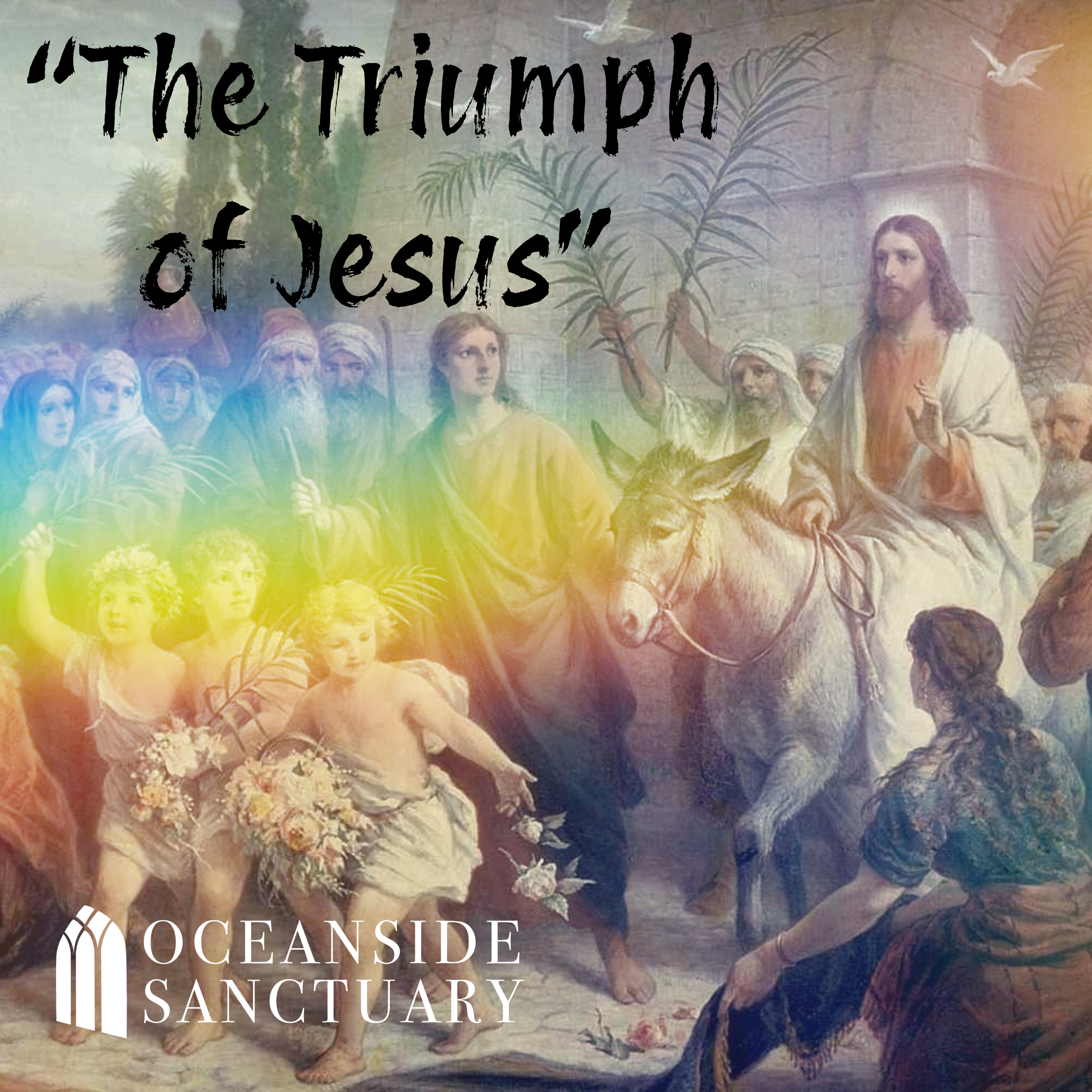
When they had come near Jerusalem and had reached Bethphage at the Mount of Olives, Jesus sent two disciples saying to them, go into the village ahead of you, and immediately you will find a donkey tied and a colt with her. A colt is a baby donkey, by the way.
Untie them and bring them to me.
If anyone says anything to you, just say this. The Lord needs them and he will send them immediately.
This took place to fulfill what had been spoken through the prophet.
Tell the daughter of Zion, look, your king is coming to you. Humble and mounted on a donkey and a colt, the foal of a donkey.
The disciples went and did as Jesus directed them.
They brought the donkey and the colt and put their cloaks on them, and he sat on them. And a very large crowd spread their cloaks on the road.
And others cut branches from trees and spread them on the road. The crowds that went ahead of him and followed were shouting, hosanna to the Son of David. Blessed is the one who comes in the name of the Lord. Hosanna in the highest heaven.
When he entered Jerusalem, the whole city was in turmoil, asking, who is this?
The crowds were saying, this is the prophet Jesus from Nazareth of Galilee.
So here's our story.
If you're like me and you've been in church a while, then you would know that this is probably a story you've heard over and over again. We read it every Palm Sunday, most of us, and seems like a really sweet story. I was getting it in the little picture books when I was 5 or 6. My grandma would read the little picture books. There would be kind of a really, like, skinny white Jesus on a little tiny white donkey riding along the city.
You've got the crowds, they are jubilant.
They're waving palms, they're throwing down their coats.
So exciting, so fun. And I mean, you know, we know almost 2,000 years later, kind of what's going to happen.
It's not going to quite end the way that the people thought it might end, but we still every Sunday get our palm branches and wave them and kind of put ourselves in the story.
At least I do, imagining myself in the crowd. How would I be. Would I be so excited?
And so we do that and we sing these great songs.
Jason last week preached on the turning over the tables as another part of Jesus's life. And one of the things that, because we don't. You guys don't come to the temple every day for a lesson like we used to on this time of Lent and Easter. We kind of jumbled the stories around because the truth is, is that the turning of the tables actually happened after the parade, after this triumphal entry.
And what Jesus, or what Jason said, was that Jesus was turning over the tables kind of in this act of prophetic defiance, something that prophets had been doing for years and years before, which was to act out a parable.
And I think coming to this story today, we need to see very much the same thing.
Jesus was using a tactic when we might today call this tactic a political theater.
And maybe that sits a little funny with you because we've been told that political theater can be disingenuous.
But at its best, it is an artistic expression to influence the public on social and government issues, to make the public think, to make them consider.
So instead of this kind of accidental, Jesus is doing his thing, going to.
Going to his Passover meal with his disciples. And all of a sudden he's like, there's a donkey and a colt. Let's have them.
This is a planned event.
This is a planned time that Jesus is fulfilling.
And I'd like you to also know, because this isn't often taught, because it's in historical texts outside of our biblical text, that there was very likely also another parade going on.
So on one end there was Jesus on a donkey, on the other end there was Pontius Pilate, the governor, who would always come into the city during Passover because there was a lot of unrest. People were getting very tired of the way they were being ruled by Rome.
And so Pontius Pilate would come in with his Own triumphal entry.
There are some scholars who, by the name of Borg and Crossan, who say it this way.
Two processions entered Jerusalem on a spring day in the year 30.
It was the beginning of the week of Passover, the most sacred week of the Jewish year.
One was a peasant procession, the other an imperial procession from the east. Jesus rode a donkey down the Mount of Olives, cheered by his followers.
Jesus was from the peasant village of Nazareth. His message was about the kingdom of God.
And his followers came from the peasant class on the opposite side of the city from the west.
Pontius Pilate, the Roman governor, entered Jerusalem at the head of a column of imperial cavalry and soldiers.
Jesus procession proclaimed the kingdom of God. Pilate proclaimed the power of empire.
The two processions embodied the central conflict of the week that led to the crucifixion of Christ.
Okay, so are you starting to see this one end of the city?
You have what the king of Rome did all the time, which was this triumphal entry.
After they had pillaged some area and taken it over, they would take all of the spoils. They'd take their soldiers, their chariots, their war horses, and they would come into the city saying, look how strong we are. Do not come against us.
We are amazing, right?
The trumpets, the lairs, all the things.
And then you have Jesus coming in on the other side on a little donkey.
People grabbing whatever they can grab off of a tree and waving it in the air, screaming, hosanna, Hosanna. In the highest.
I don't know. Could you imagine anything like that nowadays?
I know this is going to be hard for you to do, but I would like you to imagine maybe, I don't know, somewhere around October, a time when there was on one end of Oceanside, people waving these funny signs that they made saying silly things.
And on the other side, bombs going off.
And political people coming into Oceanside to show their prowess of how amazing they are. And whole areas of road being closed.
I don't know. Can you guys imagine?
Said in our text that the town was in turmoil.
Can you imagine feeling in turmoil in your.
All right, so back to our story.
You have people in Jerusalem watching this moment.
And I think just like our picture, people are seeing Jesus from all different sides.
They're having trouble seeing the whole picture.
You have Rome.
Rome sees this parade as a little threat.
There's more people than they would like to be there. But they know Passover at this time is a time of unrest. It's not just a time where people are in an upper Room eating.
It is actually a time of unrest.
But they have all of the war horses, all of the soldiers. It's kind of a little gnat.
It's a problem. They're going to watch it.
But really, what do they have then? You have the Sadducees. These are the folks that are the religious priests.
They're the elite. They're the ones that kind of have to keep one foot with the peasant class and one foot with the Roman Empire, because the Roman Empire is going to let them have their wealth, let them rule, right? So they're kind of the middleman.
They've got enough wealth, they're trying to hold on. They don't really want to see the peasant class rise up because that's pretty scary. They might lose their privilege of kind of right where they live, right? And then you have the crowd that's watching Jesus and crying out, save us.
Save us.
That's what's being called out, save us.
But they only see one side of the picture as well, because in their minds, being saved really means that Jesus will rise up an army, Jesus will take over Rome.
They will become power enough, powerful enough to make Jesus their next king, who will rule them more fairly.
And we know again that the story doesn't quite in that way. We know that they were not necessarily wrong for calling them him king, but they were misunderstanding what it meant to be the King of kings.
And it only took a week.
It only took a week until those same crowds were not yelling, save us, save us.
They were yelling, crucify him.
Crucify him.
Because they could only see one picture, one way of power.
So here we are telling, like this story that's been told over to us, many of us, over and over again.
It's easier in a way to tell that sanitized version of just an accidental Jesus on an accidental donkey that providentially fulfilled the prophet Zachariah's words and came humbly. And there were crowds of people.
There was no right, we're, we're Christians. We're not supposed to talk about politics.
There were no politics involved. This was just a sweet story that we can tell our three year olds, right?
That's kind of easier to digest.
Sarah's going, no, it's not.
I was worried I wouldn't have time. But I will say that there are tons of other political theater attempts that have been.
This very thing has happened for some reason, digging into this, I very much also dug into Rosa Parks, because she was one that had a group of people behind her helping her to sit on the bus.
Several black women had sat on the bus and been arrested before her.
She worked at the naacp. She had gone through training on how to resist. She had a huge group of people putting forth this political theater.
And since then, you know, we teach it like, she was a lowly seamstress who was just tired, Just so tired. And there wasn't room on the bus, so she sat in the front seat. It was so accidental.
Or if you're still on the side of white supremacy, which is in the heart of America, the very heart of America, you would say, well, that political theater isn't to be trusted.
So we change the story. We make little picture books that say, well, she was just a sweet old woman who was just tired. And, you know, we just leave it at that. She did something really courageous.
There was a whole community around her doing courageous things.
There was a whole community around Jesus doing courageous things.
They were shaking in their boots. They saw what was going down.
They were saying, like, jesus, tamp it down. We're scared.
We tell these same stories over and over again. We sanitize them because we don't want to see the whole picture.
We don't want to see the whole picture.
So it kind of doesn't matter whether we're a Roman leader, a United States leader, a Russian leader, or from a peasant class or somewhere in the middle.
We all don't know how to see the whole picture.
So when I ask, why haven't we changed?
Why are we still doing the same thing? If we've had these stories for 2000 years, why are we still closing down the I5 freeway?
And I really. I went to prayer. I went to prayer because I said, God, I don't know the point of telling the story again for another year.
And at risk of you all thinking I'm a nutcase, I heard God say back, I'm true north.
I am the picture.
I am the circles, the rectangles and the everything else.
The good news is that Jesus is the picture.
The bad news is that we are still obsessed with power and glitz and gold and wealth and houses and all the things. And that's. I mean, that drives us to make sure we have a roof over our head and food in our bellies.
I'm not saying we're terrible.
I'm saying that we always need to check ourselves.
So every year, we come to this story again and again and again because we need to remind ourselves that Jesus is the picture.
It's not the great signs we make because a week later, we might also be yelling, crucify him.
There's no patting ourselves on the back here.
It's not the power and privilege we have when we get to go do something someone else doesn't. And we think, well, if we just don't buy our coffee at Starbucks or wherever we spend, I call it four bucks or now five bucks instead, right? It's.
It's so. It's humanity who needs to see Jesus and the way of Jesus and the way of love as the picture.
So today, if you are going to wave your palm branches, I pray that we continue to go back to these stories because we're going to need to remind ourselves over and over again and thank the God in heaven that we are still the people that Jesus loves.
Amen.
All right, I'll pray while the band comes back up.
Christ of love. We are people who struggle to see you, to see who you are, to see what you're about. We're impatient. We're a fickle people. God, we are a fickle people.
Thank you that you love us anyway.
Thank you that you are the good news.
Train our eyes to see.
Train our thoughts to believe.
Train our actions to move so that we can participate in your kingdom right now.
In your name we pray. Amen.
[00:25:34] Speaker B: Thank you for joining us for this Sunday teaching, no matter when or where you're tuning in.
To learn more about our community or to support the work we do, Visit
[email protected] We hope to see you again soon.