Episode Transcript
[00:00:00] Speaker A: Foreign.
[00:00:08] Speaker B: Welcome to the collective table where we celebrate the intersections of Jesus, justice and joy.
This podcast is brought to you by Oceanside Sanctuary Church. Each week we bring our listeners a recording of our weekly Sunday teaching at Oceanside Sanctuary, which ties Scripture into the larger conversations happening in our community, congregation and even the podcast. So we're glad your here and thanks for listening.
[00:00:41] Speaker C: Hey, for those of you don't know, my name is Jason Coker, I'm one
[00:00:43] Speaker A: of the co lead pastors here and my job today is to bring you
[00:00:48] Speaker C: our lesson, which is part of a series that we have been doing leading up to Easter through the Lent period called Snapshots of Jesus. So we've been visiting different sort of stories of Jesus in the scriptures and trying to sort of take from that
[00:01:07] Speaker A: what it means for us to be Christians, to be followers of Jesus in
[00:01:12] Speaker C: this time and place. Today I want to share with you a passage From Matthew chapter 21, verses 12 through 13.
As usual, we will put the words up on the screen.
[00:01:24] Speaker A: If you have a Bible, you're welcome to turn there as well.
[00:01:27] Speaker C: This is a very familiar passage, Matthew chapter 21. This is after Jesus's triumphal entry into Jerusalem in the Passover period leading up to his crucifixion.
And so this really is folded into that whole narrative about Passover and the crucifixion of Jesus. This is the same time that we have the Last Supper and lots of other familiar stories. But this particular story follows on the triumphal entry in verse 12.
[00:01:55] Speaker A: We pick it up and it says this.
[00:01:57] Speaker C: Then Jesus entered the temple and drove out all who were selling and buying in the temple.
And he overturned the tables of the
[00:02:06] Speaker A: money changers and the seats of those who sold doves.
[00:02:10] Speaker C: And he said to them, it is written, my house shall be called a house of prayer, but you are making
[00:02:16] Speaker A: it into a den of robbers.
And that's where we'll end here.
[00:02:22] Speaker C: But I want to read a little
[00:02:23] Speaker A: bit further just for the purposes of today, so feel free to just listen.
[00:02:28] Speaker C: In verse 14 says the blind and the lame came to him in the temple and he cured them.
But when the chief priests and the scribes saw that the amazing things that he did and heard the children crying out in the temple, hosanna to the
[00:02:42] Speaker A: Son of David, they became angry and
[00:02:45] Speaker C: said to him, do you hear what these are saying? And Jesus said to them, yes. Have you never read out of the
[00:02:51] Speaker A: mouths of infants and nursing babies, you have prepared praise for yourself.
Would you say a prayer with me as we jump into this
[00:03:01] Speaker C: God we thank you again for today, for this
[00:03:04] Speaker A: time in this space that we've dedicated, to listen, to sing, to pray, to recite familiar words, to worship and to be challenged and stretched, to grow and to become the kind of people who reflect your gospel in the world.
And as we dig deeper into this, I just want to say that this is a.
This is a challenging time for many of us to be Christians in the world, to be people who wear that name, and to be people who, despite all evidence to the contrary, believe that the gospel is good news.
So we ask that you would sharpen our sense of your good news. We pray this in Jesus name.
Amen. Okay, so I sort of collect religious jokes. I'm not like a joke telling pastor. Every now and then I tell a joke, right?
[00:04:14] Speaker C: Okay, I'm funny, but I don't like,
[00:04:17] Speaker A: tell jokes, jokes, you know.
But today I'm going to tell you a joke. All right?
[00:04:22] Speaker C: Maybe you've heard this joke, maybe you haven't. It's a very old joke.
[00:04:25] Speaker A: In fact, Sting, the former lead singer of the Police, references is it in one of his songs on 10 summoners tales. If you're old enough to remember that record, then you're probably a Gen Xer like me.
[00:04:37] Speaker C: But the joke goes something like, this guy dies and he wakes up and he finds himself standing before a giant ornate gate. And the gate opens and out comes the devil.
And the devil says, hey, listen, I got good news and I've got bad news.
The bad news is you're in hell.
[00:04:57] Speaker A: Sorry, that's just how this worked out.
[00:05:00] Speaker C: But the good news is you have choices. There are three rooms that you can
[00:05:04] Speaker A: choose from to spend all of eternity in which to be tormented.
[00:05:10] Speaker C: And the guy says, all right, this
[00:05:12] Speaker A: doesn't sound so great.
Show me around.
[00:05:15] Speaker C: So the devil takes him into hell and shows him door number one. He opens door number one, and inside door number one is a giant cavern full of people as far as the eye can see, standing on their heads
[00:05:26] Speaker A: on a hard wood floor.
Guy says, that doesn't look very good.
[00:05:32] Speaker C: What do you got behind door number two?
[00:05:35] Speaker A: Devil says, let me show you.
[00:05:37] Speaker C: He opens up door number two, and he sees giant cavern as far as the eye can see, people one after the other, standing on their heads on a metal floor.
[00:05:49] Speaker A: Guy says, metal, hardwood.
[00:05:52] Speaker C: I don't really like either of these choices.
Double says, all right, it's okay. I got one more choice for you. So he takes him, you know, down the hallway to door number three, Opens door number three, and giant cavern as far as the eye can see its people standing, drinking coffee, knee deep in poop.
[00:06:15] Speaker A: Guy goes, I mean, seems like it's
[00:06:19] Speaker C: better than standing on your head. And, I mean, I probably could get
[00:06:22] Speaker A: used to the smell.
[00:06:22] Speaker C: And I love coffee.
[00:06:24] Speaker A: I mean, I guess if I could drink coffee for all eternity, that wouldn't be so bad.
I'll go with door number three.
[00:06:30] Speaker C: Devil says, sounds great, come on in.
[00:06:32] Speaker A: Guy goes in, there's a little table, gets his coffee, fixes it, finds a
[00:06:36] Speaker C: little place, stands next to a few others, starts drinking.
[00:06:39] Speaker A: It suddenly hears the devil's voice come over the loudspeaker.
[00:06:43] Speaker C: Okay, number three breaks over.
[00:06:46] Speaker A: Time to start standing on your heads,
[00:06:54] Speaker C: Guys. Didn't see that coming.
I love religious jokes because I feel like the good ones critique religion.
They critique all of our sort of tropes and stereotypes and reveal something that
[00:07:11] Speaker A: I think is true not only about religion, but about our relationship to it.
[00:07:16] Speaker C: And what I love about this particular joke is that it is about the
[00:07:22] Speaker A: truth, that all good news also comes with bad news.
[00:07:27] Speaker C: And I think this is something we struggle with. We struggle with the idea that all of life, the most consequential decisions in life, the most important decisions in life,
[00:07:37] Speaker A: the most difficult decisions in life, are always good news, bad news decisions.
[00:07:45] Speaker C: There really is no such thing as
[00:07:47] Speaker A: a win win in life's most important issues.
When you make a choice for one thing, you are choosing against another.
And this is also how the gospel works.
[00:08:01] Speaker C: And maybe that sits very uncomfortably with you.
[00:08:04] Speaker A: And so that's okay. But I'm going to spend the next 45 minutes, just kidding, the next 20 minutes trying to convince you to agree with me.
[00:08:14] Speaker C: First, a little bit of context. Jesus, before he cleanses the temple, before he shows up during Passover, and disappointment disrupts business as usual. It's really important for you to know, if you don't have sort of a background in Judaism, that for the ancient Near Eastern Jews, the temple was the center of their existence. It was the center of not only their religious life, but it was the center of their political and their economic life as well. And of course, they also were a diasporic community, meaning that even in the first century, Jewish people were dispersed all over the known world. At that time, that is, they lived not just in Israel, but they lived everywhere in and outside of the Roman Empire and often were a part of other ethnic groups. So they may have been Jewish, but they spoke a different language than Hebrew. They had a different ethnic background than just Israeli.
And yet for important festivals like the Passover, they would pilgrim all the way
[00:09:19] Speaker A: back to the temple in Israel in order to participate in this incredibly important and significant event.
[00:09:29] Speaker C: And when that happened, there was a problem. And the problem was, is people traveling for days or weeks or perhaps even months to practice Passover. And when they get there, their job during Passover or other religious events is to offer sacrifices, blood sacrifices in the temple, according to Hebrew scripture, that would help cover or cleanse their transgressions up to that point.
And this is a problem if you're a pilgrim, because you don't want to, like, bring the doves with you on your pilgrimage for weeks or months.
[00:10:02] Speaker A: That's very inconvenient.
[00:10:04] Speaker C: And so instead there arose a kind of little cottage industry of selling doves at the temple so that pilgrims coming could purchase what they needed in order
[00:10:15] Speaker A: to make their sacrifices.
[00:10:17] Speaker C: But that created another problem, because if they were coming from far away, they
[00:10:21] Speaker A: would have a different kind of currency.
[00:10:25] Speaker C: Just like, you know, if you travel today to Mexico or Brazil or, you know, to France, they expect you to use the currency that is a part of their culture. So they had the same problem.
[00:10:36] Speaker A: So they would arrive and they would
[00:10:38] Speaker C: need to change their money out.
And just like today, there are people
[00:10:43] Speaker A: who build businesses in order to earn
[00:10:46] Speaker C: a profit off of you exchanging your
[00:10:48] Speaker A: money based on, like, exchange rates.
[00:10:52] Speaker C: Well, this became a huge problem because most people at this time, not unlike today, were relatively poor.
And so when they arrived at the temple, they would arrive and be taken
[00:11:06] Speaker A: advantage of by the money changers, the
[00:11:09] Speaker C: people who would exchange their money and
[00:11:11] Speaker A: charge them exorbitant rates in order to do it.
[00:11:15] Speaker C: What happened essentially there is that religion, for the Jews in the ancient near east and for the people, especially in Jesus day, religion had become a place of profit rather than a place of healing.
And I don't know if that has any resonance with you.
Most of my closest friends in my
[00:11:39] Speaker A: neighborhood are not churchgoing people. They're amazing people that we have met,
[00:11:44] Speaker C: raising our kids with our kids, going
[00:11:45] Speaker A: to the same, you know, elementary schools,
[00:11:47] Speaker C: and so we go to the same neighborhood parties. And most of them are not church going folks.
[00:11:51] Speaker A: Most of them would rather not tell
[00:11:52] Speaker C: you what they believe about God.
[00:11:53] Speaker A: But I'll just tell you, most of them don't believe in God in any sense, like a sort of classical theist.
[00:11:59] Speaker C: But they're all very quick to remind Janelle and I that we must be
[00:12:03] Speaker A: doing this professional religion thing wrong because we're too poor.
When they turn on the TV and they see preachers on tv, they, you know, have much more Expensive sneakers and
[00:12:16] Speaker C: drive much nicer cars and live in
[00:12:18] Speaker A: much bigger houses and oftentimes have their own private, private jets. I'm still holding out for the private jets.
[00:12:26] Speaker C: Thanks.
So this problem of religion becoming a
[00:12:32] Speaker A: place of profit rather than a place
[00:12:34] Speaker C: of healing is a very old problem.
[00:12:37] Speaker A: It's nothing new.
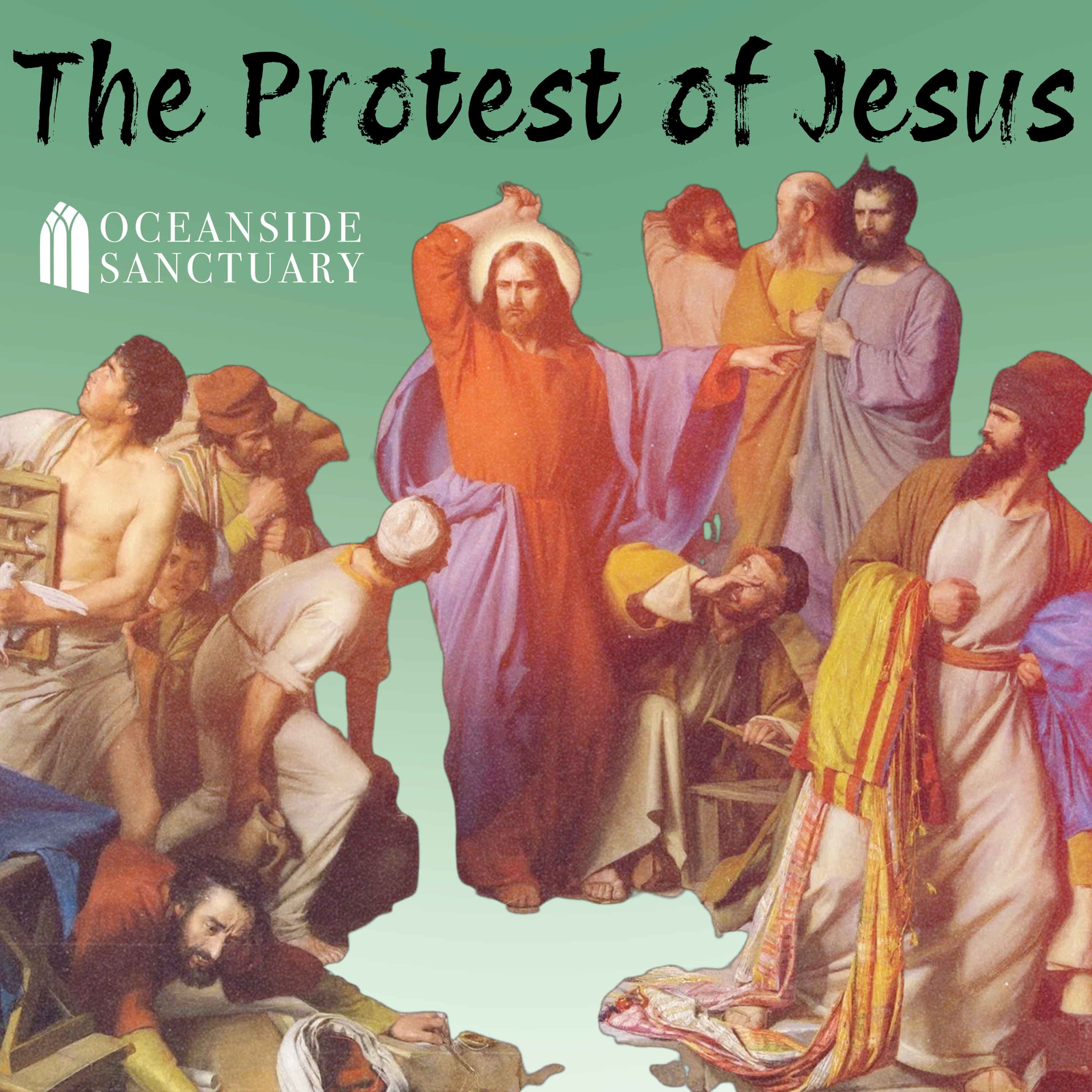
[00:12:40] Speaker C: Jesus walks into the temple where people are being taken advantage of, where they are being economically exploited, and he throws a massive fit.
He disrupts the entire business. He flips over the tables. In another passage in John where John tells us this story, John says, Jesus doesn't just show up and, like, throw a fit and turn over all the tables and disrupt the businesses. It says, first, Jesus sits down and he braids himself a leather whip out of three cords.
Jesus is so angry about this and so intentional about this that he fashions for himself something with which he can
[00:13:25] Speaker A: whip the oppressors in the temple.
That's how serious he is about it.
[00:13:33] Speaker C: And I think it's easy for us to look, especially in a church like this, it's easy for us to look at this and say, this is Jesus engaging in a kind of political protest. And I think that's true. Jesus is engaging in political protest. Jesus is disrupting the political status quo. He's also disrupting the exploitation that's happening here. And in that sense, the very best followers of Jesus certainly wouldn't be afraid to pick up a picket sign and protest injustice wherever they see it.
[00:14:04] Speaker A: Thank you very much to those of you who help organize the no Kings rallies.
Seriously, thank you.
Yes,
[00:14:16] Speaker C: I hope you'll be protesting whatever
[00:14:18] Speaker A: egregious things the next administration does, too,
[00:14:23] Speaker C: because this is not the end
[00:14:26] Speaker A: of the injustices that will be committed on the part of the United States of America.
So, yes, protest.
[00:14:36] Speaker C: But it occurs to me that Jesus
[00:14:38] Speaker A: is tapping into a very Jewish tradition. It's the tradition of prophetic acts.
[00:14:44] Speaker C: And Old Testament prophets did all kinds of weird and bizarre and crazy things
[00:14:48] Speaker A: in order to make a point about
[00:14:51] Speaker C: what is good and what is not. So In Isaiah, chapter 20, Isaiah walks naked for three years in order to make a point that God told him to make to the powers that be, the rulers that be in that Nation. Ezekiel, chapter four tells us that Ezekiel laid on his side for 390 days and ate food that was cooked over
[00:15:17] Speaker A: a fire that burned dung.
[00:15:22] Speaker C: All of this to make a kind of theatrical, dramatic point that God was displeased with God's own people for not doing what they were called to do, which is to do justice and love, mercy and to walk humbly with God. To quote Micah4.8, that is the vocation of God's people. And when they're not doing what God has called them to do, the prophets come out of the wilderness and they do weird, bizarre things in order to
[00:15:50] Speaker A: get you to pay attention to the fact that you're not living up to your calling. If you are an ancient Jewish, Jesus is tapping into this same tradition. Jesus doesn't roll up on the temple and suddenly, like, have a suburban snap and lose his mind and, you know,
[00:16:08] Speaker C: start overthrowing everything in the temple. No, Jesus knows exactly what he's doing. And the first clue is that he quotes two bizarre Old Testament prophets.
When Jesus says in verse 13, he said to them, it's written, my house shall be called a house of prayer, but you are making it a den of rob. Jesus is like a weaver taking two
[00:16:32] Speaker A: prophetic threads and weaving them together in order to bring his judgment to the religious elites who are running the temple operation. Isaiah chapter 56, verse 7 says, A
[00:16:45] Speaker C: house of prayer for all people is what the temple of God will be.
[00:16:49] Speaker A: We're going to get back to that passage in just a moment. But Jesus picks up that phrase from
[00:16:55] Speaker C: Isaiah 56 very intentionally, and he weaves it together with Jeremiah 7:11, which says, had this house become a den of robbers? Jesus is asking a question and answering
[00:17:06] Speaker A: it with two prophetic passages.
And in doing that, he's bringing very bad news to the people who run the show.
[00:17:19] Speaker C: And this is where I think this
[00:17:20] Speaker A: gets a little bit challenging for us,
[00:17:23] Speaker C: because what prophets tend to do is
[00:17:25] Speaker A: prophets tend to bring bad news.
[00:17:29] Speaker C: They come out of the wilderness, they do bizarre things, they raise their voices, they call down fire from heaven because they have bad news to bring.
But we tend to associate Jesus with good news.
I mean, the word gospel literally means good news. Beautiful are the feet of those who bring good news, or glad tidings, depending on the interpretation of that passage. Jesus is all about the gospel or good news, or so we think. Jesus is all about bringing good news to the poor, to the oppressed, to the blind, to the lame. That's Luke chapter four.
Jesus is all about healing the sick. We see it in this very passage. So again, we tend to think about Jesus bringing good news.
We think about passages like the Beatitudes in Luke chapter four, where Jesus says, blessed are you who are poor, for yours is the kingdom of God. Blessed are you who are hungry, for you will be filled. Blessed are you who weep, for you will laugh good news.
But we forget the second half of Jesus. Beatitudes in Luke chapter 4 says, Woe to you who are rich, for you
[00:18:46] Speaker A: have received your consolation.
[00:18:49] Speaker C: Woe to you who are full now, for you will be hungry.
Woe to you who are laughing now,
[00:18:57] Speaker A: for you will mourn and weep.
[00:19:06] Speaker C: There is no version of the good
[00:19:08] Speaker A: news of God that isn't bad news for somebody.
[00:19:14] Speaker C: If the good news of Jesus is that the poor will be lifted up, that they'll be liberated from their poverty,
[00:19:20] Speaker A: then that's bad news for whoever is getting rich off of exploiting them.
[00:19:26] Speaker C: If the good news is good news for those who have been enslaved by systemic racism or bias and Jesus good news is that they are liberated from that kind of oppression, then it's bad news for the people who have benefited from that oppression. And I think as Americans, we really have a hard time with this idea that anybody benefits from, from bad things.
But this is the worldview of Jesus, that people who are exploited exist because there are exploiters.
And so to bring the good news of liberation to the oppressed is to
[00:20:12] Speaker A: bring bad news to the oppressors.
[00:20:15] Speaker C: This is why the prophets are troublemakers.
[00:20:17] Speaker A: It's why they're constantly killed.
[00:20:19] Speaker C: It's why the prophets like, it's why the prophets are always the victims of wildly creative ways of torturing and killing people.
Because what they're constantly doing is bringing bad news to the people who are in power.
And people who are in power are
[00:20:36] Speaker A: tired of hearing it, and so their wrath is poured out on the people who bring them bad news.
Jesus is bringing
[00:20:46] Speaker C: the people who profit
[00:20:48] Speaker A: off of religion very bad news.
And then he demonstrates for everybody to
[00:20:58] Speaker C: see what the temple should exist for
[00:21:03] Speaker A: when he heals all that come to him.
[00:21:07] Speaker C: He says, no, you guys are doing this all wrong. This temple exists to be a place
[00:21:13] Speaker A: of healing, a place of goodness for everybody. And you have turned it into a den of robbers.
[00:21:21] Speaker C: So he, he cleanses the temple, he drives out the people who are profiteering off of religion, and then he welcomes the sick and he heals them. And in doing that, he demonstrates that that is what it's for.
Judaism is for the healing of people who are sick. It is for the liberation of the oppressed.
But it is so easy to take those structures, those religious forms and structures,
[00:21:51] Speaker A: and turn them into ways of making a profit, ways of oppressing, ways of harming.
And so there is no way to bring good news to those who suffer without bringing a word of bad news to those who are causing their suffering.
[00:22:17] Speaker C: Okay, at the risk of contradicting myself, I'LL say this, the whole good news,
[00:22:22] Speaker A: bad news thing is just a short sighted way of receiving the gospel of liberation.
And here's where I think we can zoom out and Gabe gain a more wisdom oriented perspective going back to Isaiah, chapter 56. This is the other passage that Jesus quotes.
Isaiah, chapter 56 is where Jesus refers to the temple being a house of prayer for all people.
Here's what's going on in this passage. In Isaiah 56.
If you back up and you read the whole thing, what's happening is that Isaiah is prophesying something kind of amazing.
[00:23:08] Speaker C: He's saying, hey, hey, listen, despite the way that you all have screwed up
[00:23:11] Speaker A: God's intentions for being a people who exist for the goodness of others, despite
[00:23:16] Speaker C: that, despite the fact that, you know, those who are in power have taken
[00:23:19] Speaker A: it and corrupted it and turned it
[00:23:21] Speaker C: into something that, you know, serves their own interests and their own gain, despite all of that, God's intention is that this thing would exist for the goodness of everyone, including, including those who are not Jewish.
[00:23:40] Speaker A: And so in verse seven, Isaiah says this, or excuse me, verse six, Isaiah, chapter 56, verse six says this.
And the foreigners who join themselves to
[00:23:52] Speaker C: the Lord to minister to him, to love the name of the Lord, and to be his servants, all who keep the Sabbath and do not profane it and hold fast to my covenant.
In other words, all of those, even those who are not Israelites, even those who are not Jewish, even those who have not converted to this official religion, all of those who obey the goodness of God, people who treat people well, people who liberate the oppressed, people who act justly and love mercy. Those people.
Verse 7, I will bring to my holy mountain and make them joyful in my house of prayer.
Their offerings and sacrifices will be accepted on my altar.
And my house shall be called a house of prayer for all people.
All people there is ethnos, right?
[00:24:51] Speaker A: Ethnic groups.
[00:24:54] Speaker C: In other words, Isaiah has the nerve, he has like the gall to say that the goodness of God isn't just for Israelites, it's not just for those who are Jewish, but rather the goodness, the righteousness, the peace of God is for everybody.
And that the temple exists to be
[00:25:11] Speaker A: a place of goodness and righteousness and peace for everyone.
This is why Jesus is so upset.
[00:25:22] Speaker C: Because their vision for the goodness of
[00:25:25] Speaker A: their faith, their religion is far too small.
[00:25:30] Speaker C: He's saying to them, you've missed this amazing opportunity to be a place where
[00:25:34] Speaker A: all people come from all over the world to learn goodness and righteousness and justice and peace. And you have turned it into a business.
And exploited people in the process.
The point is this.
Jesus's good news for those who are being crushed, for those who are suffering, is bad news for the people who are doing the crushing.
[00:26:03] Speaker C: But in the long run, it's good news for them too, Because oppressors are
[00:26:16] Speaker A: oppressed by their own machinery.
People who do harm in order to gain profit are themselves harmed in the process.
Every system of oppression doesn't just dehumanize the victims of it. It dehumanizes those who oper those systems of oppression too.
[00:26:46] Speaker C: So in this sense, if you take
[00:26:48] Speaker A: a longer view, if you recognize that the reason it seems like bad news for me as a rich, wealthy, privileged person, the reason it seems like bad news to me is because I lose my toys.
[00:27:06] Speaker C: But what I fail to see, what I'm blind to see, is that that
[00:27:09] Speaker A: very system of profiteering that I have created is destroying me.
And so your liberation is my liberation.
And this is where what seems like bad news can become good news.
When those who do the harm, when those who do the hurt, when those who are doing the oppressing let go and discover that there is liberation for them alongside the poor, the weak, the blind, the captives.
I think what we struggle with as people who hear these passages where Jesus is bringing good news and then bad news alongside of it, I think what we struggle with is that we have a tendency to want to figure out which team we're on.
[00:28:27] Speaker C: Is Jesus's gospel good news for me,
[00:28:29] Speaker A: or is it bad news for me?
I think that freedom is found when we understand that all of our liberation is bound up in each other's liberation.
And in that sense, what seems like a bitter pill becomes a medicine.
What seems like bad news becomes the gospel.
And so I think the.
[00:28:59] Speaker C: The task ahead of us is to
[00:29:01] Speaker A: figure out how to have that wisdom, how to recognize when we're being harmed and how to recognize when we're doing the harming.
And there's no easy, quick answer to that.
We have to be willing to wrestle with it.
And that wrestling is also the gospel.
Amen.
Would you pray with me? God, we thank you again for today and for this opportunity for us to
[00:29:33] Speaker C: hear these words and be stretched by them.
We thank you for the opportunity to
[00:29:41] Speaker A: figure out how what you're calling us to, through the gospel, can teach us how to be in the world in a way that extends goodness and healing and righteousness to others.
No matter where we are located, no matter what privilege we might have, no matter what our social location might be.
How is it that we apply the Gospel so that it is good news first for those who suffer and then for all of us?
Help us to have eyes to see that in Jesus name, amen.
[00:30:33] Speaker B: Thank you for joining us for this Sunday teaching, no matter when or where you're tuning in.
To learn more about our community or to support the work we do, Visit us@oceansidesanctuary.
We hope to see you again soon.