[00:00:00] Speaker A: Foreign.
[00:00:08] Speaker B: Welcome to the collective table where we celebrate the intersections of Jesus, justice and joy.
This podcast is brought to you by Oceanside Sanctuary Church. Each week we bring our listeners a recording of our weekly Sunday teaching at Oceanside Sanctuary, which ties Scripture into the larger conversations happening in our community, congregation and even the podcast. So we're glad your here and thanks for listening.
[00:00:38] Speaker A: Good morning. How are you guys? Good. Yeah. For those of you who don't know, my name is Jason Coker. I'm one of the co lead ministers here.
So I want to talk to you today about Acts Chapter two. We did start a new teaching series last week called the Spirit of Action.
Today we're going to read from Acts, chapter 2, verses 42 to 47. If you have your Bible, you can turn there. If you don't, we will put the words up on the screen as always. Acts chapter 2, verse 42. It's a little tricky because if in your Bible there are paragraph breaks like there are in mine, the paragraph, the new paragraph begins in verse 43, but we're going to back up to verse 42, which is the last passage in the previous paragraph. It says this.
They being the disciples, devoted themselves to the apostles teaching and fellowship and to the breaking of bread. And the prayers and awe came upon everyone because many wonders and signs were being done by the apostles and all who believed were together and had all things in common.
They would sell their possessions and goods and distribute the proceeds to all as any had need.
And day by day, as they spent much time together in the temple, they broke bread at home and ate their food with glad and generous hearts, praising God and having the goodwill of all the people. And day by day, the Lord added to their number those who were being saved.
Now this current teaching series is all about the Holy Spirit. And so we're going to be moving through the Book of Acts and touching on those passages that highlight the actions that we see the Spirit of God taking. And so this is no exception. I want to share with you some of the things that I'm noticing that I think the Spirit of God is doing in this passage. And hopefully the idea there is we would have some sense of how to recognize that in our own lives. Before we jump in, would you just say a prayer with me?
God, we thank youk for today and for this opportunity for us to gather, to lift our voices together, to sing of your goodness and your love, to pray prayers together, to attend to these passages of Scripture together.
It's no small thing, God, that a group of people would gather in one place and give our attention to what is good and righteous and true.
And we ask today that you would illuminate this passage so that we would have a clearer sense of what is good and righteous and true, that we would recognize the work of your spirit, and that we'd be able to follow after you wherever you go. We pray all this in Jesus name. Amen.
Okay, a bit of background. So if you were here last week or if you listened or watched online last week, you know that we started out at the beginning of Acts chapter two, which is, I said, sort of the birth of the church, right? It's when the whole Holy Spirit is depicted as being poured out on those disciples and the larger community that had gathered in the upper room after Jesus's ascension. So Jesus has gone, he has ascended into heaven, whatever that means. We've talked about that a couple weeks ago.
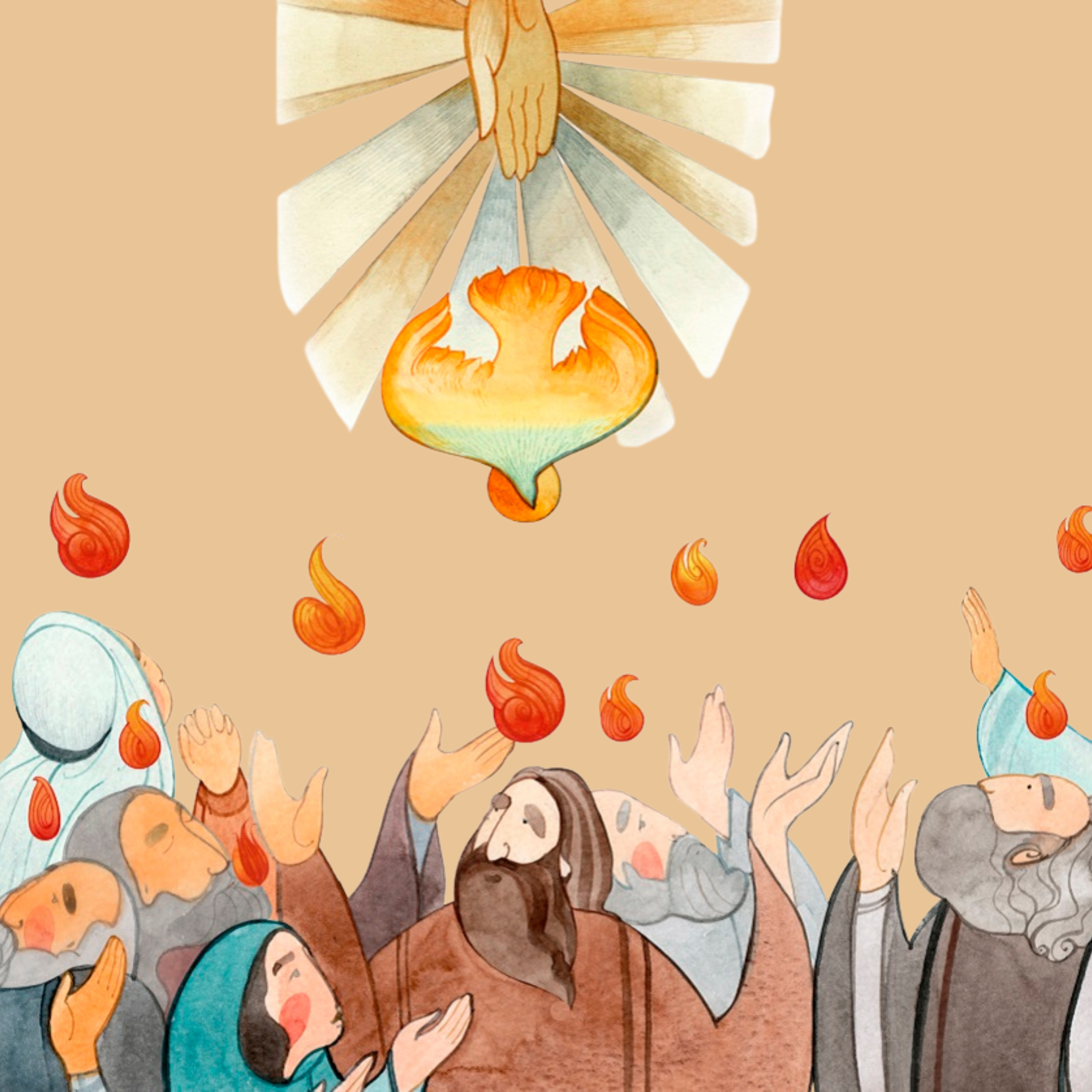
And then what happens is, as they're waiting 50 days later on the day of Pentecost, which is this festival of harvest, essentially the celebration of God's goodness, the Spirit of God is poured out, it says, at the beginning of Acts chapter two. And everybody has this, like, equitable distribution of the Spirit that looks like tongues of fire coming down from heaven. And they hear the sound of a rushing wind. And then what happens immediately after that that we have sort of skipped over because this is not a sermon series on this subject. But immediately after that, Peter essentially preaches to the surrounding crowd and interprets for them what's happen. It seems very odd to them. In fact, at the end of that last passage we read last week, it says that the crowd assumed that all of the disciples were drunk because they were acting weird, right? They were sort of acting as though they were intoxicated in some way. Peter steps up and says, hey, listen, we're not drunk. It's too early in the morning for that. Which seems like a very optimistic, you know, argument. But he says, we're not drunk. What's actually happening here is that the Spirit of God has come, just as God's Spirit always promised.
And he interprets for them what the coming of Jesus means for the promises of God in the Hebrew Bible. And as a result of that, a lot of people believe Peter. They hear Peter's preaching, they hear his argument, and they're persuaded. They believe him. They believe that Jesus is indeed the fulfillment of. Of the Hebrew law. And because they believe them, suddenly they all form a kind of community together. So in verse 41, it says, those who were welcome, who welcomed his message, were baptized. And that day about 3,000 persons were added to this community of early followers of Jesus. So it has significantly grown their community. This preaching moment that Peter has. So we're going to pick it up there, where suddenly there are a couple of, not just a couple dozen people who are followers of Christ. Now there are a couple thousand people who are part of this community. And this is why this chapter is often depicted as the birth of the church.
Now, the trouble with Acts Chapter two is this.
It's really, really weird.
Like the spirit of God is depicted as pouring out like the sound of a rushing wind and tongues of fire that come down on people's heads. And I'm not going to get into that too much because we talked about that last week. But then real problem is Peter preaches a sermon and thousands of people become Christians or are converted. And now the church is big. And these realities really feed into the worst impulses of people who want power.
And so the church has been sort of obsessed with Acts Chapter two ever since. And it's not just the growth of the church. It's not just that, you know, people like me want big churches. We want more. More people that we can collect like little, you know, trinkets in our little curio or something. It's not just that, although it is that.
It's also that the power of God depicts maybe miracles happening. And we really like the idea of having power, being able to not only command large groups of people, but also do like magic tricks.
Anybody ever experimented with a little bit of magic? You know, like card tricks or something at a party?
People are so impressed with you.
Janelle and I raised kids in an era when the best way, or the most convenient way I should say, to raise children was to park them in front of a Disney film. This was like, you know, the late 90s, early 2000s, and it was the best era of Disney in my opinion. Right. You had like Beauty and the Beast and Aladdin.
You guys have seen these movies, right?
We could all sing these songs together, I would imagine.
I'm not going to sing.
One of my kids favorite movies at that time was Aladdin. Aladdin was a big deal, right, Because Robin Williams played the genie and we all loved Robin Williams.
And the genie was this big, larger than life character. And the really fun thing about the genie is that the story of the genie, the legend that we find in the old, like, you know, tiny tale of Arabian Nights and then depicted in this Disney film is the promise of the ability to do really cool, fun things like Perform magic tricks.
And so there's this story of a genie who is trapped in a lamp, and a poor person who has no power, no wealth, no money, no influence, and somehow stumbles upon the magic password that opens the cavern. And then the get to hunt for the lamp and this giant hoard of treasure. And then they find the lamp and, you know, they have to, like, polish the lamp in just the right way, and then the genie comes out and they get all of their wishes fulfilled. My kids love this movie because, you know, you'd see them picking up whatever, like, little vessel they could find around the house, you know, rubbing it to see if maybe a genie would emerge and they could finally get their wishes, which probably had something to do with, like, eating as much candy as they wanted to without mom and dad being upset with them.
I think the church has largely treated the Holy Spirit like the genie of the lamp.
Like, if we just have the magic password, like, if we just know where the lamp is hidden, if we just know the right way to rub the vessel, then out will come the Holy Spirit and will grant us our wishes, will give us power to perform miracles, will give us power to grow churches and acquire cultural power.
And in doing this, the church has essentially domesticated the idea of God and the idea of the Spirit. The spirit becomes a kind of pet that we hope we can appeal to, that we hope we can conjure, that we hope we can control. But of course, this is not the point of the story of the genie of the lamp. It's a cautionary tale of how dangerous power can be if you haven't earned it, if you don't have the character to wield it.
And so I think it's a problem that we tend to take passages like this and read them as though what's being promised in Acts chapter two is a kind of genie. If we can just figure out how to conjure it, right? Like, if we just give our minds to the right list of beliefs, right? If we check the right beliefs off, then we will be filled with power.
If we just carry the right version of the Bible or if we just have enough faith, like this invisible measurement of faith, that suddenly we will be cured of our disease, Our relational dysfunctions will melt away, we will become healthy people. Checks will arrive in our mailbox.
These are all the ways that I think passages like this are abused and misused.
I see a little something different happening in this passage that points in a different direction.
Verse 42, to begin with, says they devoted themselves to the apostles teaching and Fellowship to the breaking of bread and to prayers. The first thing this passage tells me is that the Spirit of God, when the Spirit of God came, it inspired and empowered and activated them to form a community of people.
People who gathered together regularly. They ate together, they learned together, they prayed together. In other words, what the Spirit has done when the Spirit came in Acts chapter two is bring people together. And if you remember last week, it brought people together across their differences, across their racial and ethnic differences, across their linguistic differences. Those differences that might otherwise be an occasion to judge and exclude and harm people were eradicated. The Spirit instead brought them together to form a community.
Verse 43 says, Awe came upon everyone because many wonders and signs were being done by the apostles. And this is the sentence, I think that tends to trip us up because we want the wonders and the signs.
We want to be able to do cool things, party tricks that will make people impressed and become a part of our church or our religion. But I think that the passage itself tells us what the signs and the wonders were.
If you just go to the very next sentence, it says all who believed were together and had all things in common.
And they would sell their possessions and goods and distribute the proceeds to all as any had need. In other words, they didn't just form a community, they formed a community that made sure that nobody else in the community had a need that wasn't met.
This is a miracle.
It is a miracle that any group of people gathered together would ensure that nobody else in that group went hungry, or didn't have a place to live, or didn't have their needs met. Any community that does this is miraculous. It is a sign and a wonder. Their community was about caring for each other.
Consider for a moment the possibility that our entire culture rests upon the willingness to say, I don't care.
It's practically a cliche that any man in his early 20s would use that phrase over and over and over again when confronted with the overwhelming reality of.
Of the complexities and difficulties of our life. I don't care. I don't care.
This is a community, though, of caring.
And I think that's the miracle.
Like I was.
If you guys think I'm difficult now, when I was in my early 20s, I was extraordinarily problematic.
And you know, because you've heard some of the stories, especially around what a terrible husband I just generally am, but especially in my early 20s, right?
But I was also that guy who would show up at church in our very right wing Pentecostal church in the mountains of Utah I had just become a Christian. Like a real Christian. Not the kind of Christian who was raised Christian and of course believed whatever his parents told him to believe, but the kind of person who walked away from Christianity as a teenager because it all seemed ridiculous. And then I discovered that I was going to be a horrible husband and a horrible father. And then I was like, maybe Jesus can fix me. And so then I became a Christian and then I was all about my Christianity. Like, I poured myself into my Christianity like it was water in the desert. I read the Bible as often as I possibly could. And every single Sunday I would show up with my Bible and another book that I had picked up at the library. Because my education is a bit unorthodox. For those of you who don't know. I didn't go to college and then I went to Bible college and then I went to seminary. I sort of took the back way to graduate school.
And so before I ended up in Bible college, I would just go to the library and like pick up whatever book seemed interesting because I was like hungry for whatever information I could get. And one of my favorite books that I picked up was this little book called the Communist Manifesto. And I thought this book was so interesting that for a long period of time I would show up at church with the Bible and the Communist Manifesto together because the correlations were obvious.
And one time one Sunday, one of the elders of the church came up to me and he was like, hey, what do you got there? And I was like, oh, it's my Bible. And he's like, what else do you got there? And I was like, oh, this is the Communist Manifesto. I said, have you read this?
And he was like, you know, that's not.
I wouldn't take that too seriously. He said.
I said, let me show you this right here. It says, from each according to his abilities, to each according to his needs.
I said, isn't that amazing? Check this out. And then I turned to Acts 2 and I read this.
All who believed were together and had all things in common. And they would sell their possessions and goods and distribute the proceeds to all as any had need. It's the same thing.
And he just like walked away.
I didn't, I didn't know.
But that's kind of a miracle.
Like to the eyes of a, you know, 23 year old young guy who was trying to learn how to take his faith seriously. It seemed as plain as the nose on my face that Jesus Gospel was about meeting the needs of those who were poor, you know, Gustavo Gutierrez is the father of liberation theology, and he's famous for saying, oh, you care about the poor? Tell me their names.
That cuts deep.
It's hard to truly care about somebody whose name you don't know.
It's hard to claim that you care about anybody whose name you don't know.
Karl Marx is famous for saying that religion is the opiate of the masses, which he didn't mean that as a bad thing at all, although it sounds bad.
James cone, who's the father of black liberation theology, picked up on that little nugget. And he cleverly refers to it when he says, without concrete signs of divine presence in the lives of the poor, the gospel becomes simply an opiate.
What James cone is saying is, yeah, Marx was right.
Unless we're doing what Jesus actually said, and then it's not something that we do to make ourselves feel better. Religion isn't something that we do to escape from the realities and complexities of this life. Religion is something we do to right the wrongs, to balance the scales, to raise every valley and lower every mountain so that there is equality. That is what is happening in this passage. And forgive me if I think that is a miracle.
I think it's just caring doesn't have to be communism, doesn't have to be socialism, doesn't mean democratic socialism, or doesn't have to be a, you know, some sort of, I don't know, northern Scandinavian version of friendly capitalism. It just has to be caring.
Do you care?
Do you care?
Now here's another miracle.
After all of that, Day by day they spent time together in the temple. Verse 46, they broke bread in their homes and they ate their food with glad and generous hearts.
There's a reason they're glad. There's a reason they're generous, because none of them are abjectly poor.
Verse 47, praising God and having the goodwill of all the people.
And day by day they added to their number those who were being saved. Here's the second miracle. That a group of Christians in a society gathered together doing their thing, were actually liked by the rest of society.
We would be the most beloved institution on the planet if what we really did was form communities of prayer and learning and caring and just made sure that nobody in our orbit was starving or homeless or hurting.
It's the best church growth plan I've ever heard.
This is what happens in this passage.
Okay, so three things I'm taking away from this.
The first is just to say it again, because I think it's kind of important, is that the Spirit of God is not a magic trick.
Spirit of God is not the genie of the lamp. The Holy Spirit is not the thing that you conjure in order to get what you want. There is no magic phrase. There is no secret handshake. There is no correct doctrine that will unlock the Spirit of God so that once you finally have enough faith, the checks start rolling in, you become physically healthy and all your dreams come true. That is not the Spirit of God. Number two, the Spirit of God. Is this your care for each other?
That is what the Spirit of God is doing.
This is not new.
When Jesus preached his gospel, Luke chapter four, he preached that the power of God comes when people are fed, when people are healed, and when people are liberated from their prisons. Then he demonstrated that everywhere he went, what did he do? He fed hungry people, he healed people who were sick, and he liberated people from their oppressive construction.
And then Jesus empowered his followers to do the same thing everywhere they went. The Spirit of God is that spirit that is present when you say I care and actually do something about it.
And number three, this isn't rocket science, you guys.
It's way harder.
This isn't rocket science.
It's not complicated.
But it is really hard.
Because I don't know about you, but my spirit is not generally inspired and animated and engaged in meeting other people's needs. That's why we say that when the Spirit of God comes, it's a miracle.
Because on any given day, from moment to moment, I am obsessed with getting what I want.
Every single day I rub this cup.
And what's inside of it is kind of magic.
So then when it happens that on occasion, from time to time, I am inspired, excited, enthusiastic, willing to actually attend to the needs of people around me who are hurting, who are unhealthy, who are unwell, who are oppressed. When that happens, when I am willing to overlook my extreme self absorption and become useful to other people, we rightly say that it's a miracle.
It's a miracle that I might at any given time be inspired to do that.
That's why when we say that we are caring people, loving people, that we are possessed by a spirit other than our own, that's all spirit is. It's the thing that animates you, the.
Employment of your will to accomplish something in the world.
That's what we mean when we say they have spirit, they're spirited.
This is what we say about our kids. When they're willful, they've got spirit.
It's a nice way of saying they're a little jerk, they're disobedient, they won't clean their room. When I say that they should clean their room. He's got spirit.
When we conjure that part of us that allows us to act on the world in ways that are powerful, and we do it for the sake of goodness and righteousness and peace, we say, I am possessed by a spirit that is divine, that is good, that is righteous, and not entirely my own.
It's what we mean by the spirit of God.
Do you believe that that spirit exists?
Do you believe that's possible?
That's what we come here for, to believe that, to be animated by that spirit that we call holy good.
Amen.
Would you pray with me? God, we thank you again for today, for this chance for us to be moved in our spirit in some way by you, by the words that we read and the songs that we sing, by the encouragement we have for each other and today especially God. I would pray that you would agitate us and animate us towards caring.
Caring about the people around us, caring about the needs of our world and our community.
Amen.
[00:27:22] Speaker B: Thank you for joining us for this Sunday teaching, no matter when or where you're tuning in.
To learn more about our community or to support the work we do, Visit
[email protected] We hope to see you again soon.