Episode Transcript
[00:00:00] Foreign.
[00:00:08] Welcome to the collective table where we celebrate the intersections of Jesus, justice and joy.
[00:00:15] This podcast is brought to you by Oceanside Sanctuary Church. Each week we bring our listeners a recording of our weekly Sunday teaching at Oceanside Sanctuary, which ties scripture into the larger conversations happening in our community, congregation and even the podcast. So we're glad your here and thanks for listening.
[00:00:39] Good morning.
[00:00:41] How are you guys today?
[00:00:42] Good.
[00:00:43] I'm good. We got a little May gray, June gloom going on.
[00:00:47] Right, that's, that's okay.
[00:00:50] It's okay. It's going to be okay.
[00:00:54] I know. Where's the sunshine?
[00:00:57] For those of you who don't know, my name is Jason Coker. I'm one of the co lead ministers here. And today we're going to kick off a kind of follow up series to our recent teaching series on post resurrection appearances of Jesus that flowed us sort of into the Book of Acts. We're going to pursue a series that we're calling the Spirit of Action through the Book of Acts. And if you have a Bible, you can turn to Acts chapter two.
[00:01:23] If not, we'll put the words up on the screen. But for those of you who don't know, if you have not been raised in a kind of more traditional or liturgical setting in a church, you may not not know that this is Pentecost Sunday. And so Pentecost Sunday is that part of the liturgical calendar that celebrates what we're about to read about today, which is Acts chapter 2, the coming of the Holy Spirit. In the Christian tradition, this is sort of considered the birth of the church, when the church became a thing. And so we don't make a lot of hay out of like liturgical days like this at the Oceanside Sanctuary. But we do highlight how we're celebrating some of these milestones. And so today I just want to share with you what noticing from Acts chapter two and kick off this series with something that I hope will stretch us to reconsider what's possible when we talk about what it means to be filled with the Spirit of God. So Acts chapter 2, verses 1 through 13. Let's read that on the screen. Acts chapter 2 means I got to find it in my Bible. Here it is, starting in verse one. When the day of Pentecost had come, they were all together in one place, they being the disciples. This is shortly after Jesus ascends in into heaven. He's given them their marching orders, so to speak, their commission.
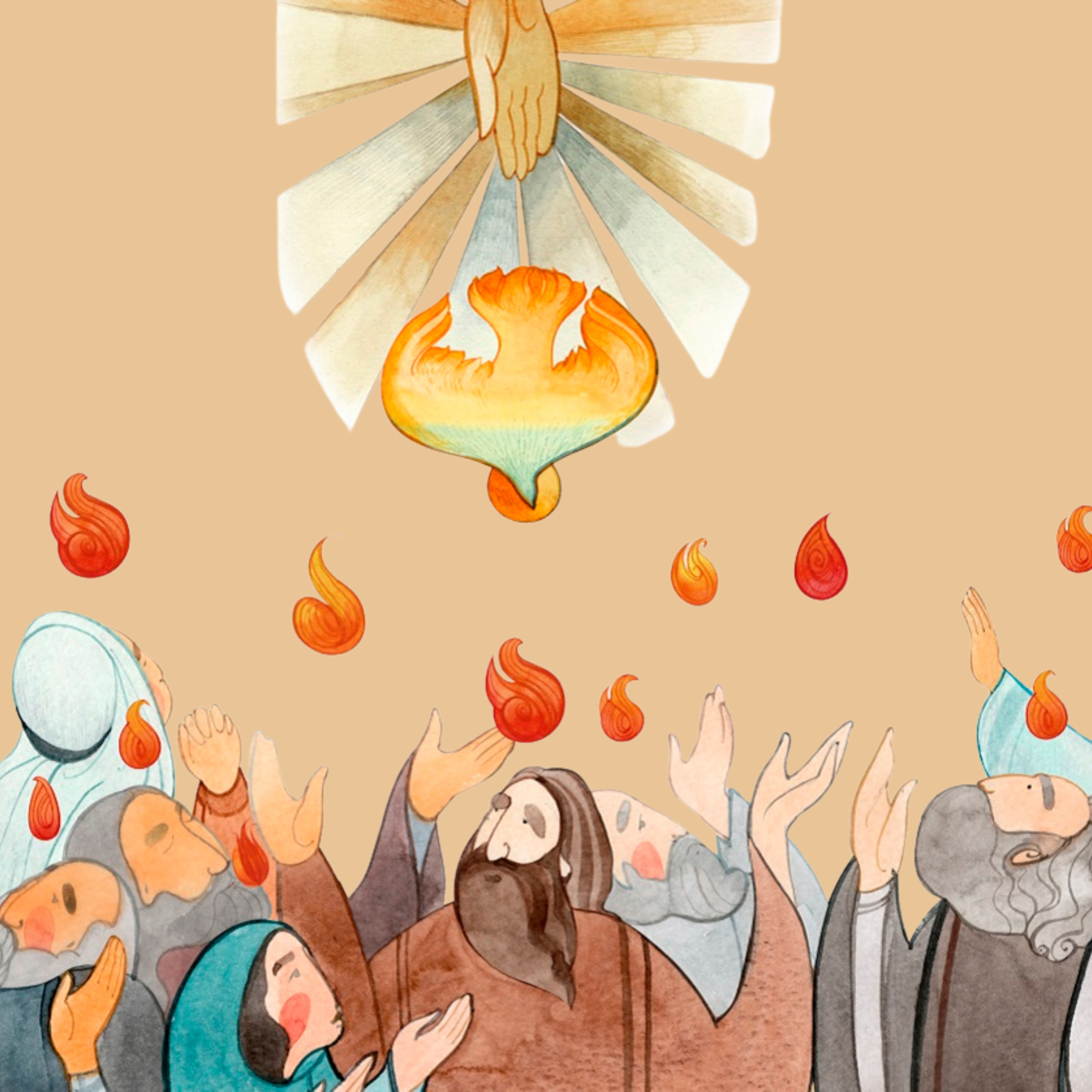
[00:02:44] And then he tells them to wait. And they wait. And on the day of Pentecost, they all happen to be gathered together in one room, it says in verse two. And suddenly from heaven there came a sound like the rush of a violent wind.
[00:03:00] And it filled the entire house where they were sitting. And divided tongues as of fire appeared among them and a tongue rested on each of them. And all of them were filled with the Holy Spirit and began to speak in other languages as the spirit gave them ability. I want to pause there and ask that you pray with me. And then I want to share with you what I'm taking away from this passage today.
[00:03:31] God, we thank you again for today for a chance for us to get together, to encourage each other, to sing together and to pray together, to read these words and to open our hearts and our minds to what is possible. What you may be calling us to.
[00:03:56] We've already done this today God, but again I'll just invite your spirit to be here for us to have a more finely tuned sense of awareness of how your spirit is resting on us and filling us.
[00:04:18] We ask that moving forward we would be open to how your spirit is at work leading us to act and to engage with the world around us.
[00:04:30] We pray all this in Jesus name.
[00:04:33] Amen.
[00:04:35] Okay, so I grew up in San Bernardino, California. I mentioned this before, yet that doesn't happen very often. By the way.
[00:04:44] I don't think I've ever announced that I was from San Bernardino, California and into a crowd and had somebody woo hoo.
[00:04:52] But Tina is also from San Bernardino and growing up in San Bernardino, one of the things that I was very familiar with, which many of you no doubt are familiar with as well, and that is every fall or winter there is the rushing of a mighty wind that comes through that we call the Santa Anas. The Santa Anas tend to rip through Southern California, especially that corridor that extends from about San Bernardino at the base of the San Bernardino Mountains all the way to the ocean. And the Santa Anas can be incredibly so. When I was growing up on Casa Loma street in San Bernardino, we had a couple of very tall pine trees on our street, or at least they seemed tall to me. When I was, you know, growing up and I was 6, 7, 8, 9, 10 years old living on that street, these trees were much, much taller than the houses on that street. And when the Santa Ana's would rip through San Bernardino, one of my good friends and I, we would climb these pine trees. We'd climb to the very top, as high as we possib, and we would wrap our little arms and legs around the narrow trunks at the top. Of these pine trees, and we would just sway with the wind in these trees. It was a great ride. It was like, it was like we felt so, like, powerful and dangerous, you know, at the same time, because it felt like, you know, something catastrophic could happen, which tickled us and also terrified our parents, which also tickled us.
[00:06:29] And yet you could feel, in a real sense, the awe inspiring power of the wind.
[00:06:38] And so I remember one day I got up after there'd been a particularly strong bout of Santa Anas had blown through, and you could hear it, you know, shake the windows. You could hear it blowing around the house at night. I was very excited about that. And we got up the next day and went over to where these pine trees were and one of them had been uprooted and blown over, which I also thought was super cool because, like, all the roots were exposed. You know, there's a giant hole in the ground. And, you know, we were checking out the gnarly roots of this giant pine tree, but somehow managed to miss everything. Like, didn't hit a house, didn't hit a car, just fell over into the street and it's a big deal. I remember the city had to come, like, you know, chop it up and clean it up. But it occurred to me that, like, any one of us could have been at the top of that tree when it blowed over. Like, even though we took the power of the wind seriously as a form of entertainment, we didn't really take it seriously as something that was dangerous.
[00:07:42] I mentioned this last week when we visited numbers 11, that the imagery of God in the Hebrew Bible often drifts into God as being dangerous, that the imagery of God is that of fire.
[00:08:00] So we talked about the people of God, the Hebrews wandering through the wilderness and how God often is depicted as a pillar of fire leading them around. But in Numbers 11 specifically, God was a fire that was dangerous. They shouldn't get too close to it.
[00:08:19] This kind of imagery is used for God a lot in the Hebrew Bible. It's commonly the presence of God or the proximity of God is represented in these symbolic forms of fire or wind or water.
[00:08:36] These are the ways that God is typically symbolized.
[00:08:39] And it occurs to me that all three of those things are incredibly powerful.
[00:08:45] They're things that we harness for our own good.
[00:08:49] And we harness the wind in order to create electricity. We harness the wind, or at least used to harness the wind more often in order to get places. You know, we would hoist a sail on a ship and then that wind would push the ship. But that same wind was also dangerous. And what I suggested to you last week is that something that might be a bit uncomfortable is this idea that what we see depicted in these passages is the representation of God as power.
[00:09:24] And that power can be used for good or for bad. It can be useful, or it can be a little bit dangerous.
[00:09:33] And so in Acts, chapter two, we see a couple of things going on. I want to just visit this passage very briefly. It's not a long passage, but there are some things that I think are helpful for us as we wade into this series on the spirit of action. The first is it says in verse one, when the day of Pentecost had come, they were all together in one place. Bit of background. Pentecost was a festival, and ancient Judaism happened 50 days after Passover. It was essentially a spring festival. There had been, of course, a period of growing, growing crops. And at the end of spring, 50 days after Passover is typically when they would celebrate the harvest. And so Pentecost was basically a harvest festival. They were deeply grateful for the abundance of the earth, for how God had blessed them with their crops. And so they would gather for this giant festival every year to give thanks to God for the goodness that God had brought. In Judaism, this is sometimes called the feast of weeks because of the weeks after which it occurs, after Passover itself.
[00:10:43] It also became, however, a kind of symbolic celebration of the giving of Torah to Moses on Mount Sinai.
[00:10:51] And so even today, if you're part of a Jewish community, the feast of weeks is celebrated as the celebration of the giving of Torah. Not many people in our society today, even if you're Jewish, are celebrating, you know, the harvest of your crops.
[00:11:08] We don't really live in an agrarian society anymore. And so it's become much more the celebration of God's goodness delivered in the form of God's word, God's Torah. So that's what's happening here in verse 1.
[00:11:22] On the day of Pentecost, not only were the disciples gathered in this room, but it's also true that many Jewish people from all over Palestine would have traveled back to Jerusalem for this important festival, this festival that celebrated the goodness of God, the blessing of God, the provision of God, and would have been gathered together in Jerusalem for this important celebration.
[00:11:49] And so there the disciples are waiting, and it says, verse 2. Suddenly, from heaven, there came a sound like the rush of a violent wind. And it filled the entire house where they were sitting.
[00:12:02] So again, they're gathered, and here we have this symbolism of the presence of God depicted as a wind. In this case, a violent wind.
[00:12:10] It's a powerful wind. It's a form of raw power that to them seems perhaps a little bit frightening. They don't know exactly what's happening here. And then, as if it couldn't get weirder than that, verse three says, divided tongues as of fire appeared among them and a tongue rested on each of them.
[00:12:37] And again, this is reminiscent of the Hebrew Bible, the way that the presence of God is depicted. When Moses first encounters God, he encounters God in the form of a burning bush. The presence of God is depicted as fire that is burning a bush but not consuming it.
[00:12:57] So again, you have the image of God as a form of power that somehow doesn't destroy.
[00:13:06] That's interesting to consider. Like, what does it mean to have power in a form that doesn't destroy?
[00:13:15] That's not explained in the story of Moses, but it is depicted symbolically. Likewise, we see that when Moses ascends Mount Sinai to speak to God, to encounter God, to receive the Ten Commandments, to receive the Torah, a fire descends on Mount Sinai. Again, the presence of God is the fire that is powerful but does not destroy. Moses doesn't consume.
[00:13:43] And of course, as I've already mentioned, there's the story of the Hebrews wandering through the wilderness. And at night, they're accompanied by a pillar of fire and a pillar of smoke. During the day, the presence of God is depicted as this smoldering source of power that accompanies them everywhere we go.
[00:14:06] And so the disciples more than likely would have understood this symbolism. That wind blowing in and the fire coming down and resting on each of their heads represents the power of God, the presence of God.
[00:14:22] And then something interesting happens that in Christianity, in the church, we've done some interesting things with. Verse 4 says all of them were filled with the Holy Spirit and began to speak in other languages as the Spirit gave them ability.
[00:14:42] What's interesting about this passage is that we tend to interpret this to mean that when the Spirit of God comes, that people will be able to, like, utter foreign languages, or maybe that they'll be able to utter angelic languages. Janelle mentioned that we were part of Pentecostal tradition for a very long time. And in that tradition, whether or not you could do that, whether or not you could perform this gift, was generally seen as a way to. To guarantee if you were like, part of the privileged, chosen few.
[00:15:18] It was sort of like a class structure, right? Like, you had the regular Christians and then you had the Christians who could speak in tongues.
[00:15:29] And so in those kinds of traditions, who took this passage and said, oh, when the Spirit of God comes, it means that you're going to be able to speak in a foreign language, or you're going to be able to speak in an angelic language. That's a sign that the Spirit of God has come upon you. And so if you can't do those things, you haven't received that expression of the Spirit of God. And this produces some really interesting behaviors in a group of people.
[00:15:55] When you tell a group of people that in order for them to be considered truly chosen, truly good, or truly favored by God, that they have to speak in a strange language, guess what?
[00:16:07] People will speak in a strange language.
[00:16:12] There will be a lot of pressure exerted on them in order to do it. And then this interesting sort of dynamic produces all kinds of argument, all kinds of division. People will say, well, this passage isn't really talking about people speaking. Speaking in angelic languages. We're not going to get into where else Paul talks about this, by the way, because it gets a little bit more complicated.
[00:16:34] My point is, is that this one passage is often latched upon in order to create a kind of power dynamic.
[00:16:43] In those churches, there are those who have more of God and those who have less of God.
[00:16:49] There are those who are more favored by God and those who are less favored by God for whatever reason. And maybe you don't quite have enough faith.
[00:16:59] What's happening here, of course, in chapter four, however, has nothing to do, at least it appears to me, has nothing to do with receiving an odd or a strange or a special gift. And I'm not saying that there's anything wrong with that odd, strange, special gift.
[00:17:18] But what's interesting to me is that there's a kind of purpose to this gift. What happens if we read a little bit later is that the disciples, because they're able to speak in these other languages, are able to share the goodness of God with people who only understand those other languages. So here's what's happening. As I mentioned, Pentecost is an incredibly important feast in the yearly ritual, the yearly tradition of the Hebrews.
[00:17:48] And so people don't just come from all over Israel, they don't just come from all over Palestine. Jewish people in the first century, in Jesus Day, come from all over what is to them the known world. They come from all over places like northern Africa and what we would consider today to be Asia Minor, like sort of Eastern Europe, or even as far as what we would consider today to be the British Isles. People who are Jewish but a part of other ethnicities will travel back to Jerusalem in order to take part in this important festival.
[00:18:22] What that means is that they're showing up and not speaking the local language. They're not speaking Greek, they're not speaking Aramaic, which is the language Jesus would have spoken. Instead, they're coming from foreign countries as members of other races, other ethnicities, only able to speak the language from the area in which they come.
[00:18:47] So the purpose here seems to be that when the Spirit of God comes to the disciples in Acts chapter two, they're able to speak in ways that all of the Jews who have come from all over the known world can understand.
[00:19:04] The point here is not, I think that if you just get close enough to God, that if God likes you enough or if you have enough faith, that you'll be able to, like, have this great party trick where you can speak Russian even though you never learned it.
[00:19:20] The point of this story is that when the Spirit of God comes, when the Spirit of God fills people, when the Spirit of God rests on people, whatever, all of that means that when that happens, the things that divided us no longer matter.
[00:19:41] What the Spirit of God empowers them to do is to overcome their racial and ethnic and linguistic and even, you might say, religious distinctions.
[00:19:53] The Spirit of God brings them together across their differences in ways that they weren't able to before. This also is reminiscent of numbers chapter 11 that we visited last week.
[00:20:06] Last week we saw that In Numbers chapter 11, God came to Moses and said, hey, gather the elders, because I want to give them my Spirit so that you don't have the burden of authority and leadership entirely on your own. And so Moses does, and it says, the Spirit of God rested on the elders, and they were able to prophesy. That is, they were able to speak to good possibilities or call out those who were acting unjustly. And remember, in the story, not only was the Spirit of God shared with the elders, but even those elders that were outside the camp received the Spirit and began to prophesy. And what I said to you is that this. This is symbolic of the fact that the Spirit wants to escape our boundaries, that there is no containing the Holy Spirit, there is no containing God. There is no controlling or. Or coercing or harnessing God in a way that serves our needs, our interests. Instead, God by God's Spirit, is constantly trying to escape the boundaries we have created, created for God.
[00:21:17] And I think the same thing is happening here.
[00:21:21] The longing of God, the longing of the Spirit of God to be with all people, no matter what their ethnicity, no matter what their religion, no matter what their gender, I would say no matter what their sexuality, no matter what their political distinctions. The spirit of God wants to rest with you.
[00:21:46] And what we do constantly is try to, like, box that spirit in.
[00:21:53] Oh, no, no, no. The spirit of God only belongs to those who are able to speak in tongues, whatever that means. No, the spirit of God only belongs to those who are Christian, not those who are non Christian. Or the spirit of God only belongs to those who are a certain kind of Christian, the kind who read the right translation of the Bible, or the kind who wear the right sort of necklaces, or the kind who adhere to the right kinds of doctrines or read the right kinds of theologians, or belong to the right denomination.
[00:22:19] All of these are social constructs that we have created not for each other's good, but for our own good, for our own selfish desires.
[00:22:32] What numbers, chapter 11 and Acts, chapter 2 teach me is that God does not care about those constructs. God does not care about those boundaries. God does not care about those distinctions.
[00:22:49] Because in verse four, it says all of them were filled.
[00:22:54] All of them were filled by the spirit of God.
[00:23:01] Again, this is what God was always longing to do. God was always longing to fill you and me and us and them, regardless of our, like, very clever ways of hating each other, being distant from each other, and claiming that God belongs to us.
[00:23:28] This is, by the way, I think, the power that does not consume.
[00:23:37] And this has been, like, a shift for me.
[00:23:41] I mentioned this last week. I tend to be somebody who just deeply distrusts power of all kinds.
[00:23:50] Right. Like, I'm really good at dismissing you if you think you're trying to, like, control me.
[00:23:59] Sometimes if I'm in an ornery mood, I'll play with it a little bit. Right? But if I think that you're trying to manipulate me or coerce me or convince me or convert me, oh, my gosh, don't even get me started about when the Jehovah's Witnesses come to our door. It is so fun.
[00:24:21] And sometimes I'm like, you don't want to talk to me.
[00:24:25] And other times I'm like, I want to talk to you. Let's talk. Like, I'm not going to try to convince them. I'm just going to, like, play with them. I'm going to, like, you know, this is not a good thing. Don't do this.
[00:24:39] But if I think somebody is trying to, like, you know, manipulate me into a certain direction, like, I'll resist with everything that I have because I just am allergic to, to forms of power that try to coerce or manipulate. And this led me for the longest time to think that all power was bad.
[00:25:00] When numbers 11 in Acts chapter 2 are. The reason these are deeply uncomfortable passages to me is because it teaches me that there are forms of power that are good, that there are forms of power that don't destroy and consume like Moses burning bush, that there are ways for us to be alive and on fire with power in ways that are life giving, that don't destroy.
[00:25:30] And I think it's this. I think that the power that does not consume is the power that burns away all the constructs and divisions that we have created for our own good. It destroys those things. And all that's left is love.
[00:25:47] We are able to love each other.
[00:25:50] Who cares where you were born? Who cares how much money you do or don't have? Who cares who you voted for? I'm so sorry for who I have voted for in the past in every party.
[00:26:10] But what if power, the power of God, the righteousness of God, the goodness of God, the fire of God, the wind of God, the water of God meant that power has a purpose for good, to enhance human flourishing, to eradicate those divisions and instead bring us together not around some kind of milk toast, banal sort of compromise, but to join us together for the purpose of making sure that everybody has what everybody needs.
[00:26:46] That race and gender and sexuality and ethnicity no longer become an occasion for us to judge each other or kill each other, but they become an occasion for us to celebrate and learn about our differences. There's a really powerful moment last.
[00:27:06] When was the, when was the vigil?
[00:27:09] Wednesday night?
[00:27:13] I don't remember now. I think maybe it was Tuesday night. Janelle mentioned that we went to the vigil for the Islamic Center. Janelle and I have known Inamtaha for many, many years.
[00:27:22] It's an amazing community, the Islamic Center.
[00:27:27] I did a short study for one of my anthropology classes on Imam Taha in the Islamic center about, about five years ago.
[00:27:37] So I got to know them a little bit better by doing that by visiting their Friday prayer service and observing, you know, and interviewing Imam Taha. And one of the things that's amazing about Islam, this is true for Christianity, but in a different way. But one thing that's amazing about Islam is you will never see a more diverse group of people than Friday prayers at a mosque, especially in a place like San Diego because there aren't that many masjids there Aren't that many mosques, right? So if you are Muslim and you're from Indonesia or you're Muslim and you're from Ethiopia, or you're Muslim and you're from Palestine, or you're Muslim and you're from Canada, right? And you end up in San Diego, you all go to, like, the same very small handful of mosques.
[00:28:25] And so that means that you are in there praying and worshiping with people from a remarkably diverse set of countries.
[00:28:35] And they all do not agree with each other about Muhammad. They do not agree with each other about Allah. They do not agree with each other about how to properly, you know, dress as a Muslim. But they all show up and they all do it, and it has very real problems. Just like Christianity.
[00:28:55] In Christianity, it's an incredibly diverse religion. We just tend to segregate on Sundays.
[00:29:01] Right?
[00:29:03] So my point is, we went to the. To the vigil, and Janelle and I. Some of you know this because you've seen us in public when we go to things like that. We typically wear our clergy collars.
[00:29:18] And you don't see us do that on Sunday morning because it's weird for us because we were raised, like, evangelical. You don't do stuff like that. Right. But, you know, we're mainliners now, and. And it's really helpful when you go to public things and you are a caller because people are like, oh, that's a.
[00:29:37] That's a, you know, Christian. That's a priest. That's a father, whatever. Like, you know, I get. We get confused for priests all the time. But we were walking through there, and a woman who was clearly Muslim dressed had a hijab on. She, Janelle and I are walking around like, you know, weird little twins in our clergy collars.
[00:29:56] And a woman stopped us and said to Janelle, what do I call you?
[00:30:04] She said, can I ask, Like, I know that I'm supposed to call you. She gestured to me father. And I was like, oh, please don't do that. Right.
[00:30:13] But her point was, I know what to call men who wear these Christian clergy collars. I've never seen a woman wear one.
[00:30:23] What do I call you?
[00:30:26] And it was such a powerful moment because, like, it wasn't an opportunity to try to convert her.
[00:30:34] She just was genuinely curious.
[00:30:37] And so we stood there and had a conversation with her about, like, our tradition and why I'm not called a father in our tradition and why, you know, Janelle's wearing it. And she was so moved by the fact that a woman was wearing a collar and carried that kind of authority. Because in her tradition, women can't carry that kind of authority. And I'm not bringing this up to judge.
[00:30:58] I'm bringing this up because I want you to understand that when we encounter those kinds of differences, we have the opportunity to judge. We have the opportunity to learn.
[00:31:11] And it was a really beautiful learning moment for all three of us.
[00:31:19] Differences do matter as an opportunity for us to learn.
[00:31:27] That's the power that doesn't consume.
[00:31:33] This is what I think. Acts 2 teaches us that the Spirit wants to empower us in this way. I have preached about half my sermon.
[00:31:45] The good news is I'm just going to skip to the end.
[00:32:02] I think what I really take from this passage in the end is that the Spirit of God deeply wants to fill and empower all people.
[00:32:14] All people.
[00:32:18] And I hope what you're getting from me in this moment is that I don't just mean Christians.
[00:32:25] What I mean is that the Spirit of God can't be contained, can't be controlled. The Spirit of God will escape the tent of the elders and empower people to prophesy in the camp.
[00:32:37] The Spirit of God will escape whatever ways we try to contain it and fill people that we would rather it not fill.
[00:32:47] Spirit of God wants to fill and empower all people, no matter who, no matter where, and no matter what.
[00:32:55] And those are my three points.
[00:32:57] Amen.
[00:32:58] Would you pray with me?
[00:33:00] God, we thank you so much for today and for this chance for us to be inspired by these words in this text, to be moved by a sense that your spirit is uncontainable, uncontrollable, uncoercable.
[00:33:26] That your Spirit, despite our best efforts, can't be commodified or leveraged for our own good. But that your Spirit does seek to empower us. That your spirit does seek to give us power, to light us on fire, to light others on fire, to produce goodness and righteousness and justice and peace and equality across our differences without destroying us. We pray that you would make that possible for us. In Jesus name, amen.
[00:34:01] Thank you for joining us for this Sunday TV Reaching, no matter when or where you're tuning in.
[00:34:07] To learn more about our community or to support the work we do, visit us at oceansidesanctuary. Org. We hope to see you again soon.