[00:00:00] Speaker A: Foreign.
Welcome to the collective table where we celebrate the intersections of Jesus, justice and joy.
This podcast is brought to you by Oceanside Sanctuary Church. Each week we bring our listeners a recording of our weekly Sunday teaching at Oceanside Sanctuary, which ties scripture into the larger conversations happening in our community, congregation and even the podcast. So we're glad your here and thanks for listening.
[00:00:40] Speaker B: My name is Janelle Coker. I am one of the co lead ministers here and today we are going to be continuing our series on David and was he a man after God's own heart or not?
We're going to see.
So if you will pray with me and for me this morning, I would appreciate it, God, that we talk about and tell stories about and worship and come on Sundays for just a moment of togetherness and a feeling of being a part of something bigger. Be with us this morning.
Guide us, ground us, help us to come away with a little more understanding.
In your name we pray. Amen.
Okay, who was here last week?
A few of you, if you are here last week, you may Jason, my husband is the other co lead pastor and he was preaching last week and he told a really great story, a story about my deliveries, remember some of you.
And, and you know what? He historically, he's telling a story from his perspective about a little bit of history of our family and he did in fact give some true facts.
We do in fact have three children. I did go through labor three times.
And the bite that he talks about on my third delivery of yelling out in pain and taking a little bite of his belly, that was a fact.
Now I did find a few things from his story a little maybe interesting.
I found it really incredible that he could make himself the main character of the story.
Yeah, yeah, he's back there.
I mean, I don't know, like that's not that creative from every white cisgendered man ever to make himself the main character. I also thought it was really interesting how he said that I didn't go through transition except with our third because I'd had a little bit of medication and then this bite was akin to labor pains.
I know a few of you that weren't here last week are like, really?
Yes, he did do that.
He did in fact do that. And you know, from his perspective, I'm sure it hurt a lot.
I will say that I, unlike myself, there was no blood involved.
In fact, the mark, by the time Alana was born was nowhere to be seen. There was no hospital stay.
But the truth is, is that last Sunday Jason was indeed telling A story that did indeed have a couple of facts. Depending on the teller, you may get a different perspective or come away with a few different ideas about things.
And I think that that is the amazing thing about stories.
Stories are for us to feel, not just hear a transcript or a series of historical facts exactly the way that they may have happened in exactly. We might grab onto different parts of a story. And in fact, I don't know about you, I can be prone to a bit of exaggeration just so someone will really feel how I'm feeling. Like I may say, we went to the zoo and we walked 10,000 miles.
What's the truth I'm getting at? Because I did not walk 10,000 miles at the zoo. And I may have sat and had a coffee and let others walk around, and my oura ring may have told me I barely walked 10,000 steps.
But what I'm trying to say is, man, it was a long day. I'm tired.
Are you feeling what I'm feeling?
There's a different truth when I give this exaggeration or this effect of like a bite and labor pains. Right? Like, we're trying to get you to feel something for us.
I'm sure that if you're a fisher person, maybe your fish that you caught on the pier gets a little bigger with each telling.
The hill doesn't go down, it just goes up both ways.
Feelings become sharper, emotions are higher.
This is what we do when we tell stories.
And today we are going to talk about David and about a story that I believe is one of the greatest stories ever told, David and Goliath.
And if you've been around the biblical text very long, or if you're new coming to it, we are going to get into this story. But before I do, I do want to talk a little bit about maybe the elephant in the room.
Because the truth is, is that the David and Goliath story, even in our own biblical Te, whether we read First Samuel, which is the classic story, or we kind of get into Second Samuel or First Chronicles, we're going to see that there are some inconsistencies in this story.
And if we want to focus on the inconsistencies, I think we might lose the greater meaning.
So before I get into maybe telling the story, I at least need to talk about the inconsistencies a little bit.
So the David and Goliath story comes from multiple source texts. We know that it was a popular story, and at that time of David, maybe half a percent to 1% of all people would have been literate.
They would have told these stories orally.
In fact, we know that maybe even not just by the fireside or at bedtime, that they probably acted them out in a form of, like, critical theater. So there'd be a director and someone might be David, someone might be Goliath, and they would act them out before the town. And oftentimes different things might be highlighted. And so when we go back to the source text of where we might find these stories, we find that David and Goliath story in several source texts. We find it in the Masoretic text, which is what we're going to see from First Samuel. We also find it in the Dead Sea Scrolls.
We find it in. Let me make sure I get all of these.
We find it in the Greek Septuagint, and then we find it in the antiquities of Judaism, which would have been part of kind of the first century.
And so we know that this story was orally told over and over again.
And the editors of the Torah here, the old, what we call the Old Testament, was not afraid of some inconsistencies.
So throughout that text, we might see Goliath as either six and a half feet tall or nine and a half feet tall, maybe still possibly human to. There's no way he's human. He's almost 10ft tall.
We see that in second Samuel, Goliath isn't actually killed by David, he's killed by another warrior.
But then by the time we get to First Chronicles, actually, we're saying, well, that Goliath was Goliath's brother.
So as the stories were told and handed down, we have a few little inconsistencies.
I'm going to ask you to say that's okay today.
It's okay.
For those of you who maybe went to a church or were taught that every single word that is on this page proceeded from the mouth of God to the hand of the writer.
This might be hard for you, and I don't ask that you take that away if that's a belief that you hold too firmly.
But I would ask that maybe you consider that there's a reason that this story was handed down over and over and over again, was told over and over and over, was written in so many of our source texts or our fossils, in which we find this story and that we can find truth here.
And so in that kind of oral tradition, instead of reading the David and Goliath story as it's seen in First Samuel, I am going to tell it to you.
So I Would like you to imagine we have two armies. One is the Israelite army and the other is the Philistine army. The Philistines are kind of the social elites. They have.
They have a stronger army, they've been around longer, they have more wealth. The Israelites are a bit of a ragtag full of shepherds and farmers and herders, and they're at war.
And they find themselves at a stalemate.
You have the Philistines on one side of a. On a hill and the Israelites on another, and a big valley between them.
And they, they know that if one comes down the hill, that they're going to be at a disadvantage and the other that stays on the hill will win. Right? Like, so that's that. They're at a stalemate, but they don't want to turn their backs because then it'll give time for the other to go after them.
So they're just there.
And there's this one warrior named Goliath. He's huge.
He had a brass helmet, tons of armor. It said in our text that his armor would have been between 100 and 150 pounds.
He had so much armor that he actually had a shield bearer. So a whole other person that would have been holding his shield because he, even as big as he was, was unable to hold his own shield.
And he was yelling to the Israelites, taunting them, come on, how about instead we just do a one on one, you pick your best warrior to fight me, and whoever wins that army is subject to the other.
And so it says for 40 days and 40 nights, if you've been around me much and you've heard me preach, like, I love that it's often 40 days and 40 nights in our text. So felt like a really long time that they were like camped out.
40 days and 40 nights means like a really long time. And every morning and every evening, he's taunting the Israelites and it says that they're hiding and they're shaking in their boots. They're just so scared because this guy's huge.
There's nobody that's going to fight him. On top of that, like, a little bit of interest, it's believed that his sword was probably made out of steel, which would have been a new kind of metal that was recently used. The Philistines, having more money, like, had been able to forge this. And so it would have pierced through the armor of any Israelite because it was so strong.
And then we have our protagonist David, come on the scene.
David is the youngest son of Jesse, just Before this, what Jason preached on last week, he has been kind of secretly anointed to be the king by Samuel. And the king of the time is Saul, who nobody really liked. He was pretty rough.
He's also on the battle lines, and David's dad says, your three brothers are on the battlefield. Go and bring them provision. So he leaves his job as a shepherd, and he travels and he takes some loaves of bread and some meat to the troops.
And he gets to his troops, and it says he leaves his provisions with the provisioner. And he hears the taunting of Goliath. And he's talking to all of the soldiers, and they're telling him that this has been going on, that they're scared to death, but also that King Saul has offered wealth, the marriage of his daughter, and my personal favorite, no taxes to anybody who chooses to fight with Goliath and wins. So he may have been, like, maybe promising more because he maybe thought they weren't going to win, right? Who knows?
And so David hears all of this, and also really believing that God is with them, that God desires for them to remain a people that follows after this one God maybe being young, a little dumb, he's like, well, I can do this.
I can do this. So pretty soon, he's set before King Saul, and he convinces King Saul that, in fact, he has saved his sheep out of the mouths of lions and bears, and that he's amazing and that he can fight Goliath with God by his side.
So Saul is like, all right, and puts him in his armor.
And I just. You know, I usually sit here, but I have to. He's a young man, so he's got the armor on of Saul, and he finds that he cannot hardly even walk.
It's so heavy.
It's not his armor. It's not who he is.
So he pulls off that armor, and he takes what he knows he's good at.
He's a slinger.
He's good with a slingshot.
So he takes all the armor off.
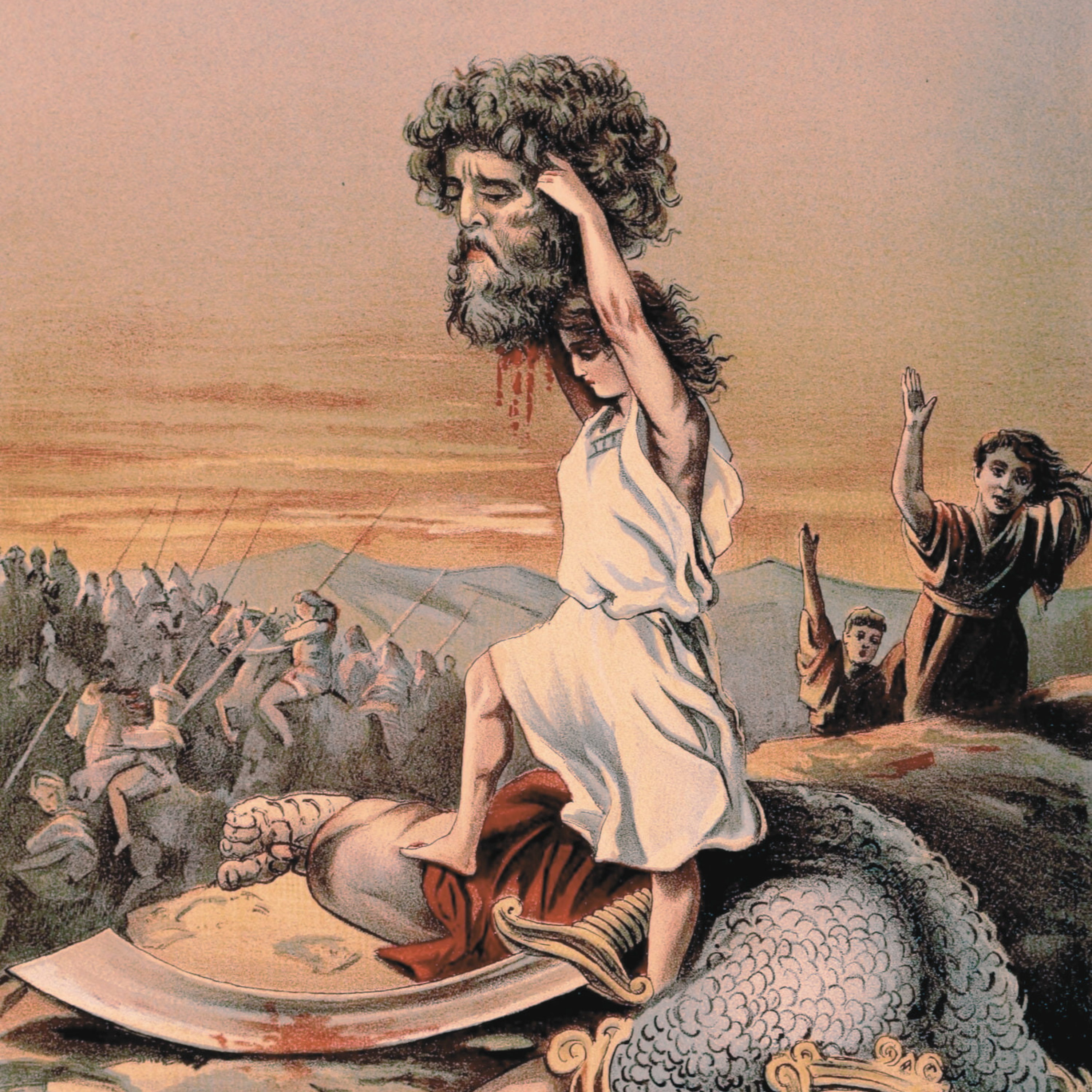
He brings his shepherding staff, his slingshot, and five smooth stones, and he gets to Goliath, this hulk of a figure with all of this armor on. And Goliath says, who is this little boy who's come with little sticks?
And then he hits Goliath in the forehead, and Goliath goes down.
And then there's a lot of other gross stuff that happens.
So that's our story. And I think we get to see stories like this often, right? We watched House of Dragons or whatever other stories are on we read.
What is the point of this?
Why has this been so enduring?
I think part of the point is what we can see in David's art.
So, you know, David wasn't just a shepherd. He wasn't just the killer of Goliath. He was actually also a psalmist, an artist. And so today I would like us to read Psalm 23, which I think will be on your screen.
This is a psalm attributed to David.
The Lord is my shepherd, I shall not want.
He makes me lie down in green pastures, and he leads beside still. He leads me beside still waters.
He restores my soul.
He leads me into the right path for my. For his name's sake.
Even though I walk through the darkest valley, or lo, that I walk through the valley of the shadow of death.
I fear no evil, for you are with me. Your rod and your staff, they comfort me.
You prepare a table before me in the presence of my enemies. You anoint my head with oil, and my cup overflows.
Surely goodness and mercy shall follow me all the days of my life. And I shall dwell in the house of the Lord my whole life long.
Putting the David and Goliath story next to Psalm 23, I think opens up some things for us.
I believe that we need to have an imagination to be able to deal with the Goliaths in our own lives as a church.
We need to have an imagination for the fact that even though there are people who are still food insecure right here in Southern California, my friends, that is a Goliath.
And I am so tired of hearing Christians say, well, the poor will always be with us.
Baloney.
We need to have an imagination that that is something that with God at our side and the gifts and the talents that are within our community, we can do something about it.
We need to have an imagination as a church, that we can come together on Sundays and that we don't see a community that is hurting someone because of their gender, their sex, the color of their skin.
We need to believe that those chains can be broken, that those Goliaths that seem to constantly be around our world, that they can be eradicated.
And I think that we can also see what might be possible for our own lives in this story, this greater truth.
So I have some questions to ask you. While we listen to rap music in the background, I'd like you to take a minute and I'd like you to kind of settle into yourself and answer the question.
What are the Goliaths in my life?
Maybe it's a relationship, a job, finances, an addiction, A health issue?
What are the Goliaths in your life?
Second question.
Is there armor that I'm trying to wear that isn't mine?
Do you believe you need to be somebody else, something else, To meet this challenge?
What are the skills I already possess inside of me?
What am I uniquely good at?
You may not be a slinger, But you may possess great grit, great compassion, youth, wisdom, fortitude.
What is already in you that can help you meet that challenge.
And then finally, it's a Goliath.
So what does it look like? That God.
And when God walks with you through the valley of the shadow of death, what do you feel?
What do you experience?
Or if you're not there yet, what would you like to feel?
What would you like to experience?
To know that God is beside you?
I want to be careful not every Goliath is overcome in the way that we think it will be.
This is not a sermon to tell you that if you believe exactly the right thing, that you will always be David holding the head of Goliath.
But I can promise you that if you cannot hold the imagination of the story, if you cannot believe that you can do something, you can endure. You do have God by your side, you will lose hope. And that is worse.
So this morning, I believe this is what we can take away in truth from this ancient text. I think it is one of the most important things we can take away in our walk and our belief that God is beside us. Amen.
All right, if you'll pray with me, I'll let the band come on up.
God, thank you for stories for this wisdom that is handed down.
Thank you, God, that we can take this ancient culture, this ancient text, and we can find faith and truth and your love and know that you are with us.
Help all of us who have Goliaths in our lives, help this church meet the Goliaths of society as we come together as a community.
We believe that you by our side and with our own gifts and talents can make a dent.
Be with us, God.
In your name we pray. Amen.
[00:27:16] Speaker A: Thank you for joining us for this Sunday teaching, no matter when or where you're tuning in.
To learn more about our community or to support the work we do, Visit
[email protected] We hope to see you again soon.